
Strategy. Entire books and academic courses are devoted to it because the development of an effective strategy is critical to the success of all organizations. And strategy is the focus of this episode.
Your strategy outlines how your organization will achieve its goals, offset competitors, and meet and serve the needs and expectations of existing and prospective customers. Strategy sets the course you will take to realize sustainable long-term growth. Strategy answers two basic questions: “Where do you want to go?” and “How do you want to get there?”
Developing a strategy entails understanding your company’s target customer, value proposition, and core and competitive capabilities. Once you identify and select an opportunity for growth you need a strategy for how to meet the challenge or leverage the opportunity. Strategy is brought to life with tactics. That is specific concreate actions or steps.
Here’s the thing about strategy. It requires making choices. Harvard Business School professor, Michael Porter, is the author of 20 books and numerous articles on strategy. He contends that making hard choices is fundamental to developing an effective strategy. He suggests that the essence of strategy is choosing what not to do and deliberately choosing what to do.
Let’s use selecting an adjacent market to illustrate the concept of selecting a growth strategy. Companies often choose to move into an adjacent market as a way to tap new customers. This strategy entails identifying and selecting a market that has customer needs that complement and fit the company’s expertise and core competencies, enables the opportunity to capture more market share, adds value to the organization, and helps the company grow. A key reason to choose the market is that the company can successfully compete.
 Strategy is the wind that enables your organization to move forward. With strategy in hand, a plan is developed and implemented. Let’s play out the example a little further. Imagine that this company begins to see traction but not as fast as hoped. And it is costing more in time and resources than initially planned, plus an unexpected competitor comes into play. So, the company halts its tactics despite forward progress. This is akin to lowering a boat’s sails just as they are filling with wind.
Sails are the engine of the boat. Sailing requires sailors to play an active role in harnessing the wind’s energy. To move a sailboat forward and gain momentum you need wind in the sails and people who know how to handle them and the boat. If you take your sails down, the boat may still move forward but eventually it will become listless in the water.
While the company can change its mind and abandon or cast aside the strategy, most likely that would be a mistake. The key to being successful with strategy is staying the course over time. Rarely can a strategy be implemented quickly and be successful without adjustments. Strategy often entails significant operational changes across the organization. Therefore, rather than changing course, the organization needs to answer a key question “how much time do we need to implement the strategy?” And employ scenario analysis to prepare for contingencies and anticipate potential adjustments.
Unfortunately, too many companies put on the brakes. We’re often befuddled when this occurs. Typically, the organization has made significant investments to implement a strategy. It can often be detrimental to come to a full stop, ceasing tactics, before the strategy has a chance to produce results.
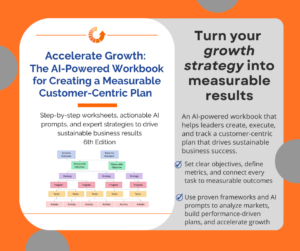
Buy Your Best-Practices Workbook
Adjust Your Tactics to Keep on Sailing
Clearly in sailing the key to forward movement is to keep the sails full. What’s the challenge when it comes to sailing? Well, the wind is rarely perfectly steady. In sailing, once the sails catch the wind, sailors make adjustments to keep all the edges of the sail tight (not flapping). Flapping sails don’t pull the boat forward.
And the same holds true for strategy. The world of customers, competitors, and the market are dynamic. They must be regularly and constantly monitored. When sailing, you adjust your sails to efficiently harness the wind’s energy, even as it changes in strength and direction to control the boat.
 This applies to every organization. Rather than changing strategy, adjust your sails, that is your tactics, to keep your growth on track.
The plan to implement your strategy encompasses the tactics you’ll deploy to support the vision, positioning, messaging, innovation, and competitive advantage defined by your strategy. Tactics inform what actions you will take to develop the offer, select the target market, and create and communicate customer value. For example, tactics include:
· the assets you create such as your website and content
· the channels you use to directly and/or indirectly connect with existing and prospective customers such as social media and advertising
· where and how you will engage customers and prospects along the customer journey
These can and should be adjusted as needed to keep your sails full without capsizing the boat. What kind of adjustments? Adjustments might include something as simple as frequency or something far more complex such as significantly modifying a product demo to support virtual vs. on premise interactions.
Before you take down your sails, consider how to adjust your tactics. Rather than stopping altogether embrace John Browne, CEO of British Petroleum’s, philosophy “No advantage and no success is ever permanent. The winners are those who keep moving.”
Ready to talk strategy? Let us help you fill your sails.
FAQ:
A1: Strategy is the set of deliberate choices that outlines how an organization will achieve its goals, serve customer needs, and compete effectively. It sets the course for sustainable growth by answering two questions: Where do we want to go? and How will we get there?
A2: Strategy requires clarity about the target customer, value proposition, and the organization’s core and competitive capabilities. Once a growth opportunity is selected—such as entering an adjacent market—strategy defines how the organization will compete and win, and tactics translate that strategy into concrete actions.
A3: Because strategy requires choices. An effective strategy is as much about choosing what not to do as it is about choosing what to do. Trade-offs focus resources, reduce distraction, and protect differentiation.
A4: Because strategy execution takes time, conditions change, and early traction may not meet expectations. Costs can rise, competitors can respond, and leaders may halt tactics despite forward progress—similar to lowering sails just as they catch wind. The result is lost momentum and wasted investment.
A5: Instead of abandoning strategy, ask: How much time do we need to implement the strategy? Then use scenario analysis to anticipate contingencies and plan adjustments. Strategy is rarely implemented quickly without iteration, especially when operational change is required.
A6: It means keeping the strategy steady while modifying execution to match changing market conditions—just as sailors adjust sails when wind shifts. Tactics include:
- The assets you create (website, content)
- The channels you use (social, advertising, partners)
- Where and how you engage customers across the journey
Adjustments can be small (cadence/frequency) or substantial (reworking a product demo for virtual engagement), but the goal is consistent: maintain momentum without capsizing.
A7: Markets are dynamic; tactics should flex. Before you stop, look for ways to keep the sails full—because sustained growth belongs to organizations that keep moving and continuously adjust execution while staying anchored to strategy.
Recent Posts
- Focus on Solving Customer Pain Points to Future-Proof Your Company | What’s Your Edge?
- Customer-Centricity in M&A: The Accelerant for Post-Deal Value
- How Strategic Clarity Drives Growth, Profitability, and Customer Value
- Breaking Through Stagnant Growth with a Customer-Centric, Process-Driven Approach | WYE?
- Why Lack of Accountability is Stalling Your Organization’s Growth


Leave a Reply
You must be logged in to post a comment.