
Big Data investments continue to expand. According to Market Reports, Big Data accounted for over $65 Billion in 2018, further expected to grow at a CAGR of 14% over the next three years. A survey by Capgemini indicated that two-thirds of executives worldwide would describe their organizations as “data driven.” Companies face many barriers when it comes to leveraging “Big Data”. How do you make this investment pay off?
Taking Advantage of Data Takes New Skills and Tools

Even with technology improvements, challenges remain. Obstacles include being overwhelmed by sheer volume, data security concerns, and not having enough dedicated staff to analyze the data. A joint survey of US marketers by Columbia Business School and the New York American Marketing Association found three top challenges marketers face in using Big Data:
- Organizational structure
- Making data actionable
- Difficulties getting down to a personal level
Even though the data deluge, particularly the volume and variety of customer information, will only increase due to mobility, cloud computing, and social networking, data collection and storage challenges are being addressed. The greater challenge actually lies in parsing the data for meaningful insights. An Avanade study revealed that nearly two-thirds of stakeholders (63%) feel their company needs to develop new skills to turn data into business insights. As we head into the next decade of the 21st century, many companies still remain unprepared to harness the value of data.
Despite the challenges, Big Data is now being leveraged through the business. Companies are making these technologies, skills, and other investments in order to improve their ability to manage and analyze Big Data to create a more holistic approach to business intelligence. Still many companies find themselves spending more time preparing the data than analyzing it.
Apply Analytics to Optimize Big Data
Big Data is described as multiple data sets related to structured and unstructured customer transactional data, warehoused data, metadata, competitive data, online data, and other data residing in extremely massive files. These challenges include the management, aggregation and real-time application of multiple forms of data.
 Without a doubt, you need to be able to harness and optimize Big Data and apply appropriate analytics to gain insights, especially insights that will improve customer experience and loyalty. For example, analyzing data to understand and manage customers’ interactions with and perceptions about the company/brand is essential to improving customer loyalty.. This type of work is often extremely data-intensive. Customer experience initiatives often result in generating millions of data points about their customers’ attitudes, online behaviors, and interactions. Successfully using data to craft more timely, targeted messaging and build richer customer segments and profiles enables companies to create more targeted, nurturing campaigns. These organizations are using customer insight and intelligence to directly influence the bottom line by cross-selling or upselling customers and pursuing higher-value sales and repeat purchases.
Other applications of Big Data including using data obtained from sensors embedded in products in order to create innovative after-sales service offerings. Or by applying data to identify ways to reduce advertising spend.
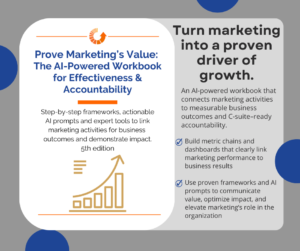
Buy Your Best-Practices Workbook
5 Ways to Use Big Data to Create Business Value
As marketers, we are often at the epicenter of acquiring, understanding, translating, and leveraging data. Creating memorable and relevant customer experiences is very complex. Customers want their problems solved faster, and they only care about being able to connect with you when they want and how they want. How to achieve this is embedded in your data. While attempting to use the data to improve customer experience and engagement, it is also critical to use the data to create business value. Here are 5 ways to use Big Data to create business value.
- To unlock significant value by making information transparent and usable at a much higher frequency.
- To expose variability and boost performance by collecting more accurate and detailed performance information on everything from product inventories to sick days.
- To conduct controlled experiments and/or scenario analysis to make better management decisions.
- To enable ever-narrower segmentation of customers to more precisely tailor products or services.
- To improve the development of the next generation of products and services ,and measure the innovation pipeline.
Learn how we help our customers convert data into business value.
FAQ:
A: Big Data accounted for over $65 billion in 2018, with expected growth at 14% CAGR over three years. Two-thirds of executives describe their organizations as “data driven.”
A: (1) Organizational structure (silos, unclear ownership), (2) making data actionable (insights to decisions), and (3) difficulties personalizing at scale.
A: Despite technology improvements, obstacles include volume overwhelm, data security concerns, insufficient staff, and—most critically—lack of skills to parse data for meaningful insights.
A: Analysis. Many companies spend more time preparing data than analyzing it. Nearly two-thirds of stakeholders feel their company needs new skills to turn data into business insights.
A: Multiple datasets combining structured/unstructured transactional data, warehoused data, metadata, competitive data, and online data in massive files—requiring management, aggregation, and real-time application.
A: Analyze data to understand customer interactions, perceptions, and behaviors. Use insights to craft timely, targeted messaging, build richer segments, and create nurturing campaigns that drive cross-sell, upsell, and repeat purchase.
A: (1) Make information transparent and usable at higher frequency, (2) expose variability and boost performance through detailed metrics, (3) conduct experiments/scenario analysis for better decisions, (4) enable narrower segmentation for precise personalization, and (5) improve product development and measure the innovation pipeline.
A: Marketers are often at the epicenter of acquiring, understanding, translating, and leveraging data—so they must connect data insights to customer experience, engagement, and bottom-line outcomes.
Recent Posts
- Focus on Solving Customer Pain Points to Future-Proof Your Company | What’s Your Edge?
- Customer-Centricity in M&A: The Accelerant for Post-Deal Value
- How Strategic Clarity Drives Growth, Profitability, and Customer Value
- Breaking Through Stagnant Growth with a Customer-Centric, Process-Driven Approach | WYE?
- Why Lack of Accountability is Stalling Your Organization’s Growth


You must be logged in to post a comment.