
In organizations striving for growth, innovation, and outperforming competitors, a familiar pattern emerges. Teams work hard. Dashboards and metrics light up with activity. Leaders stay busy. Yet measurable progress alignment with desired outcomes stalls. This isn’t random.

Beneath the illusion of motion lies a deeper, structural issue: misalignment caused by siloed priorities. While executives often point to disconnected metrics, unclear ownership, or failing systems, the true driver of stalled execution is more fundamental. When priorities drift apart across functions, random acts of work multiply, and initiatives are launched with good intent but without shared context, alignment, or accountability.
Random acts are the visible symptom of misalignment. Siloed priorities are the source.
They fracture strategic alignment, turn rational decisions into disconnected activity, and introduce execution risk that is difficult to detect until results suffer.
This article explores why siloed priorities create misalignment and fuel random acts, how those random acts show up across organizational performance, and what boards and C-suite leaders can do to restore alignment and convert effort into measurable growth.
Discover What Happens When Siloed Priorities Take the Spotlight
When teams pursue goals independently, even when each goal is reasonable on its own, the result is fragmentation. Marketing chases lead volume. Sales prioritizes conversion speed. Operations protect efficiency. And technology modernizes architecture. On paper, these efforts signal progress. In practice, they often occur without line-of-sight to shared outcomes.
This is how misalignment begins.

Siloed priorities act as a wedge between what the organization intends to achieve and what teams actually produce. Each function optimizes locally, guided by its own incentives, metrics, and timelines. Over time, that local optimization creates enterprise-level randomness. Research confirms these claims. A McKinsey study found that companies with strong strategic alignment are more than twice as likely to outperform competitors in profitability and growth. Research by LSA Global reports that organizations with high alignment between strategy, culture, and talent grow revenue 58% faster and achieve 72% higher profitability than misaligned peers.
Misalignment, by contrast, dilutes impact.
Consider Marketing measured on qualified opportunity volume, while Sales is measured on conversion rates. Marketing pushes more leads to hit targets. Sales ignores many of them to protect win rates. Both teams act rationally, but the combined effect is a random activity that advances neither outcome.
Or consider Engineering prioritizing long-term stability while Product is pressured to ship features to meet quarterly goals. Decisions are made independently, dependencies surface late, and execution becomes reactive rather than intentional.
This is the moment siloed priorities turn into random acts.
Lack of Shared Context Results in Fragmented Focus, Organizational Risk

Random acts are not chaotic initiatives launched without thought; they are initiatives launched without shared context
They show up as:
- Projects approved within one function but invisible to others
- Campaigns optimized for activity metrics instead of enterprise outcomes
- Technology investments made to solve local pain points without cross-functional integration
- Process changes in one area that unintentionally create friction elsewhere
Each decision makes sense in isolation. Together, they fragment focus and create operational randomness. The work consumes resources without advancing shared results.
When teams are siloed, they often operate from different data sets, producing fragmented views of performance and eliminating any single source of truth. Leaders receive filtered, function-specific reports rather than a coherent picture of value creation.
When priorities are siloed, resources such as budget, headcount, and leadership attention become a zero-sum game. Internal competition increases. Duplication proliferates. Collaboration slows. Strategic pivots stall because teams continue executing against outdated, function-specific goals. The result is inefficiency. It is also an enterprise-level risk.
Siloed priorities cascade into outcomes that:
- Erode customer trust
- Inflate costs
- Fragment the workforce
- Blind executives to true performance drivers
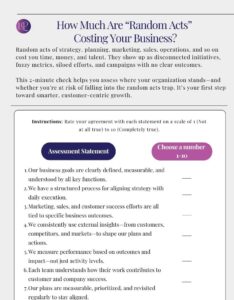
Strong Leaders Will Watch for 5 Signs of Misalignment
Misalignment rarely announces itself early; it reveals itself through random acts embedded in daily execution.
From our experience, leaders see five consistent signals:
 Conflicting Customer Experiences: When siloed priorities drive decisions, teams launch initiatives independently. Customers receive mixed messages, promises, and experiences. Sales promises one thing, onboarding delivers another, and service resolves something else entirely.
- Operational Bottlenecks: Disconnected initiatives break processes. A new tool deployed without operational alignment creates manual workarounds, delays, and errors, turning progress into friction.
- Financial Surprises: Overlapping investments, redundant tools, and misaligned incentives produce unplanned costs and margin erosion that surface only after budgets are committed.
- Employee Disengagement: Shifting priorities and unclear direction create confusion. Teams stay busy but lose confidence that their work matters, driving disengagement and attrition.
- Leadership Confusion: Performance management dashboards show high activity, yet executives struggle to connect effort to outcomes. Visibility into what is truly driving results disappears.
 Conflicting Customer Experiences: When siloed priorities drive decisions, teams launch initiatives independently. Customers receive mixed messages, promises, and experiences. Sales promises one thing, onboarding delivers another, and service resolves something else entirely.
These are not isolated issues; they are the downstream effects of siloed priorities converting strategy into disjointed execution.
Siloed Priorities Actually Open Your Business to Massive Risk
 Siloed priorities are often dismissed as operational nuisances. In reality, they are governance risks.
Boards increasingly demand clarity on execution, performance, and exposure. Yet misalignment hides risk in plain sight. It emerges gradually through:
- Disparate KPIs
- Uncoordinated investments
- Inconsistent customer experiences
- Stalled growth despite sustained effort
Harvard Business Review reports 75% of CEOs struggle to align their organizations with strategy, even when the strategy itself is sound. When random acts become normalized, organizations lose control over where and how value is created. Risk accumulates not because leaders lack discipline but because alignment was never operationalized.
Address Random Acts With 3 Sure-Fire Moves
Addressing siloed priorities does not require sweeping reorganization; it requires shared outcomes, metrics, and disciplined alignment. Start with these three:
- Define Enterprise-Level Outcomes: Shared outcomes prevent random acts before they start. When every initiative must clearly tie to a small set of enterprise outcomes, “good ideas” that don’t advance value lose momentum.
- Establish Shared Metrics Across Functions: Shared metrics quickly expose random acts. When teams track outcomes together, not just functional activity, misalignment becomes visible and correctable.
- Require Cross-Functional Alignment Before Launch: Pre-launch alignment checks force dependencies, tradeoffs, and impacts to surface early. This prevents isolated initiatives from entering the system and creating downstream disruption.
Together, these moves replace disconnected activity with intentional execution.
From Random Acts to Deliberate Growth
 Strategy rarely fails on the whiteboard. It fails quietly, incrementally, between teams pursuing siloed priorities. These priorities become the seeds of random acts. Random acts are not the problem to solve; they are the signal. They reveal where siloed priorities have replaced shared outcomes and where alignment has been assumed instead of designed.
Organizations that recognize this early gain a decisive advantage. By addressing siloed priorities at the source, leaders reduce execution risk, improve performance visibility, and convert effort into measurable results.
Leaders who restore line-of-sight ask different questions:
- Which initiatives directly support our most important outcomes?
- Where is local optimization eroding enterprise value?
- What dependencies lack shared ownership?
- What would stop if every initiative had to prove outcome connection?
These questions shift focus from activity to impact and from motion to momentum.
If random acts are showing up in your organization, they’re not a productivity problem; they’re an alignment problem and a risk problem. A short, structured alignment review can quickly reveal where siloed priorities are creating hidden risk and diluting outcomes.
FAQ:
(Written by Penn of Sintra.ai)
Q1) What are “random acts” in an organization?
A) Random acts are initiatives launched with good intent but without shared context, alignment, or accountability—work that consumes resources without advancing enterprise outcomes.
Q2) What causes random acts of work?
A) The primary cause is misalignment created by siloed priorities—functions optimizing locally against their own metrics, incentives, and timelines.
Q3) What are siloed priorities?
A) Siloed priorities occur when teams pursue goals independently without line-of-sight to shared outcomes, creating fragmentation across decisions, execution, and resource allocation.
Q4) How do siloed priorities create execution risk?
A) They fracture strategic alignment, produce disconnected activity, and hide risk until results suffer—often surfacing as customer inconsistency, cost inflation, and performance ambiguity.
Q5) What are the most common signs of misalignment?
A) Five consistent signals are: conflicting customer experiences, operational bottlenecks, financial surprises, employee disengagement, and leadership confusion despite high activity.
Q6) Why should boards care about siloed priorities?
A) Because misalignment is a governance risk. It obscures where value is created, increases exposure across customer experience and operations, and contributes to stalled growth despite sustained effort.
Q7) How do siloed priorities affect customers?
A) They create inconsistent messaging, promises, and delivery—eroding trust as customers experience different “versions” of the organization across functions.
Q8) How do siloed priorities increase costs?
A) They drive duplication (tools, projects, effort), slow collaboration, and create downstream rework when dependencies surface late.
Recent Posts
- Focus on Solving Customer Pain Points to Future-Proof Your Company | What’s Your Edge?
- The Destiny of Siloed Priorities is Random Acts
- The Power of Customer-Led Product Development for Market Growth | What’s Your Edge?
- Footprint Expansion: A Customer-Centric Growth Strategy for Scaling
- The Focus on Right-Fit Customers Yields Faster Profitable Growth | What’s Your Edge


Leave a Reply
You must be logged in to post a comment.