
 Are you missing significant growth inside your existing customer base because expansion happens by chance rather than by design? Executives often focus on net-new business while underestimating the revenue hiding in existing accounts. Fragmented outreach, internal silos, and ad hoc initiatives, what I call “random acts”—leave money on the table for B2B organizations. Footprint expansion, a customer-centric ABM growth strategy, enables companies to accelerate revenue efficiently by broadening relationships within existing enterprise accounts.
Unlike conventional ABM (account-based marketing), which is frequently resource-intensive and focused on 1:1 engagement, footprint expansion leverages proven customer value, internal advocacy, and scalable influence to drive measurable, repeatable results. Forrester Research found expansion deals typically close 10–30% faster than equivalent net-new logo acquisitions.
For C-suite leaders and boards of directors, footprint expansion provides a disciplined framework to increase customer lifetime value, reduce acquisition risk, and ensure growth investments are aligned with how customers actually buy. In this article, we outline the principles, benchmarks, and best practices for implementing footprint expansion as a repeatable, board-ready growth strategy.
Defining Footprint Expansion as a Customer-Centric Growth Strategy
Footprint expansion is the disciplined process of moving from a single point of success within a customer, the “anchor” business unit, to proactively securing commitments in adjacent, targeted business units. Rather than relying solely on vertical relationship building, this approach emphasizes horizontal growth: expanding value across the organization by leveraging customer insight, internal customer advocacy, and strategic alignment.
When executed deliberately, footprint expansion replaces reactive selling and internal guesswork with a structured, customer-informed expansion model. It ensures growth decisions are grounded in evidence rather than assumptions, eliminating random acts that dilute focus and slow momentum.
How Footprint Expansion Is Unique from Traditional ABM
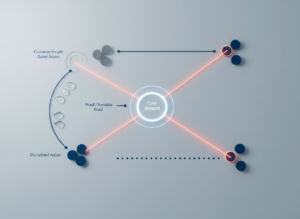 Traditional account-based marketing often relies on high-cost, high-touch engagement for every named account, regardless of readiness or intent. While effective in limited scenarios, this approach is difficult to scale and frequently introduces inefficiencies. Footprint expansion is designed for scalable, customer-centric growth by applying discipline, intent, and accountability to how expansion resources are deployed.
Effective footprint expansion requires more than ambition; it requires direction. The GPS model provides that direction by ensuring growth efforts are grounded in customer insight, reinforced with proof, and translated into disciplined action. Together, these three mutually reinforcing pillars create scalable, predictable, and customer-centric growth:
- G—Gated Access through Scalable Influence: Customer-centric growth begins with gated access to the right customers and buying group members before sales ever enter the conversation. This pillar focuses on scalable influence, shifting engagement from reactive, one-to-one interactions to deliberate 1:Few and 1:Many models. Persona-led content and targeted campaigns warm up stakeholders across adjacent business units, ensuring access is intentional rather than opportunistic. By the time sales engages, new contacts are informed and aligned, and already see the relevance of the solution. This pillar maximizes the impact of every interaction and reduces reliance on random acts.
- P—Portable Proof via the Customer Ecosystem: Expansion accelerates when trust already earned becomes a strategic asset. This pillar activates the customer ecosystem by transforming relationships into portable proof that travels across business units. Organizations systematize internal referrals by engaging customer advocates at the right moments, such as quarterly business reviews (QBRs), and equipping them with evidence, stories, and prebuilt referral assets. Portable proof reduces friction, increases credibility, and enables confident introductions that extend influence beyond the original point of entry.
- S—Simplified Action through Accountability and Execution: Even the strongest strategy fails without execution discipline. This pillar ensures simplified action by embedding accountability into the expansion motion. Introductions, engagement levels, and business unit readiness are tracked within your CRM and reinforced through coaching and operating rhythms. Visibility replaces ambiguity. Ownership replaces hope. Every step is measured. Every opportunity is followed through. Expansion becomes a governed, repeatable motion. This pillar eliminates improvised or personality-driven effort.
Together, these principles replace fragmented, ad hoc efforts with focus and discipline, enabling you to transform footprint expansion into a repeatable, governed growth engine rather than a collection of random acts.

The Proof that Footprint Expansion Drives Sustainable B2B Growth
For executive leadership teams and boards of directors, the data behind footprint expansion underscores why it is often the lowest-risk, highest-return growth strategy available:
- The probability of selling to an existing customer is 60–70%, compared to 5–20% for new prospects.
- Expansion deals close 10–30% faster than net-new business, with QBR-driven asks accelerating velocity by 15–20%.
- Warm internal referrals convert at rates 3–5 times higher than standard leads.
- The cost to acquire expansion revenue is typically 5–15 times lower than acquiring a net-new customer.
These outcomes reflect more than efficiency; they demonstrate how customer-centric growth compounded through footprint expansion drives measurable revenue and stronger relationships.
Best Practices for Executing a Footprint Expansion Customer-Centric Growth Strategy
To translate the promise of footprint expansion into measurable results, we recommend organizations adopt a disciplined, data-driven approach:
 Map Anchor and Target Units: Identify where you have the strongest relationships (anchor business units) and where adjacent opportunities exist (target business units). Boards should review these maps to ensure expansion priorities align with strategic goals and risk appetite.
 Map Anchor and Target Units: Identify where you have the strongest relationships (anchor business units) and where adjacent opportunities exist (target business units). Boards should review these maps to ensure expansion priorities align with strategic goals and risk appetite.
- Engineer Portable Proof: Develop concise, persona-specific assets that translate existing successes into the language and KPIs of the target business unit. Portable proof accelerates adoption and provides a defensible, evidence-based foundation for executive decisions.
- Leverage Influence: Deploy targeted campaigns to build awareness and intent before direct sales outreach. This reduces wasted effort and ensures every sales interaction is informed by pre-established interest. It reinforces a deliberate growth approach over random acts.
- Formalize the Referral Process: Equip champions with prewritten emails, scripts, and clear next steps to make introductions seamless. Structured advocacy transforms informal goodwill into measurable pipeline impact and ensures repeatable results.
- Integrate Accountability: Track every step in your CRM, from digital engagement to introductions secured and deals closed. Boards and executives should review these measures to maintain governance, visibility, and continuous improvement.
- Close the Loop and Measure Impact: After each expansion cycle, analyze what worked, where friction occurred, and which insights can be scaled. This practice turns insight into learning and prevents future initiatives from drifting into random, uncoordinated acts.
When boards and executive teams reinforce these practices, footprint expansion becomes a governed, repeatable growth motion rather than a series of ad hoc initiatives.
Footprint Expansion: A Growth Strategy Focused on Your Existing Base
 Footprint expansion is more than a tactic. It is a customer-centric growth strategy for B2B organizations seeking to maximize customer lifetime value, accelerate revenue, and eliminate random acts that dilute impact. Build this strategy by focusing on scalable influence, activating internal ecosystems, and enforcing disciplined action.
For boards, footprint expansion offers a clear mechanism to govern growth inside the customer base, where trust already exists, and returns compound faster. It offers a way to unlock new revenue streams with greater efficiency and lower risk. For leadership teams ready to move beyond incremental gains, footprint expansion provides a proven, repeatable path to sustainable, customer-driven growth.
Is Your Growth Strategy Deliberate or Accidental?
Many expansion initiatives stall not because opportunity is lacking but because effort isn’t aligned, governed, or measured. Organizations often believe they’re expanding intentionally even though they lack a clear framework. Expansion devolves into random acts that dilute impact.
Schedule a brief strategy conversation to discuss where you stand. Together, we’ll assess whether footprint expansion is happening by design, where customer advocacy and proof already exist, and what it would take to convert insight into a repeatable, customer-centric growth engine.
FAQ:
(written by Penn of Sintra.ai)
Q1: What is footprint expansion in a B2B growth strategy?
A: Footprint expansion is a customer-centric growth strategy focused on accelerating revenue by intentionally expanding relationships within existing enterprise accounts. Unlike traditional account-based marketing (ABM), it leverages proven value, internal advocacy, and scalable influence to drive measurable, repeatable results.
Q2: How does footprint expansion differ from traditional account-based marketing (ABM)?
A: Footprint expansion moves beyond high-cost, 1:1 ABM tactics by using the GPS model—Gated Access, Portable Proof, and Simplified Action—to scale influence, activate customer ecosystems, and embed accountability. This approach is more efficient, scalable, and customer-centric than conventional ABM.
Q3: Why is footprint expansion a powerful growth strategy for B2B organizations?
A: The probability of selling to existing customers is 60–70%, with expansion deals closing 10–30% faster and at much lower acquisition cost than net-new business. Footprint expansion compounds growth by leveraging existing trust, reducing risk, and aligning with how customers buy.
Q4: What are the key steps in implementing a footprint expansion strategy?
A: Best practices include mapping anchor and target business units, engineering portable proof assets, leveraging influence through targeted campaigns, formalizing the referral process, and integrating accountability into CRM and leadership reviews.
Q5: How does the GPS model support footprint expansion?
A: The GPS model (Gated Access, Portable Proof, Simplified Action) guides organizations to scale customer-centric growth by ensuring only high-intent prospects receive high-touch engagement, translating value across business units, and making advocacy effortless and accountable.
Q6: Who should consider adopting a footprint expansion strategy?
A: B2B C-suite leaders, boards of directors, and organizations with complex products seeking scalable, sustainable growth should consider footprint expansion to maximize customer lifetime value and accelerate revenue.
Q7: How can I assess if my organization is practicing deliberate footprint expansion?
A: Evaluate whether your growth initiatives are governed, measured, and repeatable—or if they rely on ad hoc, “random acts.” Schedule a strategy conversation to benchmark your current approach and identify opportunities to implement a customer-centric, GPS-guided expansion engine.
Recent Posts
- From Hindsight to Foresight: Closing the Growth Measurement Gap
- Focus on Solving Customer Pain Points to Future-Proof Your Company | What’s Your Edge?
- The Destiny of Siloed Priorities is Random Acts
- The Power of Customer-Led Product Development for Market Growth | What’s Your Edge?
- Footprint Expansion: A Customer-Centric Growth Strategy for Scaling


Leave a Reply
You must be logged in to post a comment.