
If you’re like most of our customers who operate in a fast-paced and competitive B2B environment, you are always looking for ways to uncover growth opportunities. Did you know businesses excelling in customer advocacy grow twice as fast as their competitors? This is why we encourage our customers to consider customer advocacy to support their customer-centric strategy. Customer advocacy involves the voluntary actions of satisfied customers who actively endorse a company’s products or services, make referrals, offer speaking opportunities, engage in positive social sharing, etc. This impactful form of word-of-mouth marketing can enhance brand preference, boost customer retention, and ultimately drive business growth. A study by Influitive reported that 89% of companies with established customer advocacy programs report a higher ROI compared to those without such programs. By leveraging the voices of loyal customers who transform into ambassadors, businesses can improve their reputation, explore new markets, and broaden their reach. This is why customer advocacy has become a vital asset that can reveal significant growth opportunities.
Two companies that have successfully implemented customer advocacy strategies for growth are Slack and Salesforce. Slack has effectively used customer advocacy to expand its user base. By ensuring a smooth user experience and actively seeking user feedback, Slack has cultivated a strong community of advocates who promote the platform within their networks. Similarly, Salesforce’s Trailblazer Community empowers users to share their experiences and insights, creating a robust advocacy network that has played a significant role in the company’s growth.

Create a Growth Strategy that Empower Customer Advocates with 5 Key Steps
Trust is a fundamental aspect of every relationship. Being transparent in all interactions, from pricing to product updates, builds trust and encourages customers to advocate for the company. Here are five ways to create a growth strategy fueled by customer advocates who trust your business:
- Create a Customer-Centric Culture: To build an effective customer advocacy strategy, businesses need to foster a culture that emphasizes customer success. This means aligning every department with the objective of creating customer value, ensuring everyone in the company is dedicated to providing exceptional experiences.
- Train and Empower Employees: Empowering customers takes empowered employees. Employees are essential in nurturing customer advocacy. Offering training that equips them with the skills to engage customers positively and resolve issues effectively is crucial. Empowering employees to take the initiative in customer interactions can result in more genuine and impactful advocacy.
- Capture, Analyze, and Address Customer Feedback: Establishing methods to collect and analyze customer feedback is essential. Customer advisory boards, regular research, and social listening tools can provide valuable insights into customer needs and preferences. Promptly addressing feedback will enhance customer satisfaction and boost your customer advocacy potential.
- Nurture Customer Relationships: Strategies such as personalized communication and proactively engaging with customers to keep the relationship vibrant and anticipate customer needs to show a commitment to their success.
- Leverage Technology and Communities of Influence: Engaging with customers’ communities of influence, such as industry forums or social media groups, amplifies their voices and broadens the reach of their advocacy. Encouraging customers to share their experiences in these communities can significantly boost brand visibility. Using customer relationship management (CRM) systems, social media platforms, and advocacy software can enhance advocacy efforts. These tools assist in tracking customer interactions and identifying potential advocates.
While customer advocacy presents significant opportunities, be prepared to address potential obstacles like pinpointing suitable advocates, ensuring authenticity, or assessing impact. Tackling these issues requires investing in appropriate tools, fostering open communication with customers, and consistently reviewing and improving advocacy efforts.
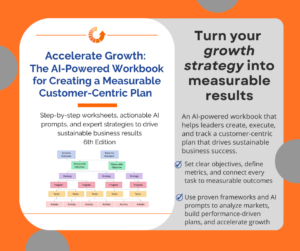
Buy Your Best-Practices Workbook
Customer Advocacy Must Really Jibe with Important Business Outcomes
Once you have completed the steps above, you are ready to develop a customer advocacy strategy. As with any strategy, this one should be aligned with and directly linked to your business outcomes. Set clear, measurable objectives to support the strategy and enable you to track progress and the impact of the strategy and associated programs.
A key aspect of this strategy entails turning customers into advocates and ultimately into ambassadors. Your program(s) need to include tactics for identifying customers willing to be advocates and motivating these customers to share their positive experiences through efforts such as testimonials and case studies. Give some thought as to how you will incentivize customers to serve as advocates, keeping your incentives in line with your company’s brand values.
As with any initiative, it is important to track the impact and value. Measures such as referral rates, customer acquisition costs, customer lifetime value, and revenue growth can offer valuable insights into the effectiveness of your customer advocacy strategy.
Transform Your Happy Customers into Growth Ambassadors
Customer advocacy serves as a powerful approach to identify growth opportunities in the B2B sector. By nurturing a customer-centric culture and focusing on advocacy, cultivating strong relationships with customers, and using technology effectively, you can potentially transform satisfied customers into enthusiastic supporters. The long-term advantages of customer advocacy include improved brand reputation, heightened customer loyalty, and sustainable business growth. We encourage every business leader to invest in creating a comprehensive customer advocacy strategy to fully realize their company’s growth potential.
Ask Yourself: Are You Leveraging Customer Advocacy for Growth?
- Do you have a formalized process to identify and engage potential advocates?
- Are your employees trained to nurture advocacy through customer interactions?
- Are you tracking key measures like referral rates and customer lifetime value?
If you answered no to any of these, let’s discuss how we can design a tailored customer advocacy strategy to fuel your growth.
FAQ:
A1: Customer advocacy is the voluntary, proactive endorsement of your company by satisfied customers—referrals, testimonials, case studies, peer recommendations, social sharing, and speaking opportunities. In B2B, where trust and risk reduction drive decisions, advocacy functions as high-credibility word-of-mouth that strengthens brand preference, improves retention, lowers acquisition friction, and opens doors to new markets. It is not a “nice program”; it is a customer-centric growth engine when tied to measurable outcomes.
A2: Satisfaction is a sentiment; advocacy is a behavior. A customer can be satisfied and still remain silent. Advocacy happens when customers believe your value is strong enough—and your relationship trustworthy enough—to attach their reputation to you. That is why advocacy is a more powerful indicator of differentiation and loyalty than satisfaction alone.
A3: A practical advocacy strategy is built on five reinforcing steps:
- Create a customer-centric culture: Align every function around customer success and value creation, not siloed outputs.
- Train and empower employees: Advocacy is nurtured through daily interactions; equip teams to resolve issues, communicate value, and act with ownership.
- Capture, analyze, and act on feedback: Use advisory boards, research, and social listening to identify needs and remove friction quickly.
- Nurture customer relationships: Maintain proactive, personalized engagement that anticipates needs and reinforces partnership.
- Leverage technology and communities of influence: Use CRM and advocacy tools to identify advocates and amplify their voices through forums, networks, and peer communities.
A4: Three common obstacles are: identifying the right advocates, ensuring authenticity, and measuring impact. Address these by establishing clear advocate criteria (outcomes achieved, relationship strength, willingness to participate), keeping incentives aligned with brand values (never “pay-for-praise”), and implementing a measurement system that links advocacy activity to business outcomes.
A5: Treat advocacy like any strategic initiative: define objectives, align them to outcomes, and measure progress. Your program should include a repeatable process to identify advocates, create proof assets (stories, testimonials, case studies), and activate peer-to-peer influence. Then track impact using measures such as referral rates, customer acquisition cost, customer lifetime value, retention, expansion, and revenue growth—so advocacy is managed as a performance driver, not a feel-good campaign.
A6: Customer advocacy is one of the highest-trust, highest-leverage growth strategies available in B2B. When you operationalize customer-centric culture, empower employees, act on feedback, nurture relationships, and amplify advocates through technology and communities, satisfied customers become ambassadors—and ambassadors become a compounding advantage in competitive markets.
Recent Posts
- Focus on Solving Customer Pain Points to Future-Proof Your Company | What’s Your Edge?
- Customer-Centricity in M&A: The Accelerant for Post-Deal Value
- How Strategic Clarity Drives Growth, Profitability, and Customer Value
- Breaking Through Stagnant Growth with a Customer-Centric, Process-Driven Approach | WYE?
- Why Lack of Accountability is Stalling Your Organization’s Growth


 Customer-centricity is the Only Way to achieve sustainable, profitable growth.
Leave a Reply
You must be logged in to post a comment.