
Understanding what your customer values gives you an opportunity to connect with them in a different way. While customers may be overwhelmed by the number of options and choices, and overloaded by an enormous number of messages, they are not confused about is what they value. It is Marketing’s job to conduct research that provides insight into the customers’ buying process and purchasing decisions. The goal of this research is to understand and interpret customer values so that messages about solutions resonate and compel action.

We’re not talking about traditional business outcomes, such as productivity/efficiency, saving money, or saving time. Almost every company/person values these, so differentiating on these values can be very difficult. We’re talking about basic values that guide a person’s purchasing choices.
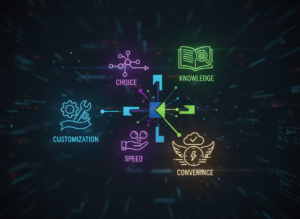
Here are some of the most common value categories of today:
- Customization. Haven’t you heard, people want it their way! They want a say in which features and functions will be included in their products (think Dell from personal computers to personalized computers.) The more you can deliver personalized value the greater your opportunity to do value pricing.
- Choice. People want options and flexibility. They expect a wide array of choices and variety. They also want flexible terms and conditions, payment and delivery options.
- Knowledge or access to knowledge. The internet has made it possible for anyone to come up to speed on any topic or product very quickly. As a result, there are more and more people who place a high value on organizations and products that provide them with full, or at least sufficient, knowledge and information while they are in the research phase of the buying process. It will be important to understand how important it is for your customers to have ready access to information and adapting accordingly.
- Speed. This is the now generation. More and more customers are placing a high value on shorter lead times and faster delivery times. We’ve gone from just-in-time to on-demand.
- Convenience. People want it hassle free.
Obviously, these categories will not apply equally to all. Also, it can be anticipated that individual customers will use different value judgments for different product and service categories. Customer-centric organizations use their understanding of customer values to create the most successful and dynamic businesses of the future. The better you understand what your target customers’ value, the better you will be able to meet their expectations and provide services and products they will want to buy. Research plays an important role in gaining insight into what your customers value.
Use Laddering to Understand Customer Purchasing Decisions
Laddering is a research methodology designed to uncover the reasons underlying a customer’s buying decision. This approach uses in-depth, one-on-one structured dialogues to understand the connections people make between product attributes, the consequences of those attributes, and the human values linked with those consequences, known as means-end chain. Technology and financial professionals and business executives are people and like all people they have preferences and value different product attributes and capabilities. When implemented properly, laddering techniques can be used effectively in B2B research and inform the development of personas.
Let’s revisit how laddering is down in a B2C study. The interviewer typically uses a series of probes to generate means-to-end chains or ladders. Each response to the question serves as the source of the next probe in trying to understand why what this particular benefit or consequence is important to the respondent until you arrive at the ultimate core value.
In a B2B study, the purpose of laddering is to understand how the product/service attributes and features link through the organizational benefits to the purchaser’s core values and beliefs. When you employ a laddering technique in a B2B study you want to be able to learn both why a particular attribute or capability is important to their business and professional success and how that particular capability or attribute personally affects them.
Uncover Customer Core Values with a Laddering Research Technique
These steps will help you employ a laddering technique in your next study:
1. Start by informing study participants why you are doing the study; explain the laddering process to them and the actual purpose of the interview which is to understand how product X affects your business and you personally, in what you have to accomplish every day.
2. The laddering process is designed first to move from a response regarding an attribute or feature, then, to a physical consequence that is a result of the feature/attribute, and finally to an emotional consequence that is a result of the physical experience, in order to elicit a core value for the respondent.
The following B2C example, using selecting a health insurance provider, illustrates a simple ladder.
a. What elements do you consider when deciding where to go receive health insurance advice and products?
i. For each element weíre going to rate them 1-10, with 10 being “very important” and 1 being “not very important”.
b. What are your 3 favorite places or services that you consult when seeking health insurance advice?
For each source, please provide one adjective to describe it.
c. Why do you prefer these places or services?
i. How do they benefit you?
ii. How are their services different from others?
d. What is your least favorite place/ service to consult health insurance advice and why?
i. What specific things did you dislike about the service?
ii. How do these negative experiences affect your current preferences?
e. Under what conditions would you consult these rejected services locations for health insurance advice?
f. How do your preferred services and locations for health insurance affect your life?
i. How do they make you feel as a consumer?
g. What do these preferred services do for you that the rejected services don’t?
h. During what period of your life are you most likely to need these services?
i. During which period has it most benefited you?
ii. Why?
i. Describe the best personal experience you have ever had concerning health insurance.
i. How has that experience changed your life?
ii. Do you seek out similar experiences today?
iii. How would you describe a service or resource that could help you achieve this?
As you can see by adding some rungs to the ladder you can apply the technique in a B2B scenario. For example for a buyer of IT network monitoring services, the ladder might be:
a. What attributes do you consider when deciding to purchase a network monitoring solution?
a. For each attribute weíre going to rate them 1-10, with 10 being “very important” and 1 being “not very important”.
b. What are your 3 favorite providers of network monitoring solutions
a. For each provider, please provide one adjective to describe it.
c. Why do you prefer these providers for network monitoring solutions?
a. What specific attributes of their solutions do you like
b. For each attribute, what is the benefits to your organization
c. How does each of these affect you personally?
d. What is the upside of this benefit for you professionally?
e. When this consequence occurs, how does that make you feel (you are looking for responses other than good, nice, fine, etc)
f. How are these solutions different from each other?
d. What is your least favorite providers for network monitoring solutions and why?
a. What specific attributes did you dislike about their solution?
b. How do these concerns affect your current preferences?
e. Under what conditions would you consult these rejected providers for network monitoring solutions?
f. What do these preferred services do for you that the rejected services don’t?
g. During what scenario in your day to day activities are you most likely to need network monitoring solutions?
a. Why?
Hopefully these examples offer a view into how laddering provides a way to gain insight into your customers’ goals and the motivation behind their buying decision.
Recent Posts
- Focus on Solving Customer Pain Points to Future-Proof Your Company | What’s Your Edge?
- The Destiny of Siloed Priorities is Random Acts
- The Power of Customer-Led Product Development for Market Growth | What’s Your Edge?
- Footprint Expansion: A Customer-Centric Growth Strategy for Scaling
- The Focus on Right-Fit Customers Yields Faster Profitable Growth | What’s Your Edge


You must be logged in to post a comment.