
 Customers are the most essential link to create alignment between your Sales and Marketing teams. Having well-oiled Sales and Marketing functions that work well together and that are both aligned with the customer buying cycle can make all the difference in successfully addressing revenue and growth efforts. Opportunity management depends on how well these two functions are aligned. Research firm IDC calls Marketing and Sales alignment one of the greatest opportunities to improve the revenue cycle. Even so, Mary Shea, principal analyst for Forrester, laments that “After years of acknowledging their issues with each other, many B2B marketing and sales teams continue to be at odds.”
Align Sales and Marketing in 4 Key Areas
There’s plenty of talk about aligning Sales and Marketing, and most often that conversation is around lead management. Taking a customer-centric outside-in view is the key to aligning these two functions. This requires Sales and Marketing to be aligned in at least these four areas:
- Market and customer segmentation
- Customer-centric go-to-market strategy, process, and planning
- The customer lifecycle and journey
- Your opportunity management process
This fourth area, opportunity management, is one of the first places any organization can address to see relatively fast improvements and value.
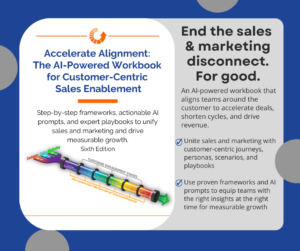
Buy Your Best-Practices Workbook
What is opportunity management? It’s the complete process of tracking and managing new revenue opportunities (prospective and current customer business) — from the generation of the opportunity to its conversion into a customer relationship. When well-defined and properly implemented, the opportunity-management process provides insight into both the effectiveness and the efficiency of your Marketing and Sales efforts.
 Apply 6 Opportunity-Management Practices to Facilitate Customer-Centric Marketing and Sales Alignment
 Apply 6 Opportunity-Management Practices to Facilitate Customer-Centric Marketing and Sales Alignment
Today’s business environment has brought the topic of opportunity management to the forefront. Organizations cannot afford opportunities to go unpursued. Nor can they afford to expend energy, time, and money pursuing opportunities that will not convert to business.
The following six best practices can help you increase the effectiveness of your opportunity-management process:
- Use the customer-buying process as the foundation for aligning both organizations.
- Track and score leads based on prospect behavior.
- Collaborate on defining what constitutes a qualified lead and on determining when an opportunity is sales-ready.
- Measure Marketing’s impact on the sales pipeline and the number of open opportunities that result from marketing programs.
- Use customer behavior to map the most appropriate subsequent interactions.
- Leverage opportunity-nurturing programs.
The first best practice, using the customer-buying process as the foundation for aligning both organizations, is the very first step any organization can take to improve its marketing and sales alignment. Doing so has implications for the remaining best practices as well as for the configuration of your marketing automation, sales automation, and campaign-management systems.
A Customer-Centric Opportunity Management Pipeline
The notion of a sales pipeline (that is, the flow of business opportunities), is very familiar to most organizations. However, developing that pipeline around the customer-buying process may be new territory.
The following two lists show the differences between a sales-oriented pipeline and a customer buying-oriented pipeline.
| Scenario A: Pipeline Elements | Scenario B: Pipeline Elements |
| · Identify the buyer | · Visit website. |
| · Send an email. | · Download a document. |
| · Call to meet. | · Request a call. |
| · Schedule a Meeting. | · Describe a project. |
| · Assess the need. | · Attend a webinar. |
| · Determine the budget. | · Schedule a meeting. |
| · Submit a quote. | · Provide Specifications and Budget. |
| · Deliver a presentation | · Participate in a Demo. |
| · Submit a proposal. | · Request a Proposal. |
Did you catch the nuances between the two scenarios? If you thought Scenario B described customer behavior and Scenario A described company behavior, you are right on target.
Seven steps you can use to create a customer-buying pipeline:
- Define the customer buying process and each incremental behavioral commitment for each buying segment.
- Group the behaviors into buying stages that map to the buying process.
- Validate the pipeline with customers, and modify it as needed.
- Determine stage owners.
- Map Marketing and Sales tools and processes to each stage.
- Configure marketing automation, sales automation, and campaign-management systems.
- Monitor, measure, and report results and payback, and modify as needed.
 Group the behaviors into buying stages that map to the buying process.
Ideally, Marketing and Sales should work together to engineer a customer-buying pipeline. There is also merit in using someone from the outside to facilitate the process to ensure it is collaborative, to manage the customer validation, and to support the system configuration changes.
Using a customer-centric model is a valuable method for improving your Marketing and Sales alignment, effectiveness, and measurement. It enables an organization to shift from a transactional focus to one that is more customer-focused and designed to accelerate and reduce the cost of revenue generation.
FAQ:
A: Because both functions exist to serve the customer buying cycle. When Sales and Marketing are aligned around customer behavior and commitments—not internal activities—opportunity management improves, revenue-cycle friction decreases, and growth efforts become more predictable.
A: Alignment is one of the greatest opportunities to improve the revenue cycle (IDC). Yet many B2B teams remain at odds despite years of acknowledging the problem (Forrester). The gap typically shows up in missed handoffs, inconsistent definitions of “qualified,” and pursuing the wrong opportunities.
A: Sales and Marketing should align in at least these four areas:
- Market and customer segmentation
- Customer-centric go-to-market strategy, process, and planning
- The customer lifecycle and journey
- Opportunity management process
Opportunity management is often the fastest place to drive measurable improvement.
A: Opportunity management is the complete process of tracking and managing new revenue opportunities—both prospective and current-customer business—from opportunity generation through conversion into a customer relationship. A well-defined process provides insight into both the effectiveness and efficiency of Sales and Marketing.
A: Because organizations cannot afford to let opportunities go unpursued—or waste time and money pursuing opportunities that will not convert. Opportunity management helps prioritize effort, improve conversion, and reduce revenue leakage.
A:
- Use the customer buying process as the foundation for aligning both organizations.
- Track and score leads based on prospect behavior.
- Collaborate on defining what constitutes a qualified lead and when an opportunity is sales-ready.
- Measure Marketing’s impact on the sales pipeline and the number of open opportunities resulting from Marketing programs.
- Use customer behavior to map the most appropriate next interactions.
- Leverage opportunity-nurturing programs.
A: A sales-oriented pipeline is organized around company actions (identify buyer, send email, call, quote, proposal). A customer-buying pipeline is organized around customer behaviors and commitments (visit website, download, request a call, describe a project, attend webinar, provide specs/budget, participate in a demo, request a proposal). The customer-buying model makes alignment and measurement more actionable.
A:
- Define the customer buying process and incremental behavioral commitments by buying segment.
- Group behaviors into buying stages that map to the buying process.
- Validate the pipeline with customers and refine as needed.
- Determine stage owners.
- Map Marketing and Sales tools and processes to each stage.
- Configure marketing automation, sales automation, and campaign-management systems.
- Monitor, measure, report payback, and adjust continuously.
A: Often, yes. An external facilitator can help ensure collaboration, manage customer validation, and support system configuration changes—reducing internal bias and accelerating adoption.
A: It shifts the organization from transactional execution to customer-driven alignment—improving effectiveness, measurement, and the ability to engineer a repeatable, scalable revenue process.
Recent Posts
- Focus on Solving Customer Pain Points to Future-Proof Your Company | What’s Your Edge?
- Customer-Centricity in M&A: The Accelerant for Post-Deal Value
- How Strategic Clarity Drives Growth, Profitability, and Customer Value
- Breaking Through Stagnant Growth with a Customer-Centric, Process-Driven Approach | WYE?
- Why Lack of Accountability is Stalling Your Organization’s Growth


You must be logged in to post a comment.