
Customer Lifetime Value (CLV) is an important outcome-based metric. This metric represents the value of a customer for the period of time during which this customer has a relationship with your company. As a result is is one of the best indicators of the health of your organization. In his book, The Complete Database Marketer, Arthur M. Hughes, defined customer lifetime value as “…the net profit that you will receive from transactions with a given customer during the time that the customer continues to buy from you.”
How to Calculate Life Time Value
This is the general formula for customer lifetime value (CLV):
CLV = Value (Initial Revenue – Costs) + Net Present Value (Loyalty multiplied by (Future Revenue – Future Costs))

 Monitor changes in CLV to keep tabs on your organizations overall health.
Calculating LTV while a matter of math, there’s more to it the concept. It is about gaining an in-depth understanding of your customers’ behavior, enabling you to use past behavior to predict future actions. Changes to certain components of customer behavior serve as leading indicators as to whether lifetime value for a customer, market segment, or the entire customer franchise is at risk.
Each of these individual elements typically used to calculate LTV also serve as leading indicators to potential change. We recommend that you monitor each of these for your most valuable customer segments:
- Initial Revenue: The revenue generated by the goods and services the customer purchases initially. Do you see the initial revenue from customers increasing or decreasing.
- Cost/Sale: The cost of making the sale (acquisition cost), plus the cost of the actual good or service sold (product cost).
- Acquisition cost: Calculated as a percentage of the total sales and marketing costs (assuming most of these are variable costs) for the company or business unit spent to acquire new customers (rather than to keep existing customers) divided by the number of customers acquired. If customer acquisition costs vary significantly by region or segment, try to get an appropriate acquisition cost for each type of customer.
- Future Revenue: The value of future purchases depends on the amount and frequency of incremental purchases and the customer’s loyalty (which determines the length of time the customer continues to purchase). Remember to include ongoing recurring revenue for services and support.
- Future Costs: The cost of the incremental products purchased and the cost to make the incremental sale, as well as the cost for ongoing service.
- Incremental purchases: Purchase history can help determine typical purchase patterns for a given time period. Companies often model several different cross-sell or up-sell scenarios and adjust those based on results.
- Loyalty (retention rate): The percentage of customers who remain customers in a given time period.
- Influence Value: The number of sales that the customer indirectly influences through references, and referrals. Some companies calculate influence value by multiplying the number of customers referred by the reduction in customer acquisition cost over a typical new customer.
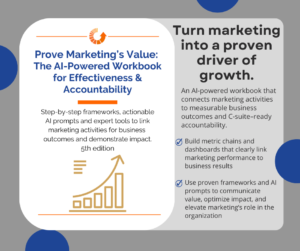
Buy Your Best-Practices Workbook
By monitoring and evaluating the rate of change each of these factors by customer and segment, you will begin to see which factors will be the best indicators of long-term customer value.
Need to be more selective? Focus on these first:
- incremental revenue (whether upsell, cross-sell and/or service revenue)
- influence value
- loyalty rates
We believe these three factors serve as the best leading indicators to changes in CLV. When you can affect one or more of these drivers in a positive direction, you can increase customer lifetime value. On the flip side, if these are moving in a negative direction, then beware, your lifetime value is in jeopardy. Creating your Marketing metrics takes expertise. We’d love to help.
FAQ:
A: CLV represents the net profit expected from a customer over the entire duration of their relationship with your company. It is a key outcome-based metric and a strong indicator of organizational health.
A: The general formula is:
CLV = Value (Initial Revenue – Costs) + Net Present Value (Loyalty × (Future Revenue – Future Costs))
This calculation considers initial purchase value, ongoing loyalty, future purchases, and associated costs.
A: Key components include:
- Initial Revenue: Revenue from the customer’s first purchase.
- Cost/Sale: Acquisition and product costs.
- Acquisition Cost: Marketing and sales costs to acquire a customer.
- Future Revenue: Value of repeat purchases and recurring revenue.
- Future Costs: Costs of incremental sales and service.
- Incremental Purchases: Patterns of cross-sell and up-sell.
- Loyalty (Retention Rate): Percentage of customers retained over time.
- Influence Value: Sales indirectly generated through referrals.
A: Focus on incremental revenue (upsell, cross-sell, service), influence value, and loyalty rates. Positive trends in these drivers can increase CLV, while negative trends signal risk.
A: By monitoring CLV drivers, companies can prioritize marketing and customer experience initiatives that enhance loyalty, increase referrals, and maximize revenue per customer, thereby driving long-term growth.
A: VisionEdge Marketing provides expertise in creating actionable marketing metrics, including CLV, to help organizations optimize customer value and business performance.
Recent Posts
- Focus on Solving Customer Pain Points to Future-Proof Your Company | What’s Your Edge?
- Customer-Centricity in M&A: The Accelerant for Post-Deal Value
- How Strategic Clarity Drives Growth, Profitability, and Customer Value
- Breaking Through Stagnant Growth with a Customer-Centric, Process-Driven Approach | WYE?
- Why Lack of Accountability is Stalling Your Organization’s Growth


You must be logged in to post a comment.