
No two companies are identical. While all companies aspire to profitably acquire more customers, maintain or increase market share, retain existing customers and grow the business with these customers, it’s very unlikely that your Marketing plan will be an exact match to another company’s plan. As a result, every company’s dashboard will be different, even though there will be common metrics categories.
Customizing an effective Marketing dashboard and creating a center of Marketing excellence at your company takes time and attention. One you have your dashboard defined and designed, you and your leadership team will find this tool extremely helpful for showing how Marketing creates value for the company, facilitates decisions, and manages risk.
The key is to define, discover, and design a Marketing dashboard that is relevant to your leadership team.
Start Your Marketing Dashboard Development with these 3 Steps

Step 1: Define Your Marketing Objectives
To demonstrate your value, Marketing objectives need to be defined within the context of business outcomes. Far too often, Marketing objectives are orphaned from business outcomes. As a member of the business team, you need to participate in defining the business outcomes. Increasing market penetration in a specific vertical or retaining a particular set of customers resulting in a target amount of revenue is an example of a business outcome. Armed with these, you can develop outcome-based customer-centric Marketing objectives. For example, securing a number of conversations with qualified prospects within the targeted vertical. The key is for the Marketing objectives to be quantifiable, performance-based, customer-centric, and aligned with the outcomes.
The following scenario helps illustrate the connection between outcomes and objectives:
- Outcome: Grow our market share by 10% in the Financial Services segment, resulting in $X incremental revenue.
- Marketing Objective: Generate X# of face-to-face meetings with at least 3 of the top stakeholders at Y financial services target accounts per month, with 50% of these converting to RFPs by the third quarter, resulting in 10 new customers.
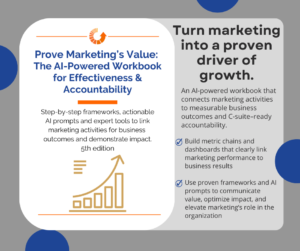
Buy Your Best-Practices Workbook
Step 2: Discover the Right Metrics for Your Dashboard
It is tempting to take the easy route and focus on the most common and easy-to-quantify metrics. The key is discover the metrics that best reflect what you are trying to measure. As a marketer, you may be tempted to focus on what you produce, such as website traffic, content consumption, discovery meetings, webinar participants, contact requests, etc. These are activity and output measures.
To discover the right measures and metrics, you need to be able to link the activities to outcomes. For example, if the outcome is to gain share in a new vertical with an existing product, your metric will be different than if the outcome is to achieve a greater category growth rate in an existing market. In each instance, you may still have many of the same activities, but the top-line metrics are different. In the former, appropriate metrics might be share of preference and net new customer acquisition. In the latter, appropriate metrics might be product adoption rate and footprint expansion among existing customers.
This example illustrates why your Marketing dashboard will be different from another company’s and how your dashboard might have to evolve.
Step 3: Design the RIGHT Marketing Dashboard for Your Business
Your plan is aligned. Your objectives are outcome-based. You have your metrics and the metrics defined. Now you’re ready for the design phase. Keep the following three characteristics in mind as you design your dashboard:
- Relevant: It has only the information that means something to you and your leadership team. Your Marketing dashboard should be providing the success or the opportunities available for Marketing at a glance and be a valuable report for executives in determining Marketing’s value, impact, and contribution.
- Easy to Understand: Save your executive team time by designing a Marketing dashboard that allows them to see value without a one-hour presentation every time it’s updated. However you determine is best, you should be able to update it easily and read it easily.
- Displays the RIGHT Performance Targets: Don’t include extra data that doesn’t show how your Marketing is working towards the defined targets set forth by your company’s plan. If your executive team looks at your dashboard and still needs to know what it all means, it means the design has failed.
For more information on designing Marketing dashboards, visit our presentation here on the good, bad and ugly.
If you need additional assistance in defining, discovering, and designing your way to a dashboard that works for your Marketing organization, contact us for a free consultation or purchase a dashboard assessment.
FAQ:
A: Because no two companies are identical. While most organizations share common growth aspirations—acquire customers profitably, maintain/increase share, retain customers, and expand customer value—the specific strategy, market context, and performance priorities differ. As a result, dashboards must be customized, even if they share common metric categories.
A: A well-defined and well-designed dashboard helps Marketing and leadership:
- Show how Marketing creates value
- Facilitate decisions (not just reporting)
- Manage risk
It also supports the broader goal of building a Center of Marketing Excellence—though it requires time and attention.
A: Define, discover, and design a dashboard that is relevant to your leadership team—so it connects Marketing performance to what leadership cares about and uses for decision-making.
A:
- Define your Marketing objectives (in the context of business outcomes)
- Discover the right metrics (that best reflect what you are trying to measure)
- Design the right dashboard (relevant, easy to understand, and target-driven)
A: Marketing objectives must be defined within the context of business outcomes. Too often, Marketing objectives are “orphaned” from outcomes. Marketing leaders should participate in defining business outcomes (e.g., penetration in a vertical, retention of a customer set tied to revenue targets), then translate them into outcome-based, customer-centric Marketing objectives that are quantifiable, performance-based, and aligned.
A: Yes:
- Outcome: Grow market share by 10% in the Financial Services segment, resulting in $X incremental revenue.
- Marketing objective: Generate X face-to-face meetings per month with at least three top stakeholders at Y target accounts, convert 50% to RFPs by Q3, resulting in 10 new customers.
A: Avoid defaulting to the easiest metrics (often activity/output measures like traffic, content consumption, webinar attendance, or contact requests). Instead, link activities to outcomes and select metrics that best reflect progress toward those outcomes.
A: Because the same activities can support different strategies, but the top-line measures must reflect the outcome. For example:
- If the outcome is gaining share in a new vertical with an existing product: metrics might include share of preference and net new customer acquisition.
- If the outcome is greater category growth in an existing market: metrics might include product adoption rate and footprint expansion among existing customers.
This is why dashboards differ across companies and must evolve over time.
A:
- Relevant: Includes only information meaningful to leadership; provides value and opportunities at a glance.
- Easy to understand: Enables executives to interpret value quickly without requiring a long presentation; easy to update and read.
- Displays the right performance targets: Focuses on the targets defined by the plan; avoids extra data that obscures meaning. If executives still don’t know what it means, the design has failed.
A: When the initiative is strategic, time-sensitive, or requires an objective third party to accelerate definition, metric selection, and design. Options include a consultation or a dashboard assessment.
Recent Posts
- Focus on Solving Customer Pain Points to Future-Proof Your Company | What’s Your Edge?
- Customer-Centricity in M&A: The Accelerant for Post-Deal Value
- How Strategic Clarity Drives Growth, Profitability, and Customer Value
- Breaking Through Stagnant Growth with a Customer-Centric, Process-Driven Approach | WYE?
- Why Lack of Accountability is Stalling Your Organization’s Growth


You must be logged in to post a comment.