

Alignment and accountability are the first steps every aspiring marketing organization must take to improve its performance management and measurement. Alignment and accountability are inextricably linked and are the cornerstones for transforming marketing into a center of excellence. Without alignment, it’s impossible to quantify Marketing’s value to the business, and to select the right metrics; metrics that measure whether you are doing the right things to generate value for the organization.
Alignment and accountability facilitate marketing effectiveness and management. In his book The Effective Executive, Peter Drucker explains the difference between efficiency and effectiveness: “Efficiency is doing things right. Effectiveness is doing the right things.”
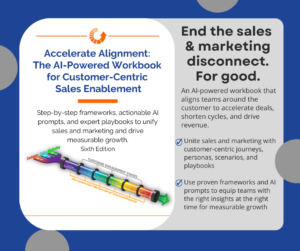
Buy Your Best-Practices Workbook
While understanding the definition of these two terms is important, Drucker also emphasizes the criticality of focusing first on effectiveness before efficiency. He explains that you will naturally grow to be more efficient at a task, but this has no bearing on whether or not what you are currently doing is the right thing. He similarly argues that becoming an effective Marketing organization takes conscious effort. Effectiveness, he asserts, is about achieving the right result by being on the right path.
Unsurprisingly, it is only when we Marketers are positively impacting and contributing to the right result that we earn our right to participate in strategic conversations.
The most sophisticated data collection and analysis can be completely undermined by the lack of proper alignment. Best-in-class marketing organizations create a direct line-of-sight between their marketing investments, activities, and the business outcomes. Alignment enables Marketing to clarify the strategic intent of all the investments it makes, and to measure and communicate the degree to which Marketing delivers on its commitments.
Use our proven Accelance® outcome-based methodology to jumpstart your alignment and lay the foundation for your metrics and subsequent dashboard.
FAQ:
A: Because they are the cornerstones of transforming Marketing into a Center of Excellence. Without alignment, you can’t quantify Marketing’s value or select the right metrics.
A: Alignment clarifies what Marketing is trying to achieve (strategic intent and outcomes). Accountability is Marketing’s ability to explain and prove how its investments and actions deliver those outcomes.
A: Even sophisticated data collection and analytics are undermined. Metrics become disconnected from business value, and Marketing can’t credibly communicate contribution.
A: Drucker: “Efficiency is doing things right. Effectiveness is doing the right things.” Marketing must prioritize effectiveness first; being efficient at the wrong work doesn’t create value.
A: Because you naturally become more efficient over time, but that doesn’t mean you’re on the right path. Effectiveness requires conscious effort and focus on the right results.
A: Alignment creates a direct line-of-sight between investments, activities, and business outcomes—so metrics and dashboards measure commitments and results, not just activity.
A: They explicitly connect marketing investments and programs to business outcomes, clarify the intent of every investment, and measure delivery against commitments.
A: Use an outcome-based methodology (e.g., Accelance®) to map activities to outcomes, define performance targets, and establish the foundation for metrics and a dashboard.
Recent Posts
- Focus on Solving Customer Pain Points to Future-Proof Your Company | What’s Your Edge?
- The Destiny of Siloed Priorities is Random Acts
- The Power of Customer-Led Product Development for Market Growth | What’s Your Edge?
- Footprint Expansion: A Customer-Centric Growth Strategy for Scaling
- The Focus on Right-Fit Customers Yields Faster Profitable Growth | What’s Your Edge


You must be logged in to post a comment.