
Your Marketing plan drives your marketing activities and investments. How you make sure your plan is is customer-centric, measurable, and outcome-based? Limited resources and high expectations make it easy for Marketing leaders to fall into the habit of ready – fire – aim. Of course there are times when immediate action (ready/fire) is needed. Creation of a Marketing plan upon which your organization’s and your success depends is not one of those times. Taking aim first, helps ensure that your Marketing efforts will move the right business needles to create value and that there is enough wood behind your arrow to be successful.
Avoid Ready, Fire, Aim: Start with Alignment and Accountability

 Put aim before fire for a successful Marketing Plan.
Alignment and accountability help you take aim. Inextricably linked, they are the cornerstones of successful Marketing organization and its plan. Achieve alignment as the first step in your marketing plan process. Without it, your risk creating a Marketing plan with a very short lifespan.
Every Marketing objective, strategy, program, and associated tactics and activities in your plan need to ladder up to a quantifiable business outcome.
This level of alignment brings the visibility needed to do the right things right because priorities and direction are clarified. When properly formulated, each outcome, objective, and program captures a customer-centric performance target. When looked at holistically what you’ve done is create the data chain and metrics needed to measure Marketing contribution, and monitor and optimize performance and processes. Without business alignment, it’s impossible to quantify Marketing’s value and to select the right metrics. Even the most sophisticated data collection and analysis can be completely undermined by poor alignment!
Consider the bottom-up approach to planning some Marketing groups take that focuses on developing programs that include some combination of what’s always been done or what they best know how to do. As a result programs are disconnected (not aligned) from the business. Measures and metrics fall primarily into activity or output categories, such as number of campaigns or events produced or email open and click through rates. These metrics make quantifying Marketing’s contribution to the business difficult, jeopardizing continued investments and obscuring the steps they should, and shouldn’t, be taking.
Now compare that to the outcome-to-activity approach that Best-in-Class marketing organizations take creates a direct line-of-sight between programs, investments, and the business outcomes. This approach requires creating outcome impact data/metrics chains. These chains facilitate alignment and enables Marketing to clarify the strategic intent of all the investments it makes and to measure and communicate the degree to which marketing delivers on its commitments. It also helps determine the marketing effort and resources required.
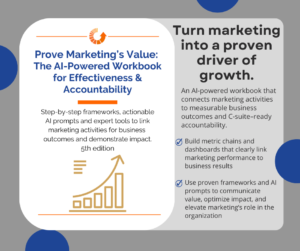
Buy Your Best-Practices Workbook
Tackle Accountability After Alignment
Once you have alignment, you’re ready to tackle accountability – the measurement and metrics aspects of your plan. You really cannot optimize your marketing by skipping metrics and measurement, the foundation for performance management. Understanding the impact of marketing on your business starts with selecting the right metrics and accurate measurement. When you incorporate the metrics into the plan, you establish the performance targets and relationship that will serve as the building blocks for your dashboard.
Follow these 7 steps for a successful Marketing plan
- Alignment: Establish direct-line-of sight between marketing initiatives and investments and business outcomes. Armed with the business outcomes and clarity around how marketing is expected to impact them, you can develop the appropriate strategy and associated integrated program.
- Metrics: Create outcome-based metrics and develop and maintain a metrics catalogue.
- Data: Leverage accurate, timely, data. Develop a Data Dictionary and Data Source Inventory, Store this information in an accessible format, and update it regularly.
- Analytics: Hone your analytics skills so you can gain insights from your data and build models.
- Performance Setting & Tracking: Commit to set outcome-based performance targets for every program and track results.
- Dashboard: Produce an actionable marketing dashboard that quickly and visually conveys your contribution to the organization and facilitates course adjustments.
- Optimization: Keep in mind that continuous improvement takes an iterative process. What you do today will feed back into the process in the future. In this way we learn from each activity and adjust our future actions accordingly.
Aim Before Your Fire – Start Now

 Take aim before you fire up your Marketing plan.
It’s never too early to start the planning process, especially if your prior plans have not been successful. Developing and adopting a new planning methodology can be challenging. But from our experience working with many companies across many industries, we know it’s worth it! The Safe Systems team found that this work enabled them “to have a set of quantifiable outcomes on which to build a more strategic, measurable Marketing plan and a set of metrics for the dashboard that more clearly communicates Marketing’s impact.”
FAQ:
A: Starting with alignment and accountability ensures Marketing activities and investments are customer-centric, measurable, and tied to business outcomes. Skipping this step risks wasted resources and weakens Marketing’s impact and credibility.
A: Alignment creates a direct line-of-sight between every Marketing objective, strategy, program, and tactic and the organization’s quantifiable business outcomes. This clarity enables prioritization, clarifies direction, and forms the foundation for meaningful metrics.
A: Accountability—through measurement and metrics—enables you to quantify Marketing’s value and optimize performance. Selecting the right outcome-based metrics and embedding them into the plan establishes performance targets and supports effective dashboards.
A:
- Alignment: Link all Marketing initiatives and investments to business outcomes.
- Metrics: Develop outcome-based metrics and maintain a metrics catalogue.
- Data: Use accurate, timely data; create and regularly update a Data Dictionary and Data Source Inventory.
- Analytics: Build analytics capabilities to extract insights and model performance.
- Performance Setting & Tracking: Set outcome-based targets and systematically monitor results.
- Dashboard: Create actionable dashboards to communicate Marketing’s contribution and enable course correction.
- Optimization: Embrace continuous improvement by iterating and learning from each activity.
A: Best-in-Class organizations start with business outcomes and work backward to define programs, investments, and activities—creating data/metrics chains that clarify intent, resource needs, and the impact of Marketing.
A: VisionEdge Marketing offers proven frameworks, planning methodologies, and advisory services to help organizations create customer-centric, outcome-driven Marketing plans that deliver measurable business value.
Recent Posts
- Focus on Solving Customer Pain Points to Future-Proof Your Company | What’s Your Edge?
- Customer-Centricity in M&A: The Accelerant for Post-Deal Value
- How Strategic Clarity Drives Growth, Profitability, and Customer Value
- Breaking Through Stagnant Growth with a Customer-Centric, Process-Driven Approach | WYE?
- Why Lack of Accountability is Stalling Your Organization’s Growth


You must be logged in to post a comment.