
Marketers are drowning in data. We generate it from our own activity or research. We collect and capture tons more from external sources. And, by now, all of us have been exposed to the conversation about Big Data—the voluminous unstructured data that is collected from nontraditional sources such as blogs, social media, email, sensors, photographs, video footage, and so on. More data is not the challenge. Insights from the data where we need to focus.
 As the number of channels and customer touchpoints expands, so does the amount of data coming from them. Every minute, there are more than 1.8 million likes on Facebook and 278 thousand tweets on Twitter. According to Stephanie Miller, VP of member relations at the Direct Marketing Association, “data is big, getting bigger, and more complex (and expensive) to manage.”
In today’s data-rich and data-driven environment, we are predisposed to gain our insights from data. But action doesn’t always follow collection. The Economist Intelligence Unit surveyed 600 executives and found that 85% of the participants thought the biggest hurdle to unlocking value from data was analyzing and acting on it, not grappling with the sheer volume. Gleaning the insights from the data is what makes data valuable.
Merriam-Webster defines insight as “the power or act of seeing”. Keyword: Seeing. We must use the data to identify and see patterns, trends, and anomalies. Once we gain this insight, its value is proven by the resulting actions we take. Data that doesn’t help you see isn’t useful. So, in this instance, more does not always translate into better insights. In fact, studies show that more than half of marketers believe that moving from data to insight is a major challenge.
In 1990, Stephen Tuthill at 3M helped make the connection between data and wisdom. His The Data Hierarchy

outlines four important concepts: data, information, knowledge, and wisdom, with data being the raw items or events. Once we have the data, we can sort and organize it into information. Knowledge is then derived from the patterns that result from understanding the relationships between the data and other factors. Wisdom comes when we understand what to pay attention to—what has meaning for us.
So, rather than focusing on more data, we need to focus on capturing the right data and then analyzing it in a way that gives us the power to see (knowledge) and act (wisdom). Bernard Marr from UK-based Advanced Performance Institute reminds us that to get the most out of our data, “you need to know what you want to know.” Once you know what you want to know, collect and organize the data.
So, now what?
Getting From Data to Insight in 5 Steps:
- Having data is one thing; analyzing and synthesizing it is another. Synthesis is where we begin to see the patterns. Once the synthesis is completed, you will need a way to bring data to life. Data visualization greatly aids in this part of the process. Data visualization presents analytical results visually so we can easily see what’s relevant among all the variables, capture and communicate important patterns, and even support predictive models. Visualization is an important step for exposing trends and patterns that you might not have otherwise noticed.
- Not all patterns are germane. Take the time to review and discuss each pattern and its potential implications. Talk about why you think each pattern is
 important and what it means. This is an essential step for going from information to knowledge.
 important and what it means. This is an essential step for going from information to knowledge.
- In one simple statement, articulate the insight that emerged out of each pattern or point of synthesis. We find it is helpful to capture insight on a Post-it Note and place it on a wall or flip chart to easily track each insight and to see the “big picture” that may be emerging as we go.
- Incubate the insights. Give yourself and your team at least a day away from the exercise. When you and the team return, you can take a fresh look and decide whether to make any changes.
- Do the insights resonate? Once you are comfortable with the conclusions/insights you’ve captured, involve other people who were part of the initial steps to gain their reactions. Be sure to give them the context. The point of this step is to decide if the insights resonate and are compelling enough to make or affect key decisions. That is, to determine whether you have acquired the wisdom you need to act.
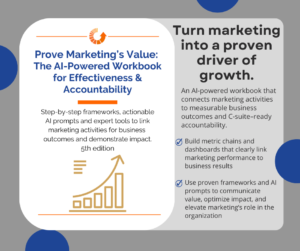
Buy Your Best-Practices Workbook
The success of this approach is contingent on the quality (not necessarily the quantity) of the data set, and then following a process proven to identify core insights to support strategic decisions. So, are you ready to transform your data? Start by downloading our white paper “Intuition to Wisdom: Transforming Data Into Models and Actionable Insights.”
FAQ:
A: The problem isn’t the volume of data—it’s the shortage of actionable insights. Marketers generate and collect massive amounts of data from internal activity, research, and external sources (including Big Data). The challenge is turning that data into patterns you can see, insights you can articulate, and actions you can take.
A: Because collection does not guarantee analysis or action. Executives consistently cite the biggest hurdle as analyzing and acting on data—not managing the sheer volume. Data only becomes valuable when it enables insight and informs decisions.
A: Merriam-Webster defines insight as “the power or act of seeing.” The keyword is seeing—using data to identify patterns, trends, and anomalies. If the data doesn’t help you see what matters, it isn’t useful. Insight proves its value through the actions it enables.
A: Stephen Tuthill’s hierarchy connects data to decision-making through four concepts:
- Data: Raw items or events
- Information: Data that has been sorted and organized
- Knowledge: Patterns derived from understanding relationships in the data
- Wisdom: Knowing what to pay attention to—what has meaning and should drive action
The hierarchy reinforces that the goal is not more data, but better synthesis and decision-grade meaning.
A: Focus on capturing the right data and analyzing it in a way that produces knowledge (the power to see) and wisdom (the ability to act). As Bernard Marr notes, you must first know what you want to know—then collect and organize data accordingly.
A:
- Synthesize and visualize: Identify patterns through synthesis; use data visualization to bring results to life and expose trends and anomalies.
- Evaluate relevance: Not all patterns matter—review each pattern and discuss implications to move from information to knowledge.
- Articulate the insight: Capture each insight in a single, clear statement (often easiest as a “Post-it Note” style summary).
- Incubate: Step away for at least a day, then revisit with fresh eyes to refine or adjust conclusions.
- Test resonance: Share insights with relevant stakeholders (with context) to confirm they are compelling enough to influence key decisions—i.e., to validate that you have the wisdom required to act.
A: The quality of the data set (not necessarily the quantity) and the discipline to follow a proven process for identifying core insights that support strategic decisions.
Recent Posts
- Focus on Solving Customer Pain Points to Future-Proof Your Company | What’s Your Edge?
- Customer-Centricity in M&A: The Accelerant for Post-Deal Value
- How Strategic Clarity Drives Growth, Profitability, and Customer Value
- Breaking Through Stagnant Growth with a Customer-Centric, Process-Driven Approach | WYE?
- Why Lack of Accountability is Stalling Your Organization’s Growth


You must be logged in to post a comment.