
 The Marketing budget provides insight into the organization’s and Marketing’s priorities, which customers to acquire, keep, and gro,w and how this will be achieved. It reflects your investment portfolio. As an investment portfolio, there is an expectation of a positive return. Yet, as Gartner points out in the Spend Survey, “Budgeting methods that lean heavily on historical data rely on the assumption that the logic that drove those decisions was and will remain sound. When this logic fails, as it often does, CMOs are left over investing in areas that don’t yield measurable returns.”
As with any investment portfolio, you need to take a forward-looking approach. That starts with having a Marketing plan tied to what the business needs to achieve, and how Marketing will contribute to creating value and ensuring the company can successfully compete.
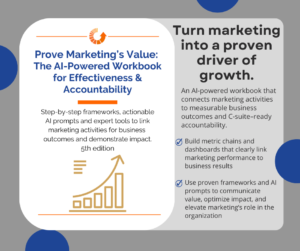
Buy Your Best-Practices Workbook
Connect the Work of Marketing and Investments to Results
 To secure and keep a budget, Marketing is being asked to demonstrate a return by showing a direct relationship between investments Marketing is making on behalf of the organization and business results. Therefore every tactic, activity, and program needs to roll up to a specific outcome. This will require you to take an outcome-based approach as opposed to a campaign-based approach to measuring the performance of your Marketing investments. It will also require data, analytics, and model skills.
While the key is to connect Marketing to outcomes, the action takes place in the trenches on the front line. For many marketers, this means understanding two key processes and how they work together: the customer buying process and your organization’s selling process.
Your Marketing Budget Depends on Your Diving Deep Into Your Customers’ Buying Process
How well you understand your customers is the key differentiator between effective and ineffective Marketing. Marketing needs to take the lead in understanding how the various stakeholders associated with the buying process evaluate offers in your industry. For each stage in the process, focus your efforts on learning your prospects’ needs and requirements. Your job is to then develop strategies and tactics to help your prospects understand and evaluate our offer in such a way as to influence the buying decision.
Design and develop your marketing programs to help your prospects achieve the milestones necessary to advance to the next stage in their buying process. To do this part of the job well, you will need to identify the people involved in the buying process and know what aspect of our product each will want to analyze.
How Well You Understand Your Sales Process Impacts Your Marketing Budget
A salesperson’s role is to facilitate the customers’ buying process. Marketing plays a key role in helping Sales engage new customers in buying discussions and keeping existing prospects and customers engaged. Everything that we do as marketers for our organizations should support the way in which the company engages with prospects and customers. The company’s sales team has tremendous influence over the perception of a company. If each salesperson has their own presentation, writes their own letters, and owns each conversation with the customer, then Sales not Marketing is creating and controlling the message and brand promise. When there a numerous creators of the brand promise, the potential for inconsistencies, confusion, and dilution increases.
Marketers must demonstrate to the Sales team that they understand both the buying and the sales cycle. In this way, we can address the assets, touchpoints, and channels that will yield the best results at each stage. Before committing to white papers, presentations, and traditional collateral, examine the sales cycle carefully and explore how some other tools, such as assessments, ROI calculators, account profiling tools, objection handling, research, case studies, etc. can be used.
Remember, Salespeople often feel a sense of urgency when a deal is on the line, so tools need to be ready sooner rather than later. When Marketing develops assets and deploys them in the correct channels so they add value to prospects while advancing the sales cycle, then Marketing is contributing to the overall process.
When you can measure your contribution you are better positioned to secure the budget.
NEED A SECOND OPINION? At VisionEdge Marketing we regularly help our customers develop the right plan and budget that allows you to step back and demonstrate the value Marketing brings to your organizations. Contact us for help building your Marketing plan and budget, and we’ll help you position Marketing as an investment that will bring a quantifiable value and impact to the business over time.
FAQ:
A: The Marketing budget provides insight into both organizational and Marketing priorities—identifying which customers to acquire, retain, and grow, and outlining how these objectives will be achieved. It serves as an investment portfolio with an expectation of measurable return. Relying on historical data alone is risky; a forward-looking, outcome-based approach is essential.
A: Marketing must show a direct relationship between its investments and business results. Every tactic, activity, and program should map to a specific, measurable outcome. This demands an outcome-based measurement approach, leveraging data, analytics, and modeling skills.
A: Deep understanding of the customer buying process distinguishes effective Marketing. Marketers must map how stakeholders evaluate offers at each stage, then develop strategies and tactics that help prospects advance through their journey. Identifying key decision-makers and their criteria is fundamental.
A: The sales and buying processes are tightly linked. Marketing’s assets and messaging must support Sales in engaging, advancing, and retaining prospects. If Sales independently creates assets, inconsistencies and brand dilution occur. Marketing must deliver timely, relevant tools that reinforce the brand promise and drive results.
A: Beyond traditional collateral, prioritize tools such as assessments, ROI calculators, account profiling, objection handling guides, research, and case studies. These assets, deployed in the right channels, add value and accelerate the sales cycle. Timeliness is critical—Sales needs resources ready when deals are at stake.
A: The ability to measure and communicate Marketing’s impact on business outcomes strengthens your case for budget allocation. Quantifiable value positions Marketing as a strategic investment rather than a discretionary expense.
A: VisionEdge Marketing regularly assists organizations in creating plans and budgets that demonstrate Marketing’s business value. Contact us for expert support in building a plan that positions Marketing as an investment with measurable impact.
Recent Posts
- Focus on Solving Customer Pain Points to Future-Proof Your Company | What’s Your Edge?
- Customer-Centricity in M&A: The Accelerant for Post-Deal Value
- How Strategic Clarity Drives Growth, Profitability, and Customer Value
- Breaking Through Stagnant Growth with a Customer-Centric, Process-Driven Approach | WYE?
- Why Lack of Accountability is Stalling Your Organization’s Growth


You must be logged in to post a comment.