

Napoleon Bonaparte once said, “War is 90% information.” Now considered one of the greatest military minds in the history of warfare, Bonaparte, though ultimately defeated, was praised as a strategic genius and a great leader of men. Though he did not live in the information age, Bonaparte understood that, when battling for a competitive advantage, gathering and analyzing the right information, at the right time, is the key to success. This same insight applies in today’s hyper-competitive world, which is why, whether it is coming from the C-Suite or the Marketing organization itself, the drive for gathering and analyzing the right data, and measuring Marketing has become table stakes.
Measuring Marketing Takes the Right Analytics and Metrics
Companies gather and analyze data, and identify data patterns, in order to surface concrete trends and insights into their company performance and customer satisfaction. A study by Deloitte posed questions to more than 1,000 executives working at large companies (500+ employees) who interact with, create, or use analytics as part of their job. The study revealed a number of concerns, including that many of the firms are still analytically challenged.
Information, data, metrics, and analytics are at the center of improvement. Regular measurement provides timely feedback, enables corrective action, provides focus, and gives your company the ability to map and monitor processes in order to adopt best practices. But the right metrics must be chosen in order to achieve the desired business outcomes.
Shift Measuring Marketing From Activities to Outcomes
To avoid winning the battle but losing the war, Marketing professionals must expand their analytics capabilities, become more comfortable using data, and shift from activity-based measures to business outcome–based metrics:
- Activity-Based Metrics
- Number of emails sent during an email campaign
- Number of Events Managed in a month
- Number of tweets sent out a day
- Outcome-Based Metrics
- Number of meetings held with prospects
- Number of conversations
- Number of quotes requested
Here are three suggestions to shift from activity and output measures to business outcome-based metrics to support measuring Marketing:
- Define success by the outcome needed to positively affect the business rather than by the number of activities completed by marketing
- Understand the data chains your company employs with respect to the final outcome.
- For example, if your goal is to give 10 quotes a week, how many website visits will be needed? Let’s say 100. If you want to get 100 website views, how many emails and social media posts will you have to send? By knowing the outcome you are seeking, you are able to determine the activities that need to be completed and how integral each of these activities is to success.
- Translate your data chain into a dashboard that will enable you to make investment and strategy decisions. Dashboards can show you at what point the data chain is stalling and allow you to make strategic decisions based on that information.
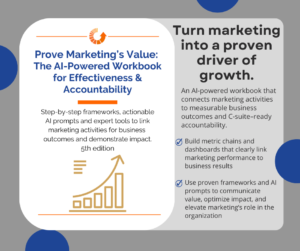
Buy Your Best-Practices Workbook
The responsibility to model the way, like generals among militia, falls to those of us with “passion and experience”. A+ marketers must set aside budget to invest in systems and processes that will enable outcome-based planning. We must establish a discipline around measuring Marketing and a culture of accountability that can only come through well-researched data and metrics. And we must demand measurement training for our teams to help achieve these goals.
Napoleon was successful on the battlefield because he utilized the technology and insights available to him at the time to formulate his strategy and tactics with his end goal in mind. Only when measurement and metrics are aligned with business outcomes, progress is tracked and reported, and the organization is both measurement and analytically competent, can Marketing take its rightful place at the head of the troops, influencing the organization’s strategic direction.
To make progress on the measuring Marketing front, Marketing professionals must make a shift to metrics that are more linked to business outcomes. To learn more about how to create these links, check out Marketing Metrics in Action. Or, if this is a strategic initiative, time is of the essence, or you need an objective third party, contact us to discuss your goals and timeline.
FAQ:
A: Because competitive advantage depends on having the right information at the right time—and using it to make better decisions. In a hyper-competitive market, intuition is not enough. Measurement, analytics, and the right metrics provide feedback, focus, and the ability to improve performance through corrective action and best-practice process management.
A: Information and analytics sit at the center of improvement. Regular measurement provides timely feedback, enables corrective action, and helps organizations map and monitor processes. However, improvement depends on choosing the right metrics—metrics that connect to the business outcomes the organization is trying to achieve.
A: Deloitte’s study of more than 1,000 executives at large companies (500+ employees) found that many firms remain analytically challenged—reinforcing that measurement capability and decision-support analytics are still gaps for many organizations.
A: Because activity measures can create the illusion of progress—winning the battle but losing the war. Outcome-based metrics connect Marketing effort to business results and help leaders understand whether Marketing is creating value, not just producing volume.
A:
- Activity-based metrics: number of emails sent, number of events managed, number of tweets posted.
- Outcome-based metrics: number of prospect meetings held, number of conversations, number of quotes requested.
A:
- Define success by the outcome needed to positively affect the business—not by the number of activities completed.
- Understand your data chains that lead to the outcome (e.g., if you need 10 quotes/week, how many meetings, visits, emails, and posts are required to produce those quotes?).
- Translate the data chain into a dashboard that supports investment and strategy decisions and reveals where the chain is stalling.
A: Set aside budget for systems and processes that enable outcome-based planning, establish discipline around measurement, and invest in training so teams build measurement and analytics competence. Accountability is not a slogan—it is operational capability.
A: Marketing earns credibility and influence. When metrics are outcome-linked, progress is tracked and reported, and the organization is analytically competent, Marketing can more effectively shape strategy and guide investments—rather than merely executing activities.
Recent Posts
- Focus on Solving Customer Pain Points to Future-Proof Your Company | What’s Your Edge?
- Customer-Centricity in M&A: The Accelerant for Post-Deal Value
- How Strategic Clarity Drives Growth, Profitability, and Customer Value
- Breaking Through Stagnant Growth with a Customer-Centric, Process-Driven Approach | WYE?
- Why Lack of Accountability is Stalling Your Organization’s Growth


You must be logged in to post a comment.