
If there is a disconnect between the Marketing plan and your enterprise’s strategic plan, then odds are you are setting yourself and your team up for trouble. Some people tell us that their organization doesn’t have a strategic plan. If that’s your situation, then insist on one before developing the Marketing plan. Why? Because the strategic plan is what binds all the different parts of the organization together so that each group knows what it needs to do to move the business forward.

The strategic plan is what the entire leadership team should use to define what success looks like in the future. This picture of the future is derived from a shared base of knowledge created by analyzing market, customer, and competitive trends and the organization’s strengths and weaknesses.
The strategic planning process is still relevant in today’s hyper-speed environment. It provides a disciplined approach for looking at external forces, such as economies, markets, competition, customers, suppliers, etc, considering a variety of potential scenarios, and exploring new opportunities for growth.
As part of the process, the organization can determine how to use its strengths best while mitigating any weaknesses and examine the impact of new markets, products, and services in order to achieve future success. By formulating this picture of the future, the organization is defining success and how success will be achieved and measured.
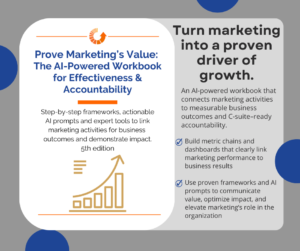
Buy Your Best-Practices Workbook
Anchor Marketing Objectives Directly to Strategic Plan Outcomes
Based on the analysis and the vision, we recommend that the leadership team select a manageable number of key business outcomes – typically no more than 7 to 10. Less can definitely be more when it comes to strategic planning. These are the key outcomes that if accomplished will enable the organization to achieve success. These mission-critical outcomes provide the foundation for the work to be performed and the parameters by which success is measured. They define the company’s priorities and enable the rest of the organization to allocate resources accordingly. Identify the time horizons for each outcome you want to accomplish.

Every Marketing objective should be anchored to one of these outcomes. These business outcomes within the strategic plan serve as the stakes in the ground around which each part of the organization builds its operational plan. Whether you’re in Sales, Marketing, Engineering, Manufacturing, or Customer Service, these outcomes are the starting point for your plan. This is why the strategic plan is so important – it is the cornerstone for action. As you solidify your plan, be sure you have the strategic plan front and center so your objectives and performance metrics are aligned around what matters most to the organization.
Access these additional resources to improve Marketing Alignment. Make sure your Marketing plan meets these 5 criteria. For expert help contact us.
FAQ:
A: Your Marketing plan should be directly anchored to your organization’s strategic plan. Alignment ensures that Marketing efforts support the broader business goals, increasing the likelihood of success.
A: Developing a strategic plan is essential before creating a Marketing plan. The strategic plan unites all parts of the organization around a shared vision of success and guides resource allocation and priorities.
A: The strategic plan defines a future state of success based on market, customer, and competitive analysis, organizational strengths and weaknesses, and potential growth opportunities. It provides a disciplined framework for decision-making in a dynamic environment.
A: Typically, 7 to 10 mission-critical business outcomes are recommended. Focusing on fewer, well-chosen outcomes helps maintain clarity and prioritization.
A: Every Marketing objective must be anchored to at least one key business outcome from the strategic plan. This ensures Marketing activities directly contribute to organizational success and resource alignment.
A: Strategic outcomes serve as “stakes in the ground” for all functions—Sales, Marketing, Engineering, Manufacturing, Customer Service—ensuring cohesive efforts toward shared goals.
A: VisionEdge Marketing offers resources and advisory services to help you align your Marketing plan with your strategic plan effectively, ensuring measurable impact and organizational coherence.
Recent Posts
- Focus on Solving Customer Pain Points to Future-Proof Your Company | What’s Your Edge?
- Customer-Centricity in M&A: The Accelerant for Post-Deal Value
- How Strategic Clarity Drives Growth, Profitability, and Customer Value
- Breaking Through Stagnant Growth with a Customer-Centric, Process-Driven Approach | WYE?
- Why Lack of Accountability is Stalling Your Organization’s Growth


You must be logged in to post a comment.