
Aligning Your Marketing Metrics to Financial Targets
The Marketing metrics you choose and use say a lot about how well Marketing is aligned to the business. Alignment between Marketing and Finance has a bottom-line impact. According to the Marketing 2020 survey, in companies where marketing works closely with finance, more than 40% outperformed expectations. And a study by Active International reported that 77% of CMOs and 76% of CFOs believe it is at least highly important to the company’s success to have alignment with their counterpart, demonstrating this is a shared goal.
But, ONLY 12% of CFOs surveyed rated their CMO as excellent at connecting Marketing initiatives to ROI. Where’s the gap? The CFOs in the Active study ranked financial priorities as the second most important area for alignment, but CMOs ranked this last!
Whether in good or bad economic times, the goal of securing your Marketing budget depends on Marketing’s relationship with the C-Suite, especially the CFO. To keep or expand your Marketing budget, forge a stronger partnership with your Finance colleagues. In many organizations, the relationship between the two organizations is more adversarial than collaborative. A key source of the friction is derived from using the same words to mean different things. For example, consider “brand equity.” The Marketing professional uses this term to describe the health of the brand’s franchise with its key audiences; the Finance professional uses it to characterize the brand as an economic asset. Whatever their differences, Marketing and Finance professionals need to find common ground. The Marketing metrics reflect this common ground.
To Select the Right Marketing Metrics, Get Clarity on What Value is
Marketing and Finance both have well-developed ideas about what value is and how it should be measured. Unfortunately, their ideas are very different. Marketing professionals typically think of value as a customer concept. Value represents the ratio between the perceived benefit that a product or service offers and its cost to the customer, and therefore is a concept external to the customer. Financial professionals link value with the concept of value creation, that is, does this activity earn a sufficient return on our investment?” Viewed from this perspective, value is a financial concept internal to the company.
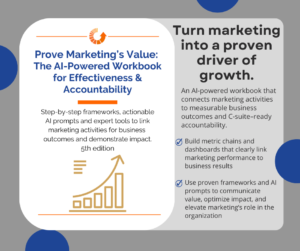
Buy Your Best-Practices Workbook
The two organizations need to integrate their ideas. Focusing on the customer benefit alone risks bankrupting the company. Focusing on minimizing the cost base for a given customer benefit may improve short-term profitability but leaves the company vulnerable to a competitor who redefines the customer value equation.
The first step in forging a viable partnership is to identify the Marketing metrics that have provided a reliable indication of a brand’s ability to generate future cash flow (the criterion for regarding the brand as an economic asset.) The conversation should focus on the conditions under which Marketing initiatives will contribute to growth in the bottom line, not just a temporary increase in the top line. As a result, you create the basis for a productive collaboration between the Marketing and Finance functions.

 Align Marketing Metrics with Financial Targets
Tie Marketing Metrics to Outcomes Linked to Value
Multiple variables can influence the outcome of your Marketing strategy. The goal should be to concentrate on establishing the combination of variables that will produce the desired business outcome from which financial value will be created. Making time to engage in this conversation will go a long way toward improving the quality of the relationship between marketing and finance. Additionally, it provides a rigorous analytical framework within which to explore the financial implications of different market outcomes, and identifies those market strategies that offer the greatest chance of generating both customer and shareholder value.
Maybe you can’t always tie marketing activities back to financial value. That’s okay. The key to gaining collaboration from Finance is to have Marketing metrics aligned with the CFO’s terminology and metrics. This means in addition to outcome based metrics such as
- share of preference
- share of wallet
- win rate
- product adoption rate, and so on.
You will need financially oriented metrics such as customer acquisition costs, customer lifetime value, time to payback, and Marketing contributed and influenced revenue.
In summary, companies where Marketing and Finance are aligned have a better chance of outperforming expectations. Successful Marketing organizations speak “business” and collaborate with Finance by identifying and reporting on metrics that tie back to financial value. Whether you are ready to take the first step in alignment or are fine-tuning your plan, you can find helpful pointers by reading one of our most popular white papers “Charting a Course for Marketing Effectiveness: Alignment and Accountability.”
FAQ:
A: Because the metrics Marketing selects signal how well Marketing is aligned to the business—and Marketing–Finance alignment has measurable performance impact. Research cited indicates companies where Marketing works closely with Finance are more likely to outperform expectations, yet CFO confidence in Marketing’s ability to connect initiatives to ROI remains low.
A: Financial priorities. Research cited suggests CFOs rank financial alignment as a top priority, while CMOs often rank it last. This mismatch undermines credibility, collaboration, and budget confidence—especially when economic conditions tighten.
A: Using the same terms to mean different things. For example, “brand equity” can mean brand franchise health to Marketing, but an economic asset to Finance. Without shared definitions and shared metrics, the relationship becomes adversarial rather than collaborative.
A:
- Marketing view: Value is external and customer-based—the perceived benefit relative to cost.
- Finance view: Value is internal and investment-based—whether an activity earns a sufficient return.
Both are necessary. Customer-benefit focus without financial discipline can bankrupt a company; cost minimization without customer value leaves the firm vulnerable to competitors who redefine the value equation.
A: Identify the Marketing metrics that reliably indicate a brand’s ability to generate future cash flow—because future cash flow is the criterion for treating the brand as an economic asset. Then focus the conversation on conditions under which Marketing initiatives will drive bottom-line growth, not just temporary top-line lift.
A: Concentrate on the combination of variables most likely to produce the desired business outcome that creates financial value. This creates a rigorous analytical framework to explore financial implications of different market outcomes and to prioritize strategies with the best chance of generating both customer and shareholder value.
A: Use a blend of outcome and financially oriented measures, such as:
- Outcome-based: share of preference, share of wallet, win rate, product adoption rate
- Financially oriented: customer acquisition cost (CAC), customer lifetime value (CLV), time to payback, Marketing-contributed and Marketing-influenced revenue
A: That is acceptable. The credibility lever is ensuring Marketing’s metrics align with CFO language and decision needs—so Finance can evaluate tradeoffs, assess risk, and support investment decisions with confidence.
Recent Posts
- Focus on Solving Customer Pain Points to Future-Proof Your Company | What’s Your Edge?
- Customer-Centricity in M&A: The Accelerant for Post-Deal Value
- How Strategic Clarity Drives Growth, Profitability, and Customer Value
- Breaking Through Stagnant Growth with a Customer-Centric, Process-Driven Approach | WYE?
- Why Lack of Accountability is Stalling Your Organization’s Growth


You must be logged in to post a comment.