
It’s Always the Right Time to Work on a Marketing Plan When It’s Designed to Achieve Alignment and Accountability
Limited resources and high expectations make it easy for Marketing leaders to fall into the habit of ready – fire – aim. Of cours,e there are times when immediate action (ready/fire) is needed. The creation of a Marketing plan upon which your organization’s success depends is not one of those times. Taking aim first helps ensure that your Marketing efforts will move the right business needles to create value and that there is enough wood behind your arrow to be successful.
Alignment and accountability help you take aim. Inextricably linked, they are the cornerstones of a successful Marketing plan and thereby the Marketing organization.
Achieve Alignment as the First Step in Your Marketing Plan Process

Every Marketing objective, strategy, program, and associated tactics and activities in your Marketing plan need to ladder up to a quantifiable business outcome. This level of alignment brings the visibility needed to do the right things right because priorities and direction are clarified. When properly formulated, each outcome, objective, and program captures a customer-centric performance target that, when looked at holistically, creates the data chain and metrics needed to measure marketing contribution, and monitor and optimize performance and processes.
Without business alignment, it’s impossible to quantify Marketing’s value and to select the right metrics. Even the most sophisticated data collection and analysis can be completely undermined by poor alignment.
Consider the bottom-up approach to plannin,g some Marketing groups take that focuses on developing programs that include some combination of what’s always been done or what they best know how to do. As a result, programs are disconnected (not aligned) from the business, and metrics fall primarily into activity or output categories, such as number of campaigns or events produced or email open and click through rates. These metrics make quantifying Marketing’s contribution to the business difficult, jeopardizing continued investments and obscuring the steps they should, and shouldn’t, be taking.
Now compare that to the outcome-to-activity approach that Best-in-Class Marketing organizations take to create a Marketing plan. In this approach, they focus on ensuring there is a direct line-of-sight between programs, investments, and the business outcomes. This approach facilitates alignment and enables Marketing to clarify the strategic intent of all the investments it makes and to measure and communicate the degree to which Marketing delivers on its commitments. It also helps determine the Marketing effort and resources required.
Tackle Accountability Next
Once you have alignment, you’re ready to tackle accountability – the measurement and metrics aspects of your Marketing plan. You really cannot optimize your Marketing by skipping metrics and measurement, the foundation for performance management. Understanding the impact of Marketing on your business starts with selecting the right metrics and accurate measurement. When you incorporate the metrics into the plan, you establish the performance targets and relationships that will serve as the building blocks for your dashboard.

 Follow these 7 to develop your Marketing Plan
Follow These 7 Steps for a Successful Marketing Plan
- Alignment: Establish direct-line-of sight between marketing initiatives and investments and business outcomes. Armed with the business outcomes and clarity around how Marketing is expected to impact them, you can develop the appropriate strategy and associated integrated program for alignment.
- Metrics: Create outcome-based metrics and develop and maintain a metrics catalogue.
- Data: Leverage accurate, timely data. Develop a Data Dictionary and Data Source Inventory, Store this information in an accessible format, and update it regularly.
- Analytics: Hone your analytics skills so you can gain insights from your data and build models.
- Performance Setting & Tracking: Commit to setting outcome-based performance targets for every program and track results.
- Dashboard: Produce an actionable Marketing dashboard that quickly and visually conveys your contribution to the organization and facilitates course adjustments.
- Optimization: Keep in mind that continuous improvement takes an iterative process. What you do today will feed back into the process in the future. In this way, we learn from each activity and adjust our future actions accordingly.
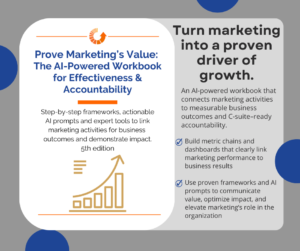
Buy Your Best-Practices Workbook
Choose Your Approach and Get Started Now
It’s never too early to start the planning process, especially if your prior plans have not been successful. Developing and adopting a new planning methodology can be challenging. But from our experience working with many companies across many industries, we know it’s worth it! Here’s what our customer, Safe Systems, had to say after our project with them: “We now have a set of quantifiable outcomes on which to build a more strategic, measurable marketing plan and a set of metrics for the dashboard that more clearly communicates marketing’s impact.”
To help you achieve the same level of success, we have combined proven techniques from the world of quality management and proven practices from our own work into Accelance®, VisionEdge Marketing’s patented methodology. Whether you are a do-it-yourselfer looking for templates or want the individualized approach and objectivity of a personalized engagement, you can find more information here.
FAQ:
A: Because a Marketing plan designed to achieve alignment and accountability prevents “ready–fire–aim” execution. Taking aim first ensures Marketing effort is focused on the right business needles, supported by sufficient resources, and structured to create measurable value.
A: They are the cornerstones. Alignment ensures every objective, strategy, program, and activity ladders up to quantifiable business outcomes. Accountability ensures the plan includes the metrics, targets, and measurement discipline needed to manage performance and prove contribution.
A: Alignment means creating a direct line-of-sight from business outcomes to Marketing objectives to programs and investments to tactics and activities—so Marketing can demonstrate contribution, prioritize correctly, and build a chain of metrics that connects actions to outcomes.
A: Because without business alignment, it’s impossible to quantify Marketing’s value or select the right metrics. Even sophisticated data collection and analytics can be undermined if Marketing initiatives are disconnected from business outcomes.
A:
- Bottom-up planning starts with programs based on what’s been done before or what the team prefers to execute. This often produces disconnected efforts and metrics that skew toward activity/output (campaign counts, event volume, opens/clicks), making contribution hard to prove.
- Outcome-to-activity planning starts with business outcomes and builds downward to strategies, programs, and activities. Best-in-Class organizations use this approach to clarify strategic intent, determine required resources, and measure performance against commitments.
A: Accountability is the measurement discipline embedded in the plan: selecting outcome-based metrics, defining performance targets, establishing metric relationships, and using those building blocks to create an actionable dashboard for performance management and course correction.
A:
- Alignment: Establish direct line-of-sight between Marketing initiatives/investments and business outcomes.
- Metrics: Create outcome-based metrics and maintain a metrics catalog.
- Data: Ensure accurate, timely data; build a Data Dictionary and Data Source Inventory and keep them updated.
- Analytics: Build analytics capability to generate insights and models.
- Performance setting & tracking: Set outcome-based targets for every program and track results.
- Dashboard: Produce an actionable dashboard that communicates Marketing’s contribution and supports adjustments.
- Optimization: Use an iterative continuous-improvement loop—learn from results and refine future actions.
A: Clients report that outcome-based planning produces quantifiable outcomes, stronger strategic clarity, and clearer dashboard metrics that communicate Marketing’s impact. For example, Safe Systems reported gaining quantifiable outcomes and metrics that enabled a more strategic, measurable plan and clearer impact reporting.
A: Start now—earlier is better. Adopting a new planning methodology can be challenging, but alignment-first planning paired with accountability practices improves focus, measurability, and the likelihood of securing resources and delivering business impact.
Recent Posts
- Focus on Solving Customer Pain Points to Future-Proof Your Company | What’s Your Edge?
- Customer-Centricity in M&A: The Accelerant for Post-Deal Value
- How Strategic Clarity Drives Growth, Profitability, and Customer Value
- Breaking Through Stagnant Growth with a Customer-Centric, Process-Driven Approach | WYE?
- Why Lack of Accountability is Stalling Your Organization’s Growth


You must be logged in to post a comment.