
As the pace of marketing transformation accelerates, marketers are tackling the hardest task of all: seizing the role of value creator. We concur with Eric Jorgenson that value creation is the foundation for business. It is among Marketing’s fundamental mission.

Value creation involves bringing a new or improved product or service to market; the ability to find a solution to a vexing customer problem; or the way a new product or service is sold and delivered. All of these fall within the realm of Marketing.
Become obsessed with value. With how you define and measure it. Consider what changes you need to create value? What new capabilities, products, or service your organization need to bring value to your customers?
Being a value creator is not some vague concept. When you focus on creating value, you build muscles that will help you make the right decisions about your products and services and improve the way you connect with your customers.
Take Steps to Become a Value Creator
The annual Marketing Performance Management (MPM) benchmark studies serve as an excellent catalyst for internal conversations with your leadership team, peers, and partners in the organization, and the Marketing team. The results provide a valuable way to benchmark your capabilities against those of your Marketing organizations in other companies, and over time.
Here’s what we know about the best practices of marketers who receive an “A” and earn the title of Value Creator:
- Despite advances in data, analytics, and technology, only about 1 in 4 marketers received or gave themselves an “A” in terms of their ability to determine their impact on the business. Will you be among the A’s this year?
- They are much better at measuring and reporting their value to the business. How does/will your marketing organization measure up?
- They serve as business value creators, making market and offering decisions that create value for both customers and shareholders. They outperform their peers. Specifically, 63% of companies with A marketers reported increased customer share of wallet compared to 48% with marketers in the middle of the pack and 38% with laggards. As for new business growth, 54% of the companies with A marketers confirmed improvements in their win rates compared to 39 and 25% with the middle of the pack and laggard marketers, respectively.
- There are a number of things that separate the A marketers from the rest of the pack. In particular, they:
- Make performance management a priority
- Have a well-defined and documented roadmap for continuous performance improvement
- Select metrics that measure business outcomes rather than effort and activity
- Build dashboards that effectively communicate business outcomes and marketing results
- Establish marketing centers of excellence in their organizations.
- Facilitate rapid-decision making and execution
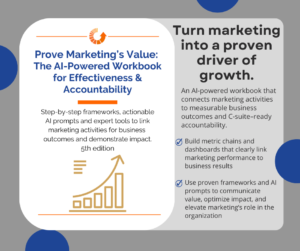
Buy Your Best-Practices Workbook
Here’s what you can learn from these Value Creators:
- Create Direct Line of Sight Between Your Activities and Business Outcomes. Marketers earning A’s are superior at aligning their Marketing objectives with business priorities, enabling them to select the right metrics.
- Work Closely with Your CEO and CFO. The A’s are twice as likely to be working directly with the CEO and CFO, and 50% more likely to understand what is most important to these senior executives. They perceive themselves as business people first, marketers second.
- Select Outcome-based Metrics. Most marketers are capable of measuring activity-based metrics: the number of articles published, email campaigns sent, or how many blog posts they produced. Only a few marketers are able to measure and track how their activity-based efforts are impacting business outcomes: Market Share, Adoption Rates, and Pipeline Contribution. There is a big difference between a marketer who produces campaigns and reports with activity-based metrics and a marketer who produces campaigns and reports with outcome-based metrics. The studies show that the marketers who earn the A report outcome-based metrics far more than their peers.
- Create Actionable Dashboards. “A” Marketers use Actionable Dashboards to boost marketing’s effectiveness, communicate impact on the business, and secure additional budget. An Actionable Dashboard must:
- Analyze the performance of campaigns or other marketing activities.
- Track the performance of core marketing strategies and processes.
- Monitor and measure marketing objectives aligned to business outcomes.
- Track Marketing Metrics in Real Time.
- Enable the C-Suite to make business decisions.
Now that you know what A marketers do, find out if you’re part of this elite group of marketers when it comes to Proving Marketing’s Value. Download the MPM benchmark study reports – they’re free.
FAQ:
A: It means Marketing moves beyond execution and promotion to become a driver of enterprise value—shaping what is brought to market, how customer problems are solved, and how offerings are sold and delivered. Value creation is not peripheral to Marketing; it is part of Marketing’s fundamental mission.
A: Value creation includes bringing a new or improved product/service to market, solving a vexing customer problem, and improving the way an offering is positioned, sold, and delivered. It also requires being explicit about how value is defined and measured—so decisions become sharper and customer connection becomes stronger.
A: They provide a catalyst for leadership and cross-functional conversations by benchmarking Marketing capabilities against peers and tracking improvement over time. They also create a structured way to identify gaps, prioritize capability building, and build a roadmap for performance improvement.
A: Research cited indicates A marketers are stronger at proving impact, measuring and reporting value, and making market and offering decisions that create value for customers and shareholders. They outperform peers on commercial outcomes such as share-of-wallet growth and win-rate improvement.
A: A marketers typically:
- Make performance management a priority
- Maintain a documented roadmap for continuous improvement
- Select metrics that measure business outcomes (not just effort/activity)
- Build dashboards that communicate outcomes and results clearly
- Establish Marketing Centers of Excellence
- Facilitate rapid decision-making and execution
A:
- Create direct line of sight between activities and business outcomes: Alignment enables smarter metric selection and clearer accountability.
- Work closely with the CEO and CFO: Value creators understand senior executive priorities and operate as business leaders first.
- Select outcome-based metrics: Move beyond counting outputs (emails sent, posts published) to tracking impact on outcomes (market share, adoption, pipeline contribution).
- Build actionable dashboards: Dashboards should analyze campaign performance, track core strategies/processes, monitor objectives aligned to business outcomes, provide near real-time visibility, and enable executive decision-making.
A: Becoming a value creator is a capability choice: define value, measure outcomes, align to business priorities, build decision-grade dashboards, and partner tightly with Finance and the CEO—so Marketing is seen and managed as a growth and value engine.
Recent Posts
- Focus on Solving Customer Pain Points to Future-Proof Your Company | What’s Your Edge?
- Customer-Centricity in M&A: The Accelerant for Post-Deal Value
- How Strategic Clarity Drives Growth, Profitability, and Customer Value
- Breaking Through Stagnant Growth with a Customer-Centric, Process-Driven Approach | WYE?
- Why Lack of Accountability is Stalling Your Organization’s Growth


You must be logged in to post a comment.