
You wouldn’t agree to play a card game if cards were missing from the deck because the odds of winning would be significantly diminished. Yet surprisingly, many marketers implement marketing programs without the benefit of analytics. The CMOSurvey.org found that only about 30% of Marketing orgs use analytics before they make a program decision!
Many of the marketers we meet at Marketing conferences are talking enthusiastically about how to make websites, SEO, social media, email campaigns, and mobile better. However, there is very little conversation about how they are using analytics. Turning to the CMOSurvey.org study again, one reason may be the study findings, “that marketers are still challenged to maximize the potential value of analytics.”
Marketers, analytics is not an option. Analytics is an essential card — actually an ace — that every marketer needs in their deck. Analytics is what enables you to make fact-based decisions and improve performance, and most importantly, work smarter.

Add to the Power of Your Analytics
While the ace alone has value, when played with other cards its power is optimized. When it comes to analytics, the other card is data. Yes, quality data is elusive but you absolutely cannot improve and prove the value of Marketing, make program, market, product, and customer decisions without it. To harness the power of your analytics card, identify your data issues and create a plan to address them.
A good way to start is by reading our white papers, starting with “Marketing Analytics Centers of Excellence – Fueling Corporate Growth” and “Intuition to Wisdom: Transforming Data Into Models and Actionable Insights.”
Don’t Let Your Luck Run Out
Another reason that you may overlook this missing card in your deck is that guessing or gut instinct has been working well enough. Certainly, experience should weigh into the equation when making critical decisions, but, today there is simply too much at stake to overlook factual data-backed information. Data backs up your intuition and experience.
Unfortunately, this approach may not suffice in the long term, and your luck may run out as organizations push to make “smart” decisions. Danny Kahneman’s book Thinking Fast and Slow suggests that human experts are “overconfident, inconsistent, and subject to a swarm of thoroughly documented biases.” Intuition is still very powerful, but when you add in insights from data, it’s a hard combination to beat.
These three important advantages of weaving data analytics into your decision-making:
- Better risk management: Data analytics help us avoid certain risks and enable us to quickly detect patterns that alert us to potential risk.
- Effective and efficient marketing: Using data analytics helps develop more effective marketing programs, improve segmentation and targeting, and determine which programs are worth further investment.
- Improved customer experience: Analytics provides us with insights into customer purchasing decisions, behaviors, and product needs so we can create better experiences across the entire customer life cycle. This translates into improved engagement, reduced sales costs and cycles, improved adoption rates, customer expansion, and referrals.
As marketers, analytics is our opportunity to bring these advantages to the table. When we use analytics, we can bring new insights about customers, markets, competitors, products, channels, and marketing strategy, programs, and mix to the conversation, paving the way for a more strategic role.
Analytics in Marketing is here for the duration. Marketers with analytical acumen will be in great demand. According to some resources, the complexities of data analysis and management are becoming so enormous that there is a shortage of people who are able to conduct analysis and present the results as actionable information. Taking the initiative and honing your analytical capabilities will enable you to make sure you have this ace in the deck — and preferably, in your hand.
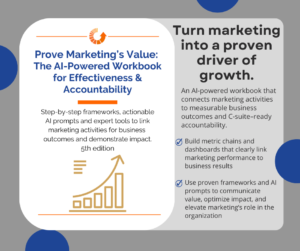
Buy Your Best-Practices Workbook
Yes, we know, most of us are working with a time and resource deficit. Even so, make time each quarter to bolster your analytical skills. Attend a conference, read a book, take a class, and bring in experts from whom you can learn. Here are seven key analytical concepts and skills every marketer should have in their arsenal:
- Quantitative Decision Analysis
- Data Management
- Data Modeling
- Industry and Competitive Analysis
- Statistical Analysis
- Predictive Analytics and Models
- Marketing Measurement and Dashboard
If you can build your analytics strength, you’ll always have an ace in your pocket. Are you ready to start building your analytical muscle? Start by reading our white paper “Marketing Analytics Centers of Excellence – Fueling Corporate Growth” and then Contact Us to discover the specific areas you and your organization need to focus on.
FAQ:
A: Because it’s like playing a card game with missing cards—your odds of winning drop. Yet many organizations still make program decisions without analytics. CMOSurvey.org reports only about 30% of Marketing organizations use analytics before making a program decision.
A: Many marketers focus on optimizing websites, SEO, social media, email, and mobile, but do not apply analytics with the same rigor. CMOSurvey.org suggests a key reason: marketers are still challenged to maximize the potential value of analytics.
A: Because analytics enables fact-based decisions, performance improvement, and smarter work. In today’s environment, analytics is not optional—it is essential for proving and improving Marketing’s value and for making better program, market, product, and customer decisions.
A: Data. Analytics is only as strong as the quality and accessibility of the data behind it. To harness analytics, identify your data issues and create a plan to address them—because you cannot prove value or optimize decisions without reliable data.
A: Experience still matters, but the stakes are higher and the environment is more complex. Data-backed insight strengthens intuition. In Thinking, Fast and Slow, Daniel Kahneman notes that human experts can be overconfident, inconsistent, and subject to documented biases—making analytics a necessary counterbalance.
A:
- Better risk management: Detect patterns early and identify potential risks sooner.
- More effective and efficient Marketing: Improve segmentation and targeting, optimize programs, and decide what merits further investment.
- Improved customer experience: Understand purchasing behavior and needs to improve lifecycle experiences—driving engagement, adoption, expansion, and referrals while reducing sales costs and cycle time.
A: Analytics allows Marketing to bring decision-grade insight about customers, markets, competitors, products, channels, and mix to leadership conversations—improving investment decisions and strengthening Marketing’s credibility and influence.
A: Because data analysis and management complexity is increasing and organizations face a shortage of people who can conduct analysis and translate results into actionable information. Analytical acumen is becoming a differentiator for both marketers and Marketing organizations.
A: Make time each quarter to build skills—read, take a class, attend a conference, and learn from experts. Treat analytics capability-building as a recurring investment, not a one-time initiative.
A:
- Quantitative decision analysis
- Data management
- Data modeling
- Industry and competitive analysis
- Statistical analysis
- Predictive analytics and models
- Marketing measurement and dashboards
Recent Posts
- Focus on Solving Customer Pain Points to Future-Proof Your Company | What’s Your Edge?
- Customer-Centricity in M&A: The Accelerant for Post-Deal Value
- How Strategic Clarity Drives Growth, Profitability, and Customer Value
- Breaking Through Stagnant Growth with a Customer-Centric, Process-Driven Approach | WYE?
- Why Lack of Accountability is Stalling Your Organization’s Growth


You must be logged in to post a comment.