

 To know whether Marketing is working, we need to align Marketing with measurable outcomes
Marketers need to measure to provide focus, to guide direction and to facilitate action. And of course to justify budgets. Metrics provide Marketing with a way to document real results compared to what we thought we were going to have and to prove value and impact. The challenge is that the list of marketing metrics has become nearly limitless.
There are so many things we can measure where do we start? The list of metrics ranges from customer satisfaction and loyalty, to rate of new customer acquisition and win/loss rate, to program payback, to open rates, fans, followers, reads, shares, likes, engagement, referrals, well you get the idea. Entire books are now being written on the subject, not to mention our own book, Measure What Matters, published in 2004 (thankfully ahead of the pack.) followed by Metrics in Action.
While the numerous amount of metrics is overwhelming, CMOs, you cannot opt out. Peter Drucker’s comment “If you can’t measure it, you can’t manage it,” still applies. Defining a good strategy or program means in some way we must define how good will be measured. To know whether Marketing is working, we need to align Marketing with well defined measurable business outcomes and establish customer-centric performance targets to measure against.
Six Criteria for a Good Marketing Metrics
Best-in-class marketers are skilled at selecting the right metrics. The first skill is making sure every metric meets the following six criteria:
- actionable
- simple
- manageable
- easily processed
- easily understood
- mix of positive and negative categories
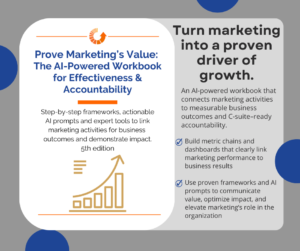
Buy Your Best-Practices Workbook
Marketing Metrics of the BIC are Customer-Centric
Leaders of Marketing organization dedicated to creating value for the company enable Marketing to serve in a more strategic role. The CMOs develop, articulate, and implement a customer-centric vision. To insure the customer-centric vision takes root you need to establish clear metrics that are linked to the company’s strategic, operational and financial goals. These metrics help determine priorities and shift the orientation of the company toward a more customer-centered business model.
Choose Marketing metrics that fit the vision and business model you create. Customer-centric CMOs choose at least one metric from each of the following categories:
- Customer metrics. These are metrics related to acquiring, keeping and growing the value of customers. Some common metrics in this category include new customer acquisition, net new deals, upgrades, renewals, share of wallet, loyalty, lifetime value, retention rates, churn rates, and so on.
- Engagement Conversion metrics: These are metrics related to channel and sales force metrics such as share of shelf, pipeline analysis (leads, cost/lead, coverage, etc), win/loss rate.
- Competitive metrics. These are metrics that provide some level of insight into how your company stacks up against others in your industry. Some metrics often looked at in the category include rate of customer acquisition, market share and growth rate comparisons by industry/vertical, by geography, etc. Win/loss metrics fall into this category as well.
- Customer Value metrics. These are metrics that provide information about whether the value of your existing customers are growing. Loyalty, share of wallet, referral rates, retention and churn rates, rate of profitable customer growth, lifetime value are all examples of metrics that fall into this category.
- Market Value Index. This is an actual index compares the market’s perception on how well you company is performing versus competitors across critical purchasing criteria and other value attributes to that of competitors. Metrics related to brand equity, share of brand preference, customer franchise value fall into this category.
- Product Innovation metrics. These metrics provide data points to help assess whether the company’s innovation engine is on track and whether the products the company is betting on are sustaining or propelling growth. Metrics often used in this category include rate of product adoption, trial rates, time to market and revenue for new products.
- Product and portfolio metrics: These are metrics related to the current portfolio such as unit growth, adoption rates, attach rates, price premium, margins, and average selling price.
- Cash flow metrics: These metrics focus on efficiency of marketing expenditures, such as budget performance, program and campaign payback and promotion redemption rates and payback.
Smart CMOs Display Metrics on a Dashboard Not a Smorgasbord

 CMOs and Marketing Leaders select and report on metrics relevant to the business.
The formats of Marketing dashboards vary as much as the metrics Marketers report. No matter the format, a good Marketing dashboard report on Marketing’s performance against agreed upon targets, its impact and contribution to the business, and facilitates decisions. We are often asked what metrics should go on the dashboard.
There isn’t a cookie-cutter recipe. The metrics categories however must find their place on every marketing dashboard. Each set of measures provides a view into Marketing’s effectiveness from a different angle. Each metric chosen from the category provides an important piece in creating the big picture. The purpose of the dashboard is to structure various metrics into a comprehensive, organized, graphical view.
Alignment is the key to your metrics and the framework for your dashboard. Once you have a measurable customer-centric outcome based Marketing plan, the metrics chains will emerge. These chains become the foundation for your marketing dashboard. Your chains most likely will include some combination from the eight metrics categories.
FAQ:
A: Measurement provides focus, guides direction, facilitates action, and justifies budgets. Metrics enable Marketing to document real results, prove value, and align strategies with business outcomes.
A: Every metric should meet six criteria:
- Actionable
- Simple
- Manageable
- Easily processed
- Easily understood
- Balanced between positive and negative indicators
A:
- Customer metrics: Acquisition, retention, loyalty, share of wallet, lifetime value, churn, renewals
- Engagement/Conversion metrics: Pipeline analysis, win/loss rates, channel performance
- Competitive metrics: Market share, industry growth comparisons, rate of customer acquisition
- Customer Value metrics: Growth in customer value, referral rates, profitable customer growth
- Market Value Index: Brand equity, brand preference, customer franchise value
- Product Innovation metrics: Adoption rates, trial rates, time to market, new product revenue
- Product/Portfolio metrics: Unit growth, attach rates, price premium, margins
- Cash Flow metrics: Budget efficiency, campaign payback, promotion redemption rates
A: Use a Marketing dashboard to report performance against targets, demonstrate impact, and facilitate decision-making. Dashboards should structure metrics into a clear, organized, and graphical view—not a smorgasbord—focused on agreed-upon business outcomes.
A: Alignment with measurable, customer-centric business outcomes ensures metrics are relevant and actionable. Metrics chains—linking activities to outcomes—form the foundation for effective dashboards and continuous improvement.
A: VisionEdge Marketing offers expertise in metrics strategy, dashboard design, and measurement frameworks to help Marketing organizations demonstrate value and drive business results.
Recent Posts
- Focus on Solving Customer Pain Points to Future-Proof Your Company | What’s Your Edge?
- Customer-Centricity in M&A: The Accelerant for Post-Deal Value
- How Strategic Clarity Drives Growth, Profitability, and Customer Value
- Breaking Through Stagnant Growth with a Customer-Centric, Process-Driven Approach | WYE?
- Why Lack of Accountability is Stalling Your Organization’s Growth


You must be logged in to post a comment.