

Contextual data adds another valuable dimension to your customer-based models and creates an opportunity to enhance customer engagement. A study conducted by Walker entitled, ‘Customers 2020’, predicted how customer expectations are most likely to evolve.
Among the key predictions is that customers will demand a more personalized experience and expect companies to be more proactive and better at anticipating their current and future needs. We can all agree that this study and others that emphasize that today’s customer is in the driver’s seat are on the right track.
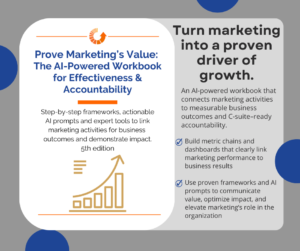
Buy Your Best-Practices Workbook
Deepening Customer Experience and Engagement Takes Data
For those of us participating in a competitive and crowded market, we recognize that customer experience and engagement are essential for differentiation and critical to survival. We need to leverage today’s access to data and use that data to understand and impact customer behavior.
There are various types of data, for example, past customer behavioral data and current contextual data. Contextual data provides additional behavior data to support model development. Models such as opportunity scoring and predisposition to purchase models.
If you find yourself with an ad popping up on your mobile device to purchase an item shortly after visiting the site, you are experiencing the use of contextual data. As your customers and prospects visit websites, conduct searches, use social media platforms, you gain insight into product preferences, usage, interactions, peer groups (for example, LinkedIn Groups), opinions (all those likes, comment and retweets), budget, and pain points.
Contextual Data Informs Buyer Intent and Preferences
Once you have the data, the next step is to use it effectively in your model development. Let’s use your opportunity scoring models to illustrate the idea. The purpose of opportunity scoring is to help salespeople know which opportunities are sales-ready and worthy, and therefore take priority. Essentially, a scoring model assigns a predetermined numerical score to specific behaviors or statuses within a database. Often, variables such as title, company, and industry serve as the basis for the scoring model. Behaviors can be used too, such as the completion of a contact form, visiting a particular page on the website, participating in or viewing a demo, etc. These behaviors form the basis of “context.”
When you tie contextual data with audience or user data, marketers can begin to understand buyer intent. As you collect contextual data about the products they currently use, the last time they purchased, their complete buying history, the types of keywords they used in their search, etc. you can improve personalization, targeting, and channel decisions. This type of analysis leads to better optimized and targeted Marketing programs and campaigns.
The end goal of contextual data is to connect with the buyer when they are most predisposed to buy. Propensity to purchase models are another good usage of contextual data. By using contextual data to build your propensity to purchase models, you are better able to develop more personalized messages and select the best mix of channels. By identifying the winning experiences associated with a particular segment, you can use this information to craft more relevant messages to similar targets to increase uptake.
Applying Contextual Data to Your Models
As you can see, contextual data adds another dimension to your marketing models. However, as with all models, data and application are everything. To be effective, contextual data must be delivered to the right person, at the right time,

 Incorporate Contextual Data into Your Models
within an actionable context. For example, for your opportunity scoring model, the date of a key customer’s contract renewal is posted in your CRM system all year long. Think how much more useful that data becomes when your system automatically alerts you to the fact that it’s the customer’s renewal date. Sending email messages about renewals too early just creates noise at best and, at worst, suggests you don’t know their renewal date. Customers are more likely to respond to a call to action when it is in the context of their workflow.
Your marketing automation system makes it easier to capture behavioral data. A Forrester study of 157 US-based marketing professionals, entitled Use Behavioral Marketing to Up the Ante in the Age of the Customer, found that marketers who have adopted behavioral marketing practices and technologies have achieved significant results ranging from higher return on marketing investment (ROMI) to higher contributions to sales pipelines and revenue. Forrester also found that B2B behavioral marketers attribute 34% of their total sales pipeline to behavioral marketing – nearly 10% higher than their peers at 26%.
However, most marketers and industry professionals are finding that the basic use of marketing automation is insufficient for persuading today’s B2B decision-makers, and that relevancy is key. Achieving relevancy can be difficult, however. A BtoB Magazine survey found that the ability to reach the right buyer at the right time ranked as the No. 2 challenge among US B2B marketers. This is why we need to understand contextual data.
Communication that is contextual is more personal and, as a result, feels more authentic, shows value, and leads customers to want to act. As a result, you can reduce the cost of customer acquisition and the cost of sales. By adding contextual data into model development, you can make your Marketing programs more effective and more relevant.
Contextual data is a compelling and challenging opportunity. As you learn more, your models evolve. Therefore, you are often in a test and learn approach. Is this idea worth further exploration? Let’s have a conversation.
FAQ:
A: Contextual data is “in-the-moment” behavioral and situational information that adds a valuable dimension to customer-based models. It strengthens your ability to personalize engagement, anticipate needs, and improve the relevance of marketing actions.
A: Research cited (Walker, Customers 2020) predicts customers will demand more personalized experiences and expect companies to be proactive in anticipating current and future needs. This raises the bar for relevance, timing, and usefulness.
A: Past behavioral data reflects historical actions; contextual data captures current signals from real-time interactions—searches, site visits, social engagement, content consumption, peer communities, and other indicators that reveal intent and preference.
A: Website behavior (page visits, repeat visits), form completions, demo participation, search keywords, social activity (likes, comments, shares), peer group affiliations (e.g., LinkedIn Groups), product usage indicators, purchase timing, and buying history.
A: Opportunity scoring assigns numerical values to behaviors and statuses to identify sales-ready opportunities. Contextual behaviors (e.g., visiting key pages, viewing a demo, completing a form) enhance scoring beyond static variables like title, company, and industry—improving prioritization for Sales.
A: When contextual data is tied to audience/user data (e.g., products used, last purchase date, renewal timing, keyword behavior), it clarifies intent and improves personalization, targeting, and channel selection—resulting in more optimized campaigns.
A: It helps identify when buyers are most predisposed to act. By linking contextual signals to “winning experiences” for a segment, marketers can craft more relevant messages and select the best channel mix to increase uptake among similar targets.
A: Contextual data must reach the right person at the right time within an actionable workflow context. The pitfall is creating noise—e.g., sending renewal messages too early or without recognizing the actual renewal date. Relevance and timing drive authenticity, action, and lower acquisition and sales costs.
Recent Posts
- Focus on Solving Customer Pain Points to Future-Proof Your Company | What’s Your Edge?
- Customer-Centricity in M&A: The Accelerant for Post-Deal Value
- How Strategic Clarity Drives Growth, Profitability, and Customer Value
- Breaking Through Stagnant Growth with a Customer-Centric, Process-Driven Approach | WYE?
- Why Lack of Accountability is Stalling Your Organization’s Growth


You must be logged in to post a comment.