
Marketers, Get Your Data Back
I’ll just put it bluntly: there’s a wealth of customer data your company is letting go to waste.
We’ve all read the IBM study that says “every day, we create 2.5 quintillion bytes of data — so much that 90% of the data in the world today has been created in the last two years alone.” But, did you see the IDC study estimates that 80% of customer data is wasted due to immature enterprise data “value chains”

 Data is the essential ingredient for wisdom.
The waste is a result of data existing in siloes throughout the organization. You’ve probably had the experience of needing customer spend information to help develop a customer segmentation campaign designed to increase share of wallet. But you didn’t have the spending data by customer. Where is it? Most likely in the finance department because that’s where accounts payable and accounts receivable applications store customer invoices and payments. Why should you care if the data is siloed and inaccessible? Because data management, integration, and quality are the cornerstones for customer analytics – they are the source of wisdom. And customer analytics are critical to your company’s performance. In fact, a McKinsey study found that 50% of companies that champion customer analytics are likely to have sales significantly above their competitors, and that 49% of companies that champion the use of customer analytics are likely to have profit well above their competitors – the source of wealth.
Marketers need as much accurate data as possible to perform analytics that provide insight into what content and channels resonate with which customers. When you miss the mark, you pay a high price. According to a Gigya survey, “after receiving irrelevant information from a brand, 43% of customers ignore all future communications, 67% of US and UK customers unsubscribed from an email list, 30% stopped visiting the company’s website or mobile app, and 20% stopped buying products from the company.” Ouch!
Ready to take action? Then, to paraphrase H&R Block, get your data back, marketers! If the data has anything to do with customers, then marketers, you need to be in the know.
How to Go from Waste to Wisdom and Wealth

 Marketers need as much accurate data as possible to perform analytics that provide insight into what content and channels resonate with which customers.
You realize you’re sitting on a pile of wasted data that, if utilized properly, contains wealth-generating wisdom. What do you? Start with these three steps.
- Put the Data in Play. Whether the data lies dormant within a siloed system or you have it at your fingertips, it will still go to waste if you don’t have the skills, processes, and tools in place to do something with the data. While the data is crucial to the analytics, it’s all for naught if you don’t know what questions to ask and how to use the data to answer the questions. For example, what good is it to create a cross-sell campaign if you don’t know what products/services your customers are currently using, their purchase history, and their content preferences? Hiring experts to help you sort through the data can make all the difference.
- Identify What Customer Data You Have and Need. In the words of Kathleen Schaub, vice president of IDC’s CMO Advisory Service, “marketers need to think about what it means to know everything about customers, then identify the most valuable pieces and figure out how to get them.” Your first order of business is to create a data inventory. Before you can use analytics to derive actionable insights, you need to know what data you have, where, and in what format; what data you need and where it is located; and what data is missing. Capture all of this information in your data inventory.
- Gain Access to the Data. Once you have the data inventory, the next step is to identify whether marketing has access to this data. Magical things occur when marketers have access to the data. Forrester Research published a case study describing how USAA’s new partnership between marketing, finance, and analytics has helped deliver better business insights. Data can be power, so be clear with your counterparts on how you will use your access to the data to positively impact customers and business performance.
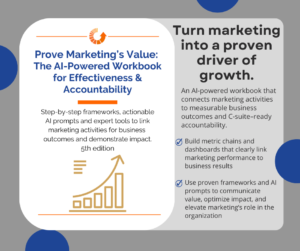
Buy Your Best-Practices Workbook
As you work to incorporate unused and missing data into your marketing analytics, you’ll be in a better position to improve customer engagement and experience. Additionally, you will be better able to communicate the role marketing plays in delivering value to customers and the business.
Learn more about transforming data into wisdom and wealth with this white paper, Intuition to Wisdom: Transforming Data into Models and Actionable Insights.
FAQ:
A: It means recognizing that a wealth of customer data is being wasted and taking action to make it accessible, usable, and decision-relevant—so Marketing can generate insights, improve customer engagement, and prove value.
A: IDC estimates that 80% of customer data is wasted due to immature enterprise data “value chains.” The waste often occurs because data lives in siloes across the organization, making it hard to find, integrate, and use.
A: Because siloed data blocks customer analytics—the source of insight and “wisdom.” For example, Marketing may need customer spend data to segment and grow share of wallet, but that data may sit in Finance systems (AP/AR invoices and payments). Without integration, access, and quality, Marketing cannot connect customer behavior to content, channels, and outcomes.
A: Customer analytics are linked to competitive advantage. A McKinsey study found that:
- 50% of companies that champion customer analytics are likely to have sales significantly above competitors
- 49% are likely to have profit well above competitors
In other words, analytics can be a source of “wealth.”
A: It is substantial. A Gigya survey reported that after receiving irrelevant information from a brand:
- 43% of customers ignore all future communications
- 67% of US/UK customers unsubscribed from an email list
- 30% stopped visiting the company’s website or mobile app
- 20% stopped buying products
This is why accurate data and analytics matter—relevance protects revenue.
A: Start with three steps:
- Put the data in play: Data still goes to waste without the skills, processes, and tools to use it. Analytics requires asking the right questions and using data to answer them (e.g., cross-sell requires product usage, purchase history, and content preferences). Experts can accelerate progress.
- Identify what customer data you have and need: Create a data inventory—what data exists, where it lives, formats, what you need, and what is missing.
- Gain access to the data: Use the inventory to determine whether Marketing has access. Cross-functional partnerships (e.g., Marketing + Finance + Analytics) can unlock better business insights; be explicit about how access will be used to improve customers and performance.
A: Marketing becomes better able to improve customer engagement and experience—and to communicate and prove the role Marketing plays in delivering value to customers and the business.
Recent Posts
- Focus on Solving Customer Pain Points to Future-Proof Your Company | What’s Your Edge?
- Customer-Centricity in M&A: The Accelerant for Post-Deal Value
- How Strategic Clarity Drives Growth, Profitability, and Customer Value
- Breaking Through Stagnant Growth with a Customer-Centric, Process-Driven Approach | WYE?
- Why Lack of Accountability is Stalling Your Organization’s Growth


You must be logged in to post a comment.