
You’ve probably heard or read this stanza from Samuel Taylor Coleridge’s “The Rime of the Ancient Mariner”: “Water, water, everywhere, / And all the boards did shrink; / Water, water, everywhere, / Nor any drop to drink.”
Are you wondering what that quote has to do with Marketing? Like the volume of water in the world’s oceans, the volume of data available to marketers is simply overwhelming.
Many Marketing organizations are employing data scientists to capture, manipulate, and transform data into meaning. Why? More new channels, competition, and distinct segments to manage, as well as shorter product lifecycles, greater price transparency, and higher customer experience expectations, are creating an exponential increase in the amount of available market, customer, and competitive data.
Data may hold tremendous amounts of potential value, but this value can only be realized when actionable insights are uncovered and used to produce business outcomes. Once you collect, analyze, and transform into meaningful and actionable insights, the next step is to create a compelling, actionable story.
Data Skills Vital to Marketing
A study from the Economist Intelligence Unit (EIU) revealed that business leaders rate creating a data strategy for Marketing and predictive analytics as one of Marketing’s most important priorities. Survey participants suggested that Marketing pros often lack the data science and business analytics skills to extract valuable, actionable insights from both large and small data sets—and that many organizations lack an information, technology, and data science strategy. The CMO Survey study found that “marketers are still challenged to maximize the potential value of analytics.”
 That capability gap has created enormous opportunities for data scientists from other disciplines to join the ranks of marketers. The demand for data scientists has skyrocketed (Harvard Business Review termed it the “sexiest job of the 21st century”).
For Marketing executives who do not yet have this role on staff, here is a short job/skills description. Data scientists capture, manipulate, and transform data to create meaning. They need superb technical skills, such as the ability to devise algorithmic solutions to solve complex business problems. Ideally, data scientists employ both internal and external data and structured and unstructured data to help an organization make better decisions and gain a competitive advantage.
Storytelling as Data Skill
When you can translate the vast volume of data into consumable information, business leaders can make smarter decisions. This is the ultimate challenge for data scientists – to use the data to create stories that can be used to support business decisions. Data scientists worth their salt can use spreadsheets and visualization tools to support analysis. Their real value lies in their ability to transform the data into a narrative experience for both internal and external communication.
Johnathan Harris, the creator of We Feel Fine, and Whale Hunt, reminds us that “the data is just part of the story.” He adds, “I think people have begun to forget how powerful human
stories are, exchanging their sense of empathy for a fetishistic fascination with data, networks, patterns, and total information… The human stuff is the main stuff, and the data should enrich it.”
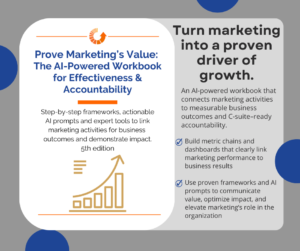
Buy Your Best-Practices Workbook
Five Tips for Data Storytelling
Many Marketing executives we work with have asked us for ideas on how to help their data scientists go beyond the data to become storytellers.
Here are five coaching tips for doing just that:
- Start with the business question that needs to be answered (think of it as a mystery to be solved), such as which customers are most likely to buy a particular product/service, or what is the next best vertical segment to pursue, or what are the key customer touchpoints that are affecting customer experience post-sale? Knowing the answers is what helps you make the story relevant to your audience.
- Ask the right questions about your data to collect the “evidence” needed to solve the mystery. Trying to glean insights from the abundance of data without the business
 questions may take you down numerous rabbit holes.
 - Craft the story, set the stage, and identify the characters, such as which customers or which competitors. Make the narrative clear and memorable. A good story has a plot—are you a challenger in an established market or the category leader facing niche players nipping at your heels? It is essential that the story inspire action and/or have a compelling takeaway. Convey the intentions and perceptions of the characters.
- Decide what data to include and organize the data to complement the narrative, support the characters, and reveal the plot. Most people cannot discern the salient points from tables. They need pictures. Visualize the data so it captivates the audience. Visualization is the process of telling a story via the graphical depiction of statistical information. Daniel Waisberg, analytics advocate at Google, says, “Good data visualization stands on its own.”
- Adapt the story to fit the audience. The language, tone, and focus may need to be adjusted depending on who is hearing the story. The C-suite may prefer a shorter version of the story—just the highlights and recommended action. The person responsible for developing the action plan may want a more in-depth version of the story, along with an understanding of the interrelationships of all the players and pieces.
 questions may take you down numerous rabbit holes.
More than ever, marketers need to be able to use data in a variety of ways—to inform the organization of customer buying preferences or to match personas with channels and touchpoints, for example. Data scientists who can bring the art of storytelling to those challenges can help you both prove and improve the value of Marketing in your organization and ultimately achieve market prominence.
Need the help of a data scientist? That’s what we’re here for – let’s chat.
FAQ:
A: It captures the modern data paradox: marketers are surrounded by data, yet still struggle to extract usable insight. Data volume is not the same as decision value—insight must be uncovered, translated, and acted on.
A: Because channel proliferation, competition, segmentation complexity, shorter product lifecycles, price transparency, and rising CX expectations have created an exponential increase in market, customer, and competitive data—requiring specialized skills to capture, manipulate, and transform data into meaning.
A: Data has potential value, but it only becomes valuable when it is converted into actionable insights that drive business outcomes—and then communicated in a way that enables decisions.
A: Research cited indicates leaders prioritize data strategy and predictive analytics, yet many marketers lack data science and business analytics skills—and many organizations lack coherent information, technology, and data science strategies. This gap has accelerated demand for data scientists.
A: They capture, manipulate, and transform data to create meaning—using algorithmic approaches to solve complex business problems, ideally leveraging internal/external and structured/unstructured data to improve decisions and competitive advantage.
A: Because leaders act on narratives, not spreadsheets. Data scientists create value when they translate analysis into a compelling, actionable story—one that preserves the “human stuff” and uses data to enrich empathy and understanding.
A:
- Start with the business question (the mystery to solve).
- Ask the right questions of the data to gather evidence—avoid rabbit holes.
- Craft the story: set the stage, define characters (customers/competitors), clarify the plot, and drive a takeaway that inspires action.
- Select and visualize the right data to support the narrative—most audiences need pictures, not tables.
- Adapt the story to the audience: concise highlights and actions for the C-suite; deeper interrelationships and detail for implementers.
A: Marketing can both prove and improve its value—using data to clarify buying preferences, match personas to channels and touchpoints, guide investments, and ultimately strengthen market position through better decisions and better execution.
Recent Posts
- Focus on Solving Customer Pain Points to Future-Proof Your Company | What’s Your Edge?
- Customer-Centricity in M&A: The Accelerant for Post-Deal Value
- How Strategic Clarity Drives Growth, Profitability, and Customer Value
- Breaking Through Stagnant Growth with a Customer-Centric, Process-Driven Approach | WYE?
- Why Lack of Accountability is Stalling Your Organization’s Growth


You must be logged in to post a comment.