
Companies often depend on various voice-of-the-customer (VoC) strategies to gauge their influence and gain a better understanding of customer loyalty and satisfaction. Many companies are now actively deploying Voice-of-Customer as a qualitative and quantitative market research technique. These companies are using VoC research to produce and prioritize a detailed set of customer wants and needs. The research is often conducted at the start of any new product, process, or service design initiative in order to better understand the customer. Some questions are well suited for VOC.
How to Design Voice of Customer Research
 Good VoC research itself is not an objective. VoC serves as a tool for helping make strategic and tactical decisions. Therefore, a successful VoC initiative should support specific business objectives, such as understanding requirements for a new product or for improving a customer-facing process. As a result, your approach will most likely vary from those of your colleagues in other organizations. Your approach needs to suit your business model, value proposition, competitive situation, and industry. The first and most important step is to define the purpose of your VoC research. There are many stakeholders in every organization, and each of them has something that they want to learn from the research. Focus is vital – it is impossible for one study to “do it all.
Five Steps to Implement Voice of Customer Research
Once you define your objectives and the purpose of the VoC research, follow these five steps to successfully implement VoC:
- Secure an executive sponsor. Having someone from the executive team support the research helps signal its value and importance.
- Design the research to capture what matters to customers in their voice in relation to the objectives. Use the research to identify, quantify, and prioritize the issues that matter most to customers within the context of your business objectives.
- Design and control the critical inputs. This includes determining the sample, population, and timing, developing the guide/instrument, and deciding on how you collect the data.
- Use the results to understand and improve what matters the most. There are numerous ways to synthesize and analyze data. Keep the business objectives in mind as you conduct your analysis.
- Use the results to drive change and improve. Track, validate, and quantify the results and link back to business objectives, which are usually expressed in terms of financial outcomes and/or customer behaviors. The most meaningful linkage to your data and performance metrics is to quantify the value of improvements, fund initiatives, and build the business case for your company’s C-suite.
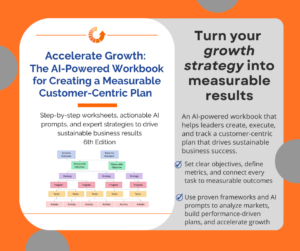
Buy Your Best-Practices Workbook
Add Another Dimension to your VoC with Sentiment Analysis
VoC research is often conducted via market research and typically entails asking customers for their opinions. And while a traditional approach to VoC is a valuable way to gain insight into customer loyalty and satisfaction, another valuable way to listen to customers is by conducting sentiment analysis.
Sentiment analysis can reveal insight and candid views into an organization’s sales, marketing, customer service, and product development operations. Social media tracking tools and sentiment analysis software are methods for capturing and analyzing sentiment data that don’t rely on extensive market or customer research techniques (such as a formal survey o

r in-depth interview). These tools enable you to digest and analyze customer and prospect conversations. And as a result, serves as a tool to gain additional insight into Voice of the Customer.
Some of the biggest challenges associated with sentiment analysis are knowing what is relevant and what to filter out, and how to capture data that isn’t contained in natural language. It is still difficult to use tools to analyze slang, symbols, and social media abbreviations.
If you decide to integrate sentiment analysis into your VoC efforts, you will need to make three important initial decisions:
- Decide which people’s you want to listen to. You will need to have a process to gather customer social media identity and then map this to your customer profiles.
- Decide what conversations and data will be and will not be relevant.
- Decide how you will use the data to make it actionable. The effort of gathering data is only worthwhile if you use it to make decisions and take action.
Link Voice of Customer to Business Results
A study by Verint Systems revealed that most companies positively view their existing Voice of Customer (VoC) programs. For many organizations, the real challenge remains in linking VoC to bottom-line metrics. Making this link necessitates that companies employ better data collection data mining techniques to support their VoC initiatives.

These 8 steps will help tighten the link between VoC and business results:
- Establish success metrics during the creation the VoC strategy.
- Define the data elements needed
- Determine the data mining technique to support your analysis
- Capture the data from the study
- Analyze the data to determine any correlations
- Set your performance targets for new initiatives based on the VoC research
- Implement the recommendations
- Track and report the results and modify your hypothesis
The data-related steps are often a laborious and expensive investment so it’s imperative that the first step is to select your success metrics. Surprisingly, very few companies actually establish outcome-based success metrics in connection with their VoC efforts. Many VoC initiatives impact product, service, and experience decisions. Therefore, the success metrics can range from reducing the cycle time for new product adoption, incremental revenue from new products, to improving loyalty to increase regency of purchase. Once you establish the success metrics, the data requirements and analytical techniques will become more apparent.
Our roots are in VoC research andthe expertise we provide our customers. Let us know how we can help.
FAQ:
A: A qualitative and quantitative research technique to gauge influence, understand loyalty/satisfaction, and produce a prioritized set of customer wants and needs—typically at the start of new product/process/service initiatives.
A: Define the purpose and business objectives. VoC serves as a tool for strategic/tactical decisions, not an end in itself—so focus is vital; one study cannot “do it all.”
A: (1) Secure executive sponsor, (2) design research to capture what matters to customers in relation to objectives, (3) design and control critical inputs (sample, timing, instrument), (4) use results to understand and improve what matters most, and (5) drive change and link back to business objectives.
A: Sentiment analysis uses social media tracking and software to capture candid customer views on sales, marketing, service, and product operations—revealing insights beyond formal surveys/interviews.
A: (1) Decide which people to listen to (map social identity to customer profiles), (2) determine what conversations/data are relevant, and (3) decide how to make the data actionable.
A: Knowing what’s relevant vs. noise, and capturing data not in natural language—tools struggle with slang, symbols, and social media abbreviations.
A: Linking VoC insights to bottom-line business metrics. This requires better data collection and mining techniques to connect customer voice to financial/behavioral outcomes.
A: (1) Establish success metrics upfront, (2) define data elements needed, (3) determine mining technique, (4) capture data, (5) analyze for correlations, (6) set performance targets, (7) implement recommendations, and (8) track/report results and modify hypothesis.
Recent Posts
- Focus on Solving Customer Pain Points to Future-Proof Your Company | What’s Your Edge?
- The Destiny of Siloed Priorities is Random Acts
- The Power of Customer-Led Product Development for Market Growth | What’s Your Edge?
- Footprint Expansion: A Customer-Centric Growth Strategy for Scaling
- The Focus on Right-Fit Customers Yields Faster Profitable Growth | What’s Your Edge


You must be logged in to post a comment.