
How do your salespeople allocate their time? Are they spending enough time interacting and engaging prospects and customers or improving sales enablement? Whether it’s an older IDC report or a more recent study by Saleforce, sales people invest nearly 70% of their time in things other than selling.
Avoid Drowning Your Sales People in Administrative Tasks
A salesperson invests about 25% of the week in completing administrative tasks. Why care? Well IDC calculated that if a company can save one sales rep about 10 minutes per week on administrative or sales prep work and reapply that time to selling activities, it could potentially gain about $57,000 per rep per year as a result. This is some serious money that goes straight to the bottom line!
When you delve deeper into the numbers, the data reveals that both inside and field salespeople spend about three hours per week acting as “pioneers” by mining for customer and industry data when preparing for customer and prospect conversations. Once they locate the information they need, they spend more than six hours per week creating presentations. They also spend more than two hours per week looking for and in some cases creating content to use in customer interactions. Presentations and content typically fall into the purview of Marketing under the umbrella of Sales Enablement.

Five Best Practices of Sales Enablement
Most marketers would claim they are enabling the field. That is, Marketing believes it is supplying the knowledge, tools, and opportunities for the Sales team to successfully engage with prospects and customers. Perhaps not. A KnowledgeTree survey showed that 84% of marketers believe they’ve done a good job in making it easy for salespeople to find the content they need – yet only 51% of salespeople feel that the right content is readily accessible. That’s a lot of time that could be spent more productively – especially when most Marketing teams believe they’ve developed resources Sales needs.
What can companies and marketers do to minimize the time salespeople spend on administrative tasks, optimize preparation time, and prioritize selling time? Here are five best practices every company can adopt.
- Aligned Marketing and Sales Performance Targets: Study after study reveals the downside of poor Marketing and Sales alignment. Lack of alignment results in longer sales cycles, eroding margins, failed launches of new products, fewer qualified opportunities, missed quotas, redundant and ineffective marketing and sales materials, inconsistent messaging to the market, and ultimately diminished shareholder value. While it takes some effort and lots of communication, the performance targets for these two organizations need to be in sync. The first essential step is to be on the same page. Alignment is not about aligning with each other but is achieved by aligning to the mission. Once there is agreement on the mission, then it is essential to engage in joint planning. Sales and Marketing are two primary partners for acquiring, keeping, and growing the value of customers. The teams should work on a common plan that connects their efforts to the same quantifiable business outcomes.
- Map sales and marketing assets to their use cases. This is the domain of Marketing Asset Management (MAM) and Digital Asset Management (DAM) solutions. Organizations typically invest a lot of money in creating the right tools needed by Salesforce to move prospects forward in a sales cycle and close them. Even so, research suggests that salespeople still spend an average of 40% of their time preparing customer-facing deliverables, while leveraging less than 50% of the materials (assets) created by Marketing. As a result, many companies cloud-based or other systems where the Marketing organization uploads an asset for Sales to access. Often a Sales person spends too much time trying to find the right materials for their particular instance. Over time, this system begins to contain hundreds of assets such as brochures, data sheets, sales tools, email templates, customer success stories, etc. The names of the files need to be descriptive enough so that it is easy to discern the purpose and use of the content from its file name. By mapping assets to use case the ROI on Sales and Marketing tools can be higher. A DAM or MAM platform improves and controls access to assets.
- Process, process, process. Define and document the Marketing and Sales process before adding any supporting technologies such as CRM or Marketing or Sales Automation solutions. If the process isn’t defined prior to the implementation, configurations may need to be reworked causing deployment delays, lack of usage, and cost overruns. Before implementing any technology, conduct a Marketing and Sales process working session and then take 60-90 days to validate the process against the customer buying and experience journeys. Make changes as necessary and update the process map. The process map can then be used to create the business rules for the technology. Experience in process mapping is critical for this work.
- Identify key improvement drivers. This seems rather obvious but if you don’t know what it will take to improve performance then people will do whatever they think will work. Identify the improvement drivers. This will enable an organization to take a systematic approach to improving sales performance. This also helps create repeatable processes that can be applied to new salespeople which will accelerate ramp-up time and productivity.
- Establish shared performance metrics in advance. When Marketing and Sales are working from different performance metrics they can potentially be working at cross purposes. Or even more importantly one team may be achieving their metric at the expense of the other. It’s easy to see how Sales and Marketing can get sideways when you examine the lack of alignment between commonly used metrics.
For example, some common sales metrics include Revenue per salesperson, Average sale cycle, Average deal size, Sales representative turnover rate, New rep ramp-up time, Average administrative time per rep, Percent of representatives that achieve quota, Average time to close, Average price discount, Percent of accurate forecasted opportunities, Average number of calls to close the deal, Average number of presentations necessary to close the deal, Average number of proposals needed to close the deal, and Average win rate.
These are far different from many metrics used by Marketing. We’ve seen marketing performance metrics such as these Marketing dollars as a percent of revenue, Average return on marketing, Total leads generated, Average response rate, Lead qualification rate, Lead close rate, Percent of marketing collateral used by sales representatives, Change in market penetration, Improvement in time-to-market, Number of feedback points, Marketing execution time, Message close rate execution time, and Message close rate. Almost all of these metrics are very internally focused.
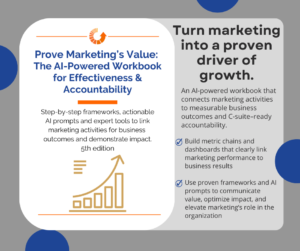
Buy Your Best-Practices Workbook
One of the best ways to create shared metrics for Sales and Marketing is to take a customer-centric approach and create customer-centric metrics. We’d recommend agreeing on the joint metrics at the start of each year and reviewing performance against these metrics together.
FAQ:
A: Studies show salespeople spend nearly 70% of their time on non-selling activities, including 25% on administrative tasks and significant time preparing presentations and content. Reducing this non-selling time can significantly increase revenue per rep.
A: Despite Marketing’s efforts, many salespeople find it difficult to access the right content quickly. Research indicates a gap between Marketing’s perception of content accessibility (84% positive) and salespeople’s experience (51% positive), leading to wasted time and reduced productivity.
A:
- Align Marketing and Sales performance targets: Joint planning and shared mission focus improve coordination and outcomes.
- Map sales and marketing assets to use cases: Use Marketing Asset Management (MAM) or Digital Asset Management (DAM) systems with clear, descriptive naming to streamline content access.
- Define and validate processes before technology implementation: Ensure CRM and automation tools support well-documented and customer-aligned sales and marketing processes.
- Identify key improvement drivers: Focus on systemic performance factors to create repeatable, scalable sales success.
- Establish shared performance metrics: Align Sales and Marketing metrics around customer-centric outcomes to avoid conflicting priorities.
A: Misaligned metrics can lead to teams working at cross purposes or optimizing their own goals at the expense of the other. Shared, customer-centric metrics foster collaboration and drive joint accountability for revenue growth.
A:
- Sales metrics: Revenue per rep, sales cycle length, deal size, quota attainment, forecast accuracy, calls/proposals to close, win rate.
- Marketing metrics: Marketing spend as % of revenue, lead generation and qualification rates, time-to-market improvements, collateral usage, message execution effectiveness.
Sales metrics tend to focus on individual and operational performance; Marketing metrics often emphasize internal campaign and process effectiveness.
A: Adopt a customer-centric approach, agree on joint metrics annually, and regularly review performance collaboratively to ensure alignment and continuous improvement.
A: VisionEdge Marketing offers advisory and implementation services to streamline sales enablement, define aligned processes, and develop customer-centric shared metrics that drive business results.
Recent Posts
- From Hindsight to Foresight: Closing the Growth Measurement Gap
- Focus on Solving Customer Pain Points to Future-Proof Your Company | What’s Your Edge?
- The Destiny of Siloed Priorities is Random Acts
- The Power of Customer-Led Product Development for Market Growth | What’s Your Edge?
- Footprint Expansion: A Customer-Centric Growth Strategy for Scaling


You must be logged in to post a comment.