
For more than two decades and counting, numerous studies, including our Marketing Performance Management (MPM) benchmark studies, suggest that many marketers still need to make progress when it comes to basic Marketing metrics. Studies as recent as this year suggest that more progress is needed when it comes to Marketing performance measurement. For example, a study by Door4 found that six out of 10 marketing leaders struggle to demonstrate the impact of their marketing investments because they are measuring the wrong metrics. Research by Anderson Analytics, Kantar, and Proof Analytics echoes the same results. Left unaddressed, the C-level disappointment with the Marketing function will continue to climb. What can Marketing do to change this perception?
Move Pass Basic Marketing Metrics

It’s not a lack of effort. The number of marketing measures and metrics is beyond count. Marketers need to move past basic marketing metrics to measures more aligned with customer engagement, customer value, market share, market velocity, growth, and value creation. This is where the progress needs to be made – connecting the work of Marketing to business results. Marketing’s ability to measure its value, impact, and contribution is the only way to improve Marketing’s standing with the C-Suite.
What can Marketing do make faster headway on measuring value? We recommend that marketers move from managing metrics to managing performance. When Marketing achieves this level of competency, it will be able to leverage metrics to support the decision-making process, investments, and drive change. The value from the investments in marketing tools, processes, systems, and skills for measuring marketing effectiveness will be lost if we do not use the insights from metrics to help guide the organization.
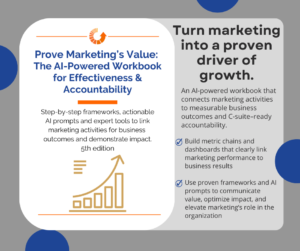
Buy Your Best-Practices Workbook
More Isn’t the Answer
Measuring marketing takes time, energy, expertise, and money. Many marketing organizations are running lean and operating in overdrive. So if organizations are not going to use the metrics to make business decisions, then regardless of how accountable we make Marketing, we’ve missed the mark. It is our contention that the next phase of the marketing measurement issue is not one so much of measures as it is accountability. Accountability is the link between the work of Marketing and business results. To select the right metrics and improve Marketing accountability, you need Marketing to be properly aligned to the business. A CIM study supports this line of thought. While 81% of the respondents foundthat the marketing strategy was aligned with the overall corporate strategy, only 37% indicated that the marketing objectives were aligned with the business outcomes.
 Alignment is a critical success factor for improving Marketing effectiveness, for moving from managing metrics to managing performance, and for using marketing metrics to facilitate change. Alignment may seem like common sense and a relatively easy fix; however, with our work with hundreds of companies, we have found that this is easier said than done. Most Marketing organizations don’t have a process for ensuring alignment. That’s why we were able to secure a patent for the ACCELANCE® methodology and application.
The key challenge is sifting through all the possible measures and metrics and landing on the right ones. This is why alignment is so critical. It provides the beacon Marketing needs to select the right Marketing metrics. Here are some basic reminders to help you move from a slew of what may be useful but irrelevant metrics:
- Avoid chasing shiny toys. Today there is so much data and potential measures that it’s easy to get mesmerized by the possibilities. Stay focused on your business outcomes. Only select metrics that will help you make better decisions, improve performance, and mitigate risk.
- Define and document what these metrics are and how to calculate them.
- Make sure your data and measures enable you to connect the results of your day-to-day Marketing efforts with these metrics. All your program measures must in some way ladder up to your primary Marketing metrics.
- Collect and analyze the data with passion. Measurement isn’t the sexiest part of marketing, but without the data, the creative side of Marketing is running on intuition and gut. Not that this is necessarily bad, but having data to support your gut makes your Marketing organization more credible.
- Don’t be lazy. Don’t rely on the button on your CRM system, Marketing automation platform, website analytics platform, and so on to produce your Marketing dashboard. These “reports” merely visualize the data within the system. It will be up to you to connect the dots between the work of Marketing and business outcomes, and whether you are within performance parameters.
We know this work is hard, but it is important work. We can help.
FAQ:
A: For more than two decades, numerous studies—including Marketing Performance Management (MPM) benchmark studies—have shown that many marketers still need to make progress with Marketing metrics and performance measurement. Recent research suggests the gap persists.
A: Multiple studies indicate that Marketing leaders struggle to demonstrate the impact of Marketing investments because they are measuring the wrong metrics. For example, Door4 found that six out of 10 marketing leaders struggle to demonstrate impact for this reason. Research by Anderson Analytics, Kantar, and Proof Analytics echoes similar findings. If left unaddressed, C-level disappointment with Marketing will continue to rise.
A: Marketing must connect its work to business results. Marketing’s ability to measure its value, impact, and contribution is the primary path to improving credibility and standing with the C-suite.
A: It means shifting from an overreliance on activity/output metrics to measures aligned with business outcomes such as:
- Customer engagement
- Customer value
- Market share
- Market velocity
- Growth
- Value creation
A: Marketing already measures an enormous number of things. Measurement also requires time, energy, expertise, and money—resources many teams do not have in abundance. If metrics are not used to make business decisions, improve performance, and mitigate risk, then the effort is wasted.
A: Move from managing metrics to managing performance. When Marketing reaches this level of competency, it can use metrics to support decision-making, guide investments, and drive change. Otherwise, investments in tools, processes, systems, and skills will fail to produce value.
A: The next phase is less about adding measures and more about accountability. Accountability is the link between Marketing’s work and business results.
A: To select the right metrics and improve Marketing accountability, Marketing must be properly aligned to the business. A CIM study supports this: while 81% of respondents believed the Marketing strategy was aligned to corporate strategy, only 37% indicated Marketing objectives were aligned with business outcomes. Alignment provides the beacon Marketing needs to select the right metrics—because it forces clarity on what outcomes matter.
A: In practice, most Marketing organizations do not have a repeatable process for ensuring alignment. This is why structured alignment methodologies (such as ACCELANCE®) exist—to operationalize alignment rather than treat it as an assumption.
A: Use these reminders to improve focus and discipline:
- Avoid chasing shiny toys: With so much data available, it’s easy to get mesmerized. Stay anchored to business outcomes. Select metrics that improve decisions, performance, and risk mitigation.
- Define and document metrics: Specify what each metric is and how it is calculated.
- Create line-of-sight: Ensure program measures ladder up to primary Marketing metrics. Day-to-day work must connect to outcomes.
- Collect and analyze data with discipline: Measurement may not be glamorous, but without data, Marketing runs primarily on intuition. Data-backed intuition increases credibility.
- Don’t be lazy with dashboards: Platform-generated reports visualize only what’s inside the system. Marketing must connect the dots between activity and business outcomes—and assess whether performance is within parameters.
Recent Posts
- Focus on Solving Customer Pain Points to Future-Proof Your Company | What’s Your Edge?
- The Destiny of Siloed Priorities is Random Acts
- The Power of Customer-Led Product Development for Market Growth | What’s Your Edge?
- Footprint Expansion: A Customer-Centric Growth Strategy for Scaling
- The Focus on Right-Fit Customers Yields Faster Profitable Growth | What’s Your Edge


You must be logged in to post a comment.