

Has your organization reached a point where priorities are blurred, and decision-making is reactive? Do you find yourself or your teams using terms like “managing noise” or one of my favorites, “too many moving parts”? These are often a sign of living with chaos. It’s one of the most underestimated barriers to performance and business growth. The solution? Clarity.
By clarity, we mean the ability to see things clearly, to understand your goals, values, and customers, and know exactly how to connect strategy to execution. Chaos, on the other hand, is disorder. Symptoms include fragmented processes, competing priorities, and initiatives that operate without coordination. This article examines why strategic clarity, not more initiatives or technology, is the best route for sustainable growth, customer value, and shareholder returns.
The Cynefin framework, a respected model in systems thinking, distinguishes between “clear” and “chaotic” domains. In the clear domain, cause and effect are known, and leaders can act with confidence. In the chaotic domain, uncertainty dominates, forcing constant firefighting, which is a very costly way to operate a business.
Strategic clarity creates the conditions for high performance. An LSA Globalstudy found strategic clarity accounts for 31% of the difference between high- and low-performing teams. In high-performing organizations, everyone understands what matters and how success is measured. As a result, execution accelerates, waste declines, and customer value becomes visible and repeatable. For over two decades, we’ve helped organizations turn strategic clarity into a measurable competitive advantage.
As a result of our work, we’ve found clarity requires four crucial elements: deliberate alignment, predictable processes, measurable outcomes, and customer-centric decision-making. Just as importantly, we’ve learned that boards of directors play a key role in enabling strategic clarity at the organizational level. Their oversight ensures strategy is well-articulated, risks are managed, and initiatives align with both shareholder and customer value.
Understand The Colossal Hidden Costs of Business Chaos
 Operating in chaos costs far more than most leaders realize. Chaos erodes efficiency. IDC research estimates inefficient business practices and misaligned processes can drain up to 30% of total revenue annually. They weaken customer experience and sap employee morale—leading to stalled growth. How do you know when you’re in chaos? Duplicated projects, inconsistent metrics, poor handoffs, busy but not productive teams, and misaligned messaging are common indicators.
In many organizations, the problem isn’t ignorance; it’s inertia. Strategy discussions occur, but translating strategy into daily decisions is weak. Common characteristics of organizations in chaos include teams operating in silos, data living in separate systems, and measures that reward output rather than outcomes. Over time, this produces a reactive culture where being busy is mistaken for being productive.
Why So Many Companies Stay in Chaos, Even When They Know Better

If the benefits of clarity are so clear, why does chaos persist? Consider the data: over, yet only 27% have a plan to address it. Our cornerstone article, Are Random Acts Costing You Money, Time, and Growth?, explored this phenomenon. When initiatives aren’t connected to strategy or customer value, they become random acts—well-intentioned but unproductive. These random acts consume resources, create confusion, and perpetuate the very chaos leaders are trying to eliminate.
Boards can help break this cycle by actively reviewing strategic priorities, performance dashboards, and customer outcomes. Their oversight ensures leadership is focused on initiatives that drive measurable value and prevents reactive behavior from becoming the default.
Breaking the cycle requires a mindset shift. Strategic clarity must move from being a goal communicated in a deck to being an operating system: a way the organization thinks, decides, and executes. This operating system facilitates high-performing teams.
What does it look like? High-performing companies that choose strategic clarity over chaos share several defining traits:
- A solid customer-value orientation. Every initiative links back to creating value for customers and, by extension, shareholders.
- Cross-functional alignment. Teams collaborate around shared goals instead of competing priorities.
- Data-driven decision-making. Clarity is sustained by facts, not assumptions.
- Strategic process discipline. Leaders operationalize clarity through frameworks and governance, and boards provide oversight to ensure discipline is maintained.
- Outcome over activity. Success is measured by impact, not motion.
When boards actively monitor these traits, they reduce organizational risk, reinforce accountability, and ensure strategy translates into measurable business outcomes.
How to Improve Performance and Strategic Clarity in 4 Steps
Yes, moving from chaos to strategic clarity will positively improve performance. But it takes continuous discipline. These four steps can help any organization begin the shift:
- Conduct a Clarity Audit: Assess where strategy and execution have drifted apart. Look for misaligned goals, redundant processes, unclear decision rights, and fragmented responsibilities. A clarity audit surfaces friction points and helps leaders reclaim strategic capacity. Boards can participate by reviewing audit findings and ensuring leadership addresses critical gaps.
 Align Around Customer-Centric Value Metrics: Make sure everyone, from the front line to the executive suite, understands how success is defined. Replace vanity metrics (likes, clicks, etc.) with outcome metrics (retention, share of wallet, lifetime value). When boards monitor these metrics, they ensure leadership decisions are anchored in meaningful results.
- Streamline and Standardize Processes: Before launching new initiatives, fix the processes that already exist. Identify where handoffs fail, where duplication occurs, and where the customer experience breaks down. Streamlined processes eliminate random acts, accelerate delivery, and improve consistency. Boards can help by requiring periodic process reviews and progress reports, reinforcing the importance of operational discipline.
- Establish Governance, Accountability, and Continuous Review: Strategic clarity requires accountability. Create structures that reinforce alignment, such as cross-functional reviews, transparent performance management dashboards, and shared ownership of outcomes. Boards should participate in regular strategy and performance reviews, ensuring leadership maintains alignment, prioritizes initiatives effectively, and continuously delivers value to customers and shareholders.
 Align Around Customer-Centric Value Metrics: Make sure everyone, from the front line to the executive suite, understands how success is defined. Replace vanity metrics (likes, clicks, etc.) with outcome metrics (retention, share of wallet, lifetime value). When boards monitor these metrics, they ensure leadership decisions are anchored in meaningful results.
Strategic clarity is about intentionality. It gives teams the confidence to adapt without losing direction. It empowers leaders to say no to distractions that don’t create business and customer value.
Choose to Focus on Strategic Clarity, Customer Value, and Smarter Growth
High-performing companies don’t grow faster by doing more; they grow by being smarter and doing what matters. Strategic clarity provides the discipline and focus to make that possible.
Chaos isn’t the opposite of order; it’s the absence of clarity. If your organization is stretched, reactive, or uncertain, embracing clarity may be the best course of action. Boards that champion clarity help transform strategy into execution, reduce chaos, and safeguard both organizational performance and customer trust.
Start by asking:
- Do we have shared definitions of success?
- Are our metrics aligned to customer value?
- Are our processes helping or hindering growth?
When you replace chaos with clarity, you’ll improve performance and create the foundation for sustainable, profitable, customer-centric growth.
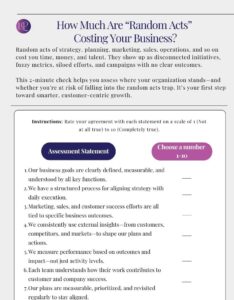
Ready to assess your organization’s strategic clarity? Use the Random Acts Risk Checklist or schedule a short clarity conversation today.
FAQ:
A: Blurred priorities, reactive decision-making, and language like “managing noise” or “too many moving parts” are common indicators. Operational symptoms often include fragmented processes, competing priorities, duplicated projects, inconsistent metrics, poor handoffs, busy-but-not-productive teams, and misaligned messaging.
A: Strategic clarity is the ability to see things clearly: to understand goals, values, and customers, and to connect strategy to execution. It functions as an operating system for how the organization thinks, decides, and executes—not merely a statement in a deck.
A: The Cynefin framework distinguishes between “clear” and “chaotic” domains. In the clear domain, cause-and-effect relationships are known, and leaders can act with confidence. In the chaotic domain, uncertainty dominates, forcing constant firefighting—a costly way to run a business.
A: Strategic clarity creates the conditions for high performance: faster execution, less waste, and more visible and repeatable customer value. Research cited from LSA Global suggests strategic clarity accounts for 31% of the difference between high- and low-performing teams.
A: Chaos erodes efficiency, weakens customer experience, and damages employee morale—leading to stalled growth. IDC research estimates inefficient business practices and misaligned processes can drain up to 30% of total revenue annually.
A: The issue is often inertia, not ignorance. Strategy discussions occur, but translation into daily decisions is weak. Silos persist, data lives in separate systems, and measures reward output rather than outcomes. Over time, this creates a reactive culture where being busy is mistaken for being productive.
A: Random acts are initiatives that are well-intentioned but not connected to strategy or customer value. They consume resources, create confusion, and reinforce the chaos leaders are trying to eliminate.
A: Boards can reinforce clarity through oversight: ensuring strategy is well-articulated, risks are managed, and initiatives align with shareholder and customer value. Boards can also help break cycles of reactivity by reviewing strategic priorities, performance dashboards, and customer outcomes.
A: High-performing organizations tend to share:
- A customer-value orientation (initiatives link to customer and shareholder value)
- Cross-functional alignment around shared goals
- Data-driven decision-making
- Strategic process discipline supported by governance and board oversight
- Outcome-over-activity measurement
Recent Posts
- From Hindsight to Foresight: Closing the Growth Measurement Gap
- Focus on Solving Customer Pain Points to Future-Proof Your Company | What’s Your Edge?
- The Destiny of Siloed Priorities is Random Acts
- The Power of Customer-Led Product Development for Market Growth | What’s Your Edge?
- Footprint Expansion: A Customer-Centric Growth Strategy for Scaling


Leave a Reply
You must be logged in to post a comment.