
Growth remains a major mandate for most every company we work with. We are often asked for how to identify and pursue a new market and build a segmentation model. This is the focus of this One Good Idea episode.
Various firms such as Gartner, PwC and KPMG have surveyed CEOs and business executives to gain insight into top priorities. Growth is consistently a top priority. CEO surveys that revealed growth as the top priority for CEOs. Growth comes from customers. Not just from keeping and growing the value of existing customers, but also new customers, potentially in a new market.
Many firms we work with struggle with successfully identifying, evaluating and selecting a new segment or segments to pursue. Sometimes these organizations select a segment based on previous experience in the market, or the rate of growth in a market, or the degree of competition in a segment. These can be viable criteria depending on how they are employed.
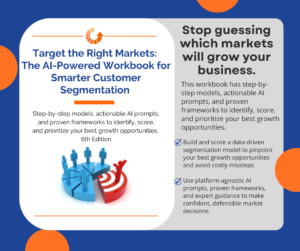
Buy Your Best-Practices Workbook
Develop a Repeatable Segmentation Process to Consistently Identify a New Market
We have found it is important to have a repeatable method to identify new segments outside an existing market that will propel growth. The lack of a defined process for consistently identifying, evaluating and selecting new segments is one of the primary reasons companies struggle with this initiative.
When we tackle segmentation, we take a data-informed approach, which our customers find very helpful. The approach is research-based and uses a rating, ranking and weighing methodology so we can evaluate segments apples-to-apples. Two primary dimensions, Opportunity and Accessibility, serve as the foundation of our approach. It’s one thing to decide a segment is a good opportunity, it’s another to be able to gain access to that segment. Collaboratively, we identify criteria for each dimension, such as number of companies, for Opportunity and domain expertise for Accessibility.
The key steps involve selecting criteria for each dimension, conducting the research, and then choosing a segment or segments that meet BOTH dimensions. Many companies first attempt to define the criteria and create the model only to circle back because experience with this approach makes a difference. Plus, seeing some nuances in the data that might not have been obvious right off the bat that helps home in on the best segments or gain insight into a market entry strategy takes experience.
Identifying a Worthy Segment is Only the First Step in Pursuing a New Market
Of course, you don’t have to use our specific approach. The Smart Business Tip in this episode is that it’s important to have a methodology based on creating criteria that you consistently employ. It’s the best way to ensure segments receive equal consideration.
Creating the model, conducting the research, and selecting the segment(s) to pursue is just the beginning. Once these steps are complete, a company needs to make sure their positioning, messaging, content, etc. match up to the segment and the buying journey of the potential customers in that segment.
FAQ:
A1: Because many lack a repeatable process. Without a defined methodology for identifying, evaluating, and selecting segments, decisions become inconsistent, overly subjective, and difficult to defend—making it harder to build momentum and reliably pursue new growth opportunities.
A2: A research-based, data-informed approach that uses consistent criteria and a structured method (rating, ranking, and weighting) to compare segments apples-to-apples. Repeatability ensures each segment receives equal consideration and reduces bias in selection.
A3: Opportunity and Accessibility. Opportunity reflects the potential value of the segment (e.g., number of companies, growth, spend, urgency). Accessibility reflects your ability to reach and win in the segment (e.g., domain expertise, channel access, credibility, partner ecosystem). A segment is not truly viable unless it scores well on both.
A4:
- Collaboratively define criteria for Opportunity and Accessibility.
- Conduct research to populate the criteria with evidence.
- Rate, rank, and weight segments to compare them consistently.
- Select the segment(s) that meet both Opportunity and Accessibility thresholds—then use the findings to inform market entry strategy.
A5: Because experience and data nuance matter. Early models often miss subtleties that only become visible once the data is reviewed—insights that can change segment attractiveness, reveal barriers to entry, or reshape the go-to-market approach. Iteration is a feature of good segmentation, not a failure.
A6: Segment selection is only the beginning. You must align positioning, messaging, content, and the buying-journey experience to the segment’s needs and decision process. Without this downstream alignment, even a well-chosen segment will underperform.
Recent Posts
- Focus on Solving Customer Pain Points to Future-Proof Your Company | What’s Your Edge?
- Customer-Centricity in M&A: The Accelerant for Post-Deal Value
- How Strategic Clarity Drives Growth, Profitability, and Customer Value
- Breaking Through Stagnant Growth with a Customer-Centric, Process-Driven Approach | WYE?
- Why Lack of Accountability is Stalling Your Organization’s Growth


Leave a Reply
You must be logged in to post a comment.