

Despite the continued emphasis and variety of approaches to accelerate the business-to-business (B2B) buying cycle, many organizations remain challenged. One of the primary reasons is that Marketing and Sales are not in synch. HubSpot found that in one in four companies, the Sales and Marketing teams are misaligned or rarely aligned. When the Marketing and Sales relationship is not working or is not effective, growth is difficult to achieve. More importantly, the lack of alignment comes with a cost of 10% or more of revenue per year. Imagine what your company could do with 10% more revenue! Misalignment also impacts the launch and adoption of new products, critical factors for achieving organic growth, and also important indicators of business success.
Like VisionEdge Marketing (VEM), organizations such as HubSpot and SaleHub study Marketing and Sales effectiveness. And like us, their research continues to find that only about a quarter of salespeople exceed their quota. In fact, 34% of salespeople admit that closing deals is really hard. The data suggests that companies that sync Marketing and Sales achieve revenue and profit faster and are 67% better at closing deals.
How to Evaluate Your Sales and Marketing Alignment
How do you know if your Sales and Marketing teams are misaligned or if a link between them is broken? Take a moment to consider where your organization ranks on these 10 statements on a scale of 1-10, with 10 being “We excel at this” and 1 being “We are completely off the mark.”
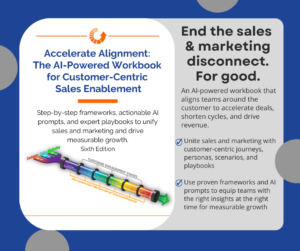
Buy Your Best-Practices Workbook
Our Marketing and Sales teams:
- Work the same opportunity pipeline or sales funnel
- Have clearly defined handoffs for when an opportunity moves from Marketing to Sales
- Use the same performance measures and metrics to determine success
- Jointly define activities to improve opportunity flow in terms of quality, quantity, and timing
- Use a common vocabulary and language to describe the customer buying process and its stages
- Solicit input from each other when drafting their respective plans
- Trust each other to independently engage and communicate directly with customers
- Attend each other’s reviews and meetings
- Rarely spend time disputing with or disagreeing with each other
- Attend training programs, events, and learning opportunities together
Did you score 100? If you gave yourself less than 8 on any statement, your organization might have an alignment challenge. Invest your energy and resources into addressing these gaps.

Focus on the Right Target
No worries, alignment gaps are fixable. One of the first ways to improve alignment is to revisit how you define success. Too often, when we ask organizations what will determine their success, they give us a revenue number. This usually raises a red flag for us. Why? Because, as you’ve read and heard from us before, companies don’t sell or market to buckets of money. When we set up a target around revenue, the potential for misalignment increases because the target is ambiguous and lacks context. We market and sell to customers.
Per the wise words of Peter Drucker, “the purpose of business is to create and serve customers.” Therefore, to improve your Marketing and Sales teams’ alignment, start with this one step. Define how many customers, which customers, which markets, and which products comprise your revenue target. Avoid leaving it to Marketing and Sales to figure it out separately. They may not come to the same conclusion. Alignment begins with joint clarity around which customers to find, keep, and grow. If you need help determining what that looks like for your particular organization, we can help.
FAQ:
A1: Because Marketing and Sales are not in sync. Misalignment is common and materially constrains growth—creating friction in handoffs, inconsistent messaging, and conflicting priorities that slow decision-making and reduce conversion.
A2: It is significant—often 10% or more of revenue per year. Misalignment also undermines new product launch and adoption, which are essential inputs to organic growth and long-term business performance.
A3: Organizations that align Sales and Marketing tend to achieve revenue and profit faster and materially improve close rates. The data also indicates persistent performance gaps in Sales execution—only about a quarter of salespeople exceed quota—making alignment and enablement even more critical.
A4: Rate your organization (1–10) on ten alignment indicators, including: shared pipeline/funnel, defined handoffs, shared measures, jointly defined flow-improvement activities, common buying-stage vocabulary, mutual input into plans, trust to engage customers independently, participation in each other’s reviews, low dispute frequency, and shared training/learning.
A5: If you rate below an 8 on any statement, you likely have an alignment gap worth addressing. Alignment weaknesses are fixable, but they require deliberate investment of time, process, and leadership attention.
A6: Clarify the target properly. Revenue alone is an ambiguous target that increases misalignment risk. Instead, define the revenue goal in customer terms: how many customers, which customers, in which markets, buying which products. Alignment begins with shared clarity around which customers to find, keep, and grow—so both functions are operating from the same definition of success.
Recent Posts
- Focus on Solving Customer Pain Points to Future-Proof Your Company | What’s Your Edge?
- Customer-Centricity in M&A: The Accelerant for Post-Deal Value
- How Strategic Clarity Drives Growth, Profitability, and Customer Value
- Breaking Through Stagnant Growth with a Customer-Centric, Process-Driven Approach | WYE?
- Why Lack of Accountability is Stalling Your Organization’s Growth


Leave a Reply
You must be logged in to post a comment.