
Back in the early days of Marketing accountability, when we were first asked – primarily by people in Finance – to be accountable, those of us in the profession reached for our ever-present, easily within-reach Merriam-Webster Dictionary and looked up the word accountability, finding the definition as “to account for.” Ah ha, we surmised, “they” want to know how much we are spending, as well as where, and on what. After we starting counting what we did and how much it cost, a new set of questions surfaced, mostly around the central question of, “how are these investments making a difference to the business?”
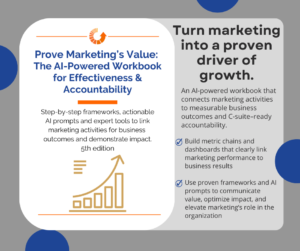
Buy Your Best-Practices Workbook
Decades later, it seems this remains the central question. Research in the area of Marketing Performance Measurement and Management continues to reveal that connecting Marketing investments to business results is still challenging for many marketers. In fact, studies by CMO.org and Forbes Insight indicate that the emphasis on marketing accountability will persist into the foreseeable future.
Let’s take a step back and revisit the meaning of Marketing accountability.

What is Marketing Accountability – and Where to Begin?
Marketing accountability is a broad concept that reflects Marketing’s ability to explain the basis for its actions. We believe that accountability must have a computational aspect and cover a range of Marketing capabilities, processes, and metrics. We find that many Marketing professionals are trying to address accountability by adding analytical tools and marketing technology.
The most sophisticated data collection and analysis can be completely undermined by the lack of proper alignment and poor selection of metrics. To determine what to measure, start by knowing what business needle you are expected to impact, what we call business outcomes, and how this impact will be measured. Only when you know the answer to this can you begin to count what matters.
When you start, as Stephen Covey says, “with the end in mind” rather than starting with your tactics and activities, you will be able to create what we call direct line-of-sight between your Marketing investments, activities and the business outcomes. With this approach, Marketing can clarify the strategic intent of all the investments it makes, determine the appropriate measure and communicate the degree to which Marketing delivers on its commitments.
The best way to approach Marketing performance management, accountability and measurement is to see it as a continuous, repeatable process designed to help you measure, analyze and learn so that you can make more informed decisions and successfully produce more and better predictable business outcomes.
This approach is the only way to ensure what you count really matters and use the measures to improve and prove the value of Marketing. And it is the only way to deliver on what Sylvia Reynolds, a CMO of Wells Fargo, once said, “Marketing must be a driver of tangible business results.”

Marketing accountability is what enables the Marketing function to run the marketing organization more effectively and efficiently. Knowing what is and isn’t working helps marketing achieve greater influence and serve in a more strategic role. We’d love to talk with you about helping you count what matters, regardless of whether or not we ultimately end up working together. Let’s talk.
FAQ:
A1: Because when Finance first pressed Marketing to be accountable, many marketers equated accountability with “to account for”—meaning spend tracking: how much was spent, where it was spent, and on what.
A2: “How are these investments making a difference to the business?” Spend visibility is necessary, but it does not answer the value question—and that value question remains the central accountability issue decades later.
A3: Because research continues to show that connecting Marketing investments to business results is still difficult for many organizations, and studies indicate the emphasis on accountability will persist into the foreseeable future.
A4: Marketing accountability is Marketing’s ability to explain the basis for its actions—supported by a computational discipline that spans capabilities, processes, and metrics—and demonstrates how Marketing decisions and investments connect to outcomes.
A5: Because even sophisticated data collection can be undermined by poor alignment and the wrong metrics. If Marketing is not aligned to the business needle it is expected to move, measurement becomes busywork and dashboards become noise.
A6: Start with the business outcomes you are expected to impact and how that impact will be measured. Only then can you “count what matters” and establish a direct line-of-sight between investments, activities, and outcomes.
A7: It clarifies the strategic intent of every investment, enables appropriate measure selection, and makes it possible to communicate performance against commitments—shifting Marketing from reporting activity to demonstrating contribution and impact.
A8: Treat it as a continuous, repeatable process to measure, analyze, and learn—so Marketing can make better decisions and produce more predictable business outcomes. This is how you both improve and prove Marketing’s value as a driver of tangible business results.
Recent Posts
- Focus on Solving Customer Pain Points to Future-Proof Your Company | What’s Your Edge?
- Customer-Centricity in M&A: The Accelerant for Post-Deal Value
- How Strategic Clarity Drives Growth, Profitability, and Customer Value
- Breaking Through Stagnant Growth with a Customer-Centric, Process-Driven Approach | WYE?
- Why Lack of Accountability is Stalling Your Organization’s Growth


You must be logged in to post a comment.