
 Are your Marketing and Finance teams truly aligned around Marketing accountability? Or are random acts and fragmented investments quietly draining your organization’s growth potential and Marketing’s ability to prove its value? Despite the proliferation of data and analytics, too many companies still struggle to connect marketing activities to measurable customer and business value. The result? Wasted resources, missed targets, and a persistent issue around performance measurement. The solution lies in forging a partnership where Marketing and Finance leaders and teams operate with mutual respect, shared goals, and most importantly, a unified language: business outcomes.
In this article, we’ll explore:
- The Blueprint for a Strong Marketing-Finance Partnership
- Why Marketers Struggle to Prove Value—and How to Change That
- One Call to Action for CFOs
The Blueprint for a Strong Marketing-Finance Partnership
Marketing leaders must speak the language of the business and position the function as a strategic partner in driving the organization forward. To do that, they need a positive relationship with their Finance partners. Not all CFOs approach their role in the same way. While CFOs might be similar in education and experience (profiles) and responsibilities (roles), they have different personas. We can use these three potential archetypes for CFOs to illustrate potential differences:
- The Visionary: Values innovation and long-term growth. Engage this CFO by highlighting how Marketing drives customer-centric, data-driven initiatives and fuels strategic innovation.
- The Steward: Focuses on financial discipline, cost control, and operational efficiency. Demonstrate how Marketing eliminates waste, optimizes resource allocation, and delivers measurable business value. Showcasing Marketing’s commitment to maximizing ROI and supporting sustainable growth reinforces the CFO’s role as a prudent financial steward.
- The Risk Mitigator: Prioritizes risk management, compliance, and the protection of organizational assets. Communicate how marketing initiatives are designed with risk in mind—emphasizing data security, regulatory compliance, brand reputation management, and scenario planning. Illustrate how Marketing collaborates with Finance to proactively identify, assess, and mitigate risks associated with new campaigns or market expansions.
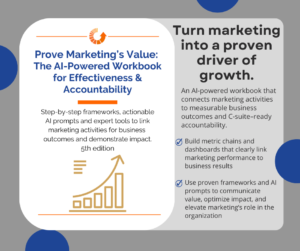
Buy Your Best-Practices Workbook
These are examples, and there are others. As a Marketing leader, take the time to understand the persona of the CFO or Finance leader in your organization. Then, as with any persona, tailor your message to their primary lens to build trust, credibility, and alignment.
Why Marketers Struggle to Prove Value—and How to Change That
 Even though there are different personas among CFOs, they all expect Marketing to have business acumen, especially when it comes to performance measurement. Unfortunately, many marketers default to activity-based metrics because they aren’t fluent in business measures. As a result, they measure what’s easy instead of what matters. A recent Gartner CMO survey found that 48% of Marketing leaders struggle to prove Marketing’s value. The path forward:
- Know your numbers.
- Align every initiative to a business outcome.
- Use data to connect activities and tactics to measures that matter, such as customer value, cost to acquire, product adoption rates, etc.
If you’re not sure, ask your Finance partners for help. They can play a pivotal role in three ways by:
- Collaborating Early: Help marketers translate goals into financial measures. Additional ideas to those mentioned above include share of wallet, footprint expansion, and market penetration/share.
- Providing Access to Data: Break down silos so Marketing can access revenue attribution and customer profitability data.
- Co-Creating Measurement Frameworks: Jointly develop performance management dashboards and KPIs that track progress toward business outcomes.
Accounting teams can also help marketers “speak CFO” by:
- Mapping marketing activities to business outcomes
- Translating campaign results into financial terms, e.g., incremental revenue, improved retention
- Replacing random acts with outcome-based stories that resonate with leadership and the board
Regular joint reviews help keep both teams focused on what truly drives growth.
Budget by Outcome to Better Support Marketing
The fundamentals haven’t changed: strategy first, then measurement, then optimization. What’s different today is the speed and precision enabled by real-time analytics. We can now spot and stop random acts before they drain resources, ensuring every initiative is aligned, measured, and optimized for growth.
 If there is one call to action I would ask of Finance, it is to help Marketing budget by outcome, which entails connecting every dollar Marketing is investing to a business outcome, not a subaccount. Need help with this? Explore how Accelance®—our visual mapping and outcome-based budgeting platform—empowers Marketing and Finance teams to co-create, measure, and optimize growth strategies that deliver true business value by helping drive better alignment and accountability.
What’s your organization’s next step to bridge the gap between Marketing and Finance?
FAQ
(written with the help of Penn at Sintra.ai)
Q1: What is a “random act” in marketing and why does it matter?
A random act is any marketing activity that is disconnected from a measurable business outcome. These acts waste resources and dilute impact. Eliminating them ensures all efforts support customer-centric growth.
Q2: How can Marketing and Finance better align around business outcomes?
By establishing shared business outcomes, using a common language focused on customer and business value, and collaborating on measurement frameworks, both teams can co-own growth and accountability.
Q3: What are the main CFO personas and how should Marketing communicate with each?
- Visionary: Emphasize innovation and long-term growth
- Steward: Highlight cost control, ROI, and operational efficiency
- Risk Mitigator: Address risk management, compliance, and brand protection
Q4: How can marketers translate campaign results into financial terms?
“Translate” by mapping activities to outcomes—using metrics like incremental revenue, customer lifetime value, and cost per acquisition—and telling outcome-based stories that resonate with leadership.
Q5: What are the first steps to moving from line-item budgeting to outcome-based budgeting?
Start by connecting every dollar to a business result, leverage performance dashboards, and shift budget discussions from transactional to strategic.
Recent Posts
- From Hindsight to Foresight: Closing the Growth Measurement Gap
- Focus on Solving Customer Pain Points to Future-Proof Your Company | What’s Your Edge?
- The Destiny of Siloed Priorities is Random Acts
- The Power of Customer-Led Product Development for Market Growth | What’s Your Edge?
- Footprint Expansion: A Customer-Centric Growth Strategy for Scaling


Leave a Reply
You must be logged in to post a comment.