

Whether you are a Marketing professional in a large or small organization, working in a B2B or B2C company, you are expected to establish Marketing metrics demonstrate the value, impact and financial contribution of the Marketing investments you make on behalf of your organization. Your leadership team wants to know how Marketing is affecting the creation of new customers and the retention of and new business from existing customers.
As a result, marketers have embraced various approaches to measuring Marketing performance and value particularly when it comes to demand generation. In the world of B2B, marketers have placed a significant emphasis on measuring cost per lead, lead volume and lead quality. We contend there’s more Marketing metrics around the pipeline than leads.
A Forrester Research study, “Redefining B2B Marketing Measurement,” found that “the metrics that most B2B marketers say they use — like number of leads generated and cost per lead” — rank in the lower half of the effectiveness list.” In fact, cost per lead may actually work against us if we don’t look further into the buying process. At first blush, one program may produce more leads than another at a lower cost and therefore appear more efficient.
But what is really important is how many of the leads convert to the next stage in the buying process. If there is a higher conversion rate from the more expensive program, than it is actually more effective. But if we only look at a marketing program in terms of qualified leads generated and cost, we could potentially be eliminating programs that actually help build the pipeline.
Therefore, we need to move beyond the lead as the Marketing metric and leverage metrics more meaningful to the organization — Marketing metrics and measures that are more closely tied to creating value. These include
- customer measures and metrics such as lifetime value, repeat purchase, referral rate which impact acquisition costs, sales cycle, and win rate down the road. And we mustn’t forget retention and customer vulnerability.
- product measures and metrics such as win rate, adoption rate,
- competitive measures and metrics such as category ownership and growth rate, brand relevance and momentum, and margin of victory.
All of these measures and metrics are affected by Marketing. Each of these have implications to every company’s financial targets associated with profit and revenue.
These financial targets are achieved by some amount of business or dollars from existing customers and some amount of business or dollars from net new customers.
These dollars represent the opportunity dollars the organization needs to generate. So while Marketing may not be directly responsible for closing these deals, Marketing is responsible for generating some or all of the opportunity dollars. By looking at the Marketing budget across the customer and product life cycles we can see that generating leads provides only a partial view into Marketing’s contribution.
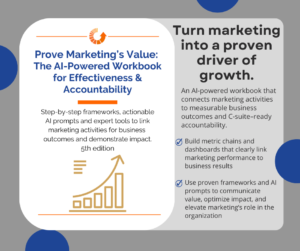
Buy Your Best-Practices Workbook
Link Marketing Measures and Metrics to the Business Outcomes
These opportunity dollars derived either by new or existing customers in new or existing markets/segments who purchase either new or existing products (solutions). Therefore the combination of these become the basis for your company’s business outcomes. Once the outcomes are quantified, Marketing objectives can be created for each one. Where it makes sense, link the Marketing objectives to specific opportunity pipelines.
Once you complete this process, these three categories of pipeline-related metrics enable Marketing to measure its contribution in terms of opportunities:
1. Pipeline contribution How are marketing programs and investment positively affecting the number of leads that convert into sales opportunities and new deals? How has marketing reduced the number of qualified leads that wither and die?
2. Pipeline movement How are the marketing programs and investments accelerated the rate at which opportunities move through the pipeline and convert into the deals?
3. Pipeline value What increase in the revenue in the pipeline have Marketing investments generated?
By moving beyond the lead and by improving your effectiveness and efficiency in terms of these three metrics, you can actually improve Marketing’s contribution, impact and value. Ideally, over time, by monitoring results and analyzing the data, Marketing can begin to create more predictable results in terms of contribution, conversion, and value.
Of course, you must remember that in addition to pipeline metrics we must also measure strategic metrics related to customer retention and value, topics for another time. Learn more in the white paper Don’t Waste Your Bullets: Customer Engagement To Accelerate Revenue And Improve Alignment.
FAQ:
A: Regardless of company size or whether the organization is B2B or B2C, leadership expects Marketing to demonstrate the value, impact, and financial contribution of Marketing investments—especially how Marketing affects new customer creation and retention/expansion from existing customers.
A: Many B2B teams emphasize cost per lead, lead volume, and lead quality. However, research (including Forrester’s Redefining B2B Marketing Measurement) suggests commonly used lead metrics rank in the lower half of effectiveness. Cost per lead can be misleading because it rewards “cheap leads” even when those leads do not convert into meaningful opportunities or revenue.
A: A program may appear efficient because it generates more leads at a lower cost. But if those leads convert poorly to the next buying stage, the program is less effective. A higher-cost program may be more valuable if it produces a higher conversion rate into opportunities and deals. If you only measure leads and cost, you may eliminate programs that actually build pipeline.
A: It means adopting metrics that are more meaningful to the organization and more closely tied to value creation—across the customer lifecycle, product lifecycle, and competitive context—not just top-of-funnel activity.
A: Metrics that reflect Marketing’s influence on business outcomes include:
- Customer metrics: Lifetime value, repeat purchase, referral rate, retention, and customer vulnerability (which affect acquisition cost, sales cycle, and win rate).
- Product metrics: Win rate, adoption rate.
- Competitive metrics: Category ownership and growth rate, brand relevance and momentum, and margin of victory.
Recent Posts
- Focus on Solving Customer Pain Points to Future-Proof Your Company | What’s Your Edge?
- Customer-Centricity in M&A: The Accelerant for Post-Deal Value
- How Strategic Clarity Drives Growth, Profitability, and Customer Value
- Breaking Through Stagnant Growth with a Customer-Centric, Process-Driven Approach | WYE?
- Why Lack of Accountability is Stalling Your Organization’s Growth


You must be logged in to post a comment.