
In order for Marketing Measurement – the act of measuring or the process of measuring Marketing’s performance – to be accepted and actively supported in your organization may require a complete paradigm change. Marketing measurement needs to be viewed as an integral part of everyone’s job and an integral part of the Marketing organization’s culture. Our annual Marketing Performance Management (MPM) benchmark studies and those of other organizations consistently reveal that when it comes to Marketing measurement many marketers are challenged with selecting the right metrics, collecting the data necessary to do the measuring, having the essential tools and processes in place, and developing measurement competence. Selecting the right metrics will determine whether you are able to assess the Marketing organization’s performance and contribution to the business.
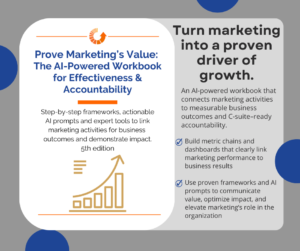
Buy Your Best-Practices Workbook
There are a number of critical elements the organization needs to measure Marketing, such as:
- The analytical acumen to develop a measurement framework that will link all marketing activities to consistent performance metrics.
- Access to complete, accurate and frequently updated marketing data and
- Useful systems, tools and processes.
Selecting the right metrics begins with ensuring that Marketing objectives are properly aligned with the organization’s business outcomes. Once you select your metrics you want to make sure they pass the “So What Test.”

Five questions to make sure your Marketing metrics pass the “So What” test
1. Business Relevance – Is the metric defined within a business context that explains how the metric score correlates to improved business performance?
2. Measurability – Is there or can there be a process that quantifies a measurement for this metric?
3. Controllability – Does the metric reflect a controllable aspect of the business process? When the measurement is not in a desirable range, some action to improve the data should be triggered.
4. Reportability – Does the metric’s definition provide the right level of information to the data steward when the measured value is not acceptable?
5. Trackability – When documenting a time series of reported measurements does the organization gain insight into the result of improvement efforts over time?
By taking steps to identify the criteria and metrics to evaluate your Marketing function’s initiatives, you play an important role in redefining your team’s culture and that of the organization.
Learn more about evaluating your marketing metrics. Think you have it nailed? Test your Metrics IQ.
FAQ:
A: Marketing measurement must become an integral part of everyone’s role and the organizational culture to gain acceptance and active support. Without this cultural integration, measurement efforts often fail to deliver meaningful insights or business impact.
A:
- Analytical acumen to develop a comprehensive measurement framework linking activities to performance metrics
- Access to complete, accurate, and frequently updated marketing data
- Systems, tools, and processes that support consistent data collection and reporting
A: Metrics should align directly with the organization’s business outcomes and pass the “So What?” test to ensure relevance, measurability, controllability, reportability, and trackability.
A: Five key questions:
- Business Relevance: Does the metric correlate with improved business performance?
- Measurability: Can the metric be quantified reliably?
- Controllability: Does the metric reflect aspects Marketing can influence and improve?
- Reportability: Does it provide actionable information when performance is off-target?
- Trackability: Can trends be monitored over time to assess improvement efforts?
A: Alignment ensures that metrics reflect Marketing’s true contribution to organizational success, enabling focused efforts and clear accountability.
A: It fosters a data-driven mindset, promotes accountability, enhances decision-making, and elevates Marketing’s strategic role within the company.
A: VisionEdge Marketing offers advisory services to help you develop measurement frameworks, select impactful metrics, and embed a measurement culture that drives business results.
Recent Posts
- Focus on Solving Customer Pain Points to Future-Proof Your Company | What’s Your Edge?
- Customer-Centricity in M&A: The Accelerant for Post-Deal Value
- How Strategic Clarity Drives Growth, Profitability, and Customer Value
- Breaking Through Stagnant Growth with a Customer-Centric, Process-Driven Approach | WYE?
- Why Lack of Accountability is Stalling Your Organization’s Growth


You must be logged in to post a comment.