
A study by Marketo, which included nearly 500 B2B and consumer marketers, found that companies are more satisfied with Marketing organizations that have a documented Marketing plan. Unfortunately, according to the study, many Marketing organizations operate without one. A list of “activities” and the associated costs is no more a Marketing plan than a list of musical notes is a symphony.
Marketing Plans are a Critical Tool
A Marketing plan serves as the critical vehicle by which the CMO leads the Marketing team. It is the score from which all members of the Marketing team play. From this perspective, the Marketing plan serves to align and chart your Marketing organization’s course of action for creating value. The pressure for Marketing organizations to account for their investments, prove the contribution of their programs to the organization, and demonstrate value is only increasing. An Ifbyphone State of Marketing Measurement Study revealed, “CEOs desire all marketing activities to be continuously measured and decision making to be founded on strong statistical evidence.
A measurement and metrics-based Marketing plan enables Marketing to meet this expectation. A well formulated Marketing plan should provide insight into how Marketing will measure its effectiveness and value. Performance targets for programs should be set at the outset, reflected in the plan, and aligned to the Marketing metrics and objectives.

Three Steps to Guide the Development of Your Marketing Plan
These three initial steps help guide your organization’s Marketing planning and budgeting efforts:
- Clearly understand the business outcomes for the organization and those that Marketing is expected to impact
- Align Marketing objectives and performance targets directly to business outcomes
- Insist on performance targets for all programs, tactics, and activities
Clearly Understand the Business Outcomes
Clear business outcomes are critical to successful marketing because these metrics enable the Marketing team to declare success; they are the results that ultimately need to be produced. Since Marketing doesn’t market to buckets of revenue, Marketing organizations that work from a revenue target are operating blindly when it comes to business outcomes.
The Marketing organization needs to know:
- How many “customer deals” does the organization need to achieve its financial, market, and category targets
- How many of these deals will come from existing customers buying existing products
- How many of these deals will come from existing customers buying new products
- How many of these deals will come from new customers, and where tare hese new customers located, in the same verticals and geographies we’ve always done business with, or new verticals and geographies?
Once the business outcomes are defined, the next thing Marketing needs is specificity as to how Marketing is expected to affect these business outcomes and how their value, contribution, and/or impact will be measured.
Keep in mind that business outcomes are customer-centric, specific, and quantifiable. For example, X% of tier one existing customers will adopt WIDGET X, resulting in $ of revenue; or acquire X number of net new customers in the ABC segment to increase market share by Y%. Marketing is expected to contribute 100% to X% of tier one existing customers’ product adoption of WIDGET X. Marketing is expected to contribute 100% of the net new customer qualified opportunities in the ABC segment.
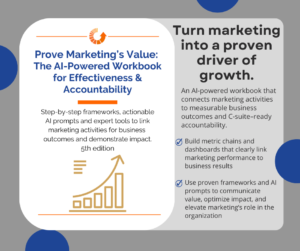
Buy Your Best-Practices Workbook
Align Marketing Objectives to Outcomes and Establish Measurable Marketing Objectives
Once the outcomes are clear, Marketing should develop measurable objectives that are directly aligned to the business outcomes. Measurable Marketing objectives articulate what Marketing must achieve to move the business closer to achieving the outcomes.
These objectives should be framed in terms of customers in order to reflect Marketing’s three core responsibilities: finding, retaining and growing the value of customers. These responsibilities directly relate to what most organizations are trying to improve as a result of revenue and sales: increased market share, customer lifetime value, and customer/brand equity, respectively.
The Marketing objectives state what Marketing will do to move the needle, and should be measurable and time-bound. For example, increase preference for ABC product among top share determiners in XYZ markets from A-B by end of 2Q, or generate X number of qualified leads within 6 months of product launch at $Y/lead with X% converting to sales worth.
Insist on Performance Targets for EVERYTHING
The issues of alignment and accountability are inextricably linked. Without alignment between Marketing and the business, it’s impossible to quantify the value Marketing is providing to the business, let alone focus on the right metrics to establish progress toward helping the organization achieve its goals. Without the ability to demonstrate value, the budgeting process becomes a game of guesswork because there is no link between expenditures and desired results.
A Forbes Insights report found that organizations need a good system in place for communicating the impact of Marketing investments back to the C-Suite. The only way to communicate impact is to ensure Marketing activities and investments are directly linked to business results and that the performance targets are specific and measurable.
Performance targets serve as a barometer of our progress. By constantly measuring actual performance against the metrics, you can determine whether a course change is required. Metrics and feedback processes are essential elements of a Marketing plan. Evaluation of the plan at key intervals should be part of the plan to determine if Marketing is meeting the objectives and performance targets outlined in the plan.
VEM’s proven patented Accelance® methodology and application were designed specifically to support alignment efforts and produce a customer-centric outcome-based Marketing plan. Schedule a Marketing Plan review or contact us to help you employ Accelance® .
FAQ:
A: Research (Marketo) found companies are more satisfied with Marketing organizations that have a documented plan. Without one, Marketing often becomes a collection of activities and costs—“a list of notes,” not a cohesive symphony.
A: It is the vehicle the CMO uses to lead the team—aligning the organization around a course of action for creating value, and providing the “score” from which the team executes consistently.
A: Executive expectations for accountability are rising. CEOs want marketing continuously measured and decisions grounded in statistical evidence. A metrics-based plan clarifies how Marketing will prove effectiveness and value.
A: (1) Clearly understand the business outcomes and which ones Marketing must impact, (2) align Marketing objectives and performance targets directly to those outcomes, and (3) insist on performance targets for all programs, tactics, and activities.
A: Translate revenue goals into customer deals: how many deals are required, how many come from existing customers buying existing products, existing customers buying new products, and net new customers—and where those new customers will come from (new or existing verticals/geographies).
A: Clarity on how Marketing is expected to affect each outcome and how contribution will be measured. Outcomes should be specific, customer-centric, and quantifiable (e.g., adoption targets, net new customers in a segment, market share change).
A: Directly aligned to outcomes, measurable, and time-bound—framed in terms of customers to reflect Marketing’s responsibilities: acquire, retain, and grow customer value (e.g., increase preference in defined markets by a date; generate X qualified leads at $Y/lead with X% converting).
A: Alignment and accountability are inseparable. Without measurable targets tied to business results, budgeting becomes guesswork and impact cannot be communicated to the C-Suite. Targets act as a progress barometer, enabling course correction through ongoing measurement and plan reviews.
Recent Posts
- Focus on Solving Customer Pain Points to Future-Proof Your Company | What’s Your Edge?
- The Destiny of Siloed Priorities is Random Acts
- The Power of Customer-Led Product Development for Market Growth | What’s Your Edge?
- Footprint Expansion: A Customer-Centric Growth Strategy for Scaling
- The Focus on Right-Fit Customers Yields Faster Profitable Growth | What’s Your Edge


You must be logged in to post a comment.