
Growth remains at the top of the list of CEO business priorities. In today’s environment, “simple incremental growth has become more difficult to achieve.” CEOs are tackling a number of initiatives to find ways to redevelop the business to sustain growth and add value. Marketing is the primary engine of growth in every company. Marketing leaders who want to earn a seat at the table need to be vigilant and diligent about developing and implementing customer-focused growth strategies.

Marketers Need to Focus on Sustained Growth
As marketers, we talk a lot about big data, demand generation, content marketing, and engagement. But as an integral part of the business, we need to talk about how we can facilitate business growth and serve as value generators for our companies. If you’re not asking this question every day, you’re missing the mark: “How does, and how can, Marketing strategically help my company grow?”
Three Areas to Help Implement a Marketing Strategy to Support Growth
To help you recommend and implement a Marketing strategy to support business growth, consider these three areas:
- Growth is a result of more than just selling. Think beyond the pipeline and tackle innovation. Take the initiative to own the idea generation phase for new products and services. Regularly gather customer input to help frame market requirements. Explore how to be innovative when it comes to addressing customer experience and apply innovation to both marketing strategy and tactical development.
- Growth decisions require understanding which customers, markets, and products to pursue and which ones to abandon. This includes knowledge of customer preferences, buying criteria, and the buying process. Implementing growth strategies requires creating compelling messaging and content that resonates with customers and prospects. These decision outputs require good data. So, lead the charge on leveraging analytics to capture the actionable insights needed to make informed choices.
- Growth strategies typically revolve around one or more of these customer-focused approaches, and each comes with data and metrics requirements:
- Identifying profitable growth opportunities for your core businesses. To create the strategy, the CMO needs to measure and benchmark the current rate of revenue growth, market share, and customer experience for each of the core businesses. Marketing should know who is, and who is not, a core customer, the firm’s competitive differentiators, and where attractive growth opportunities exist.
- Creating high impact, compelling value propositions for existing customers. This includes including creating sub-segments, understanding buying patterns, revenue, and profit contribution, and conducting A/B value proposition testing. Once again, you can see the importance of data and analytics in this
- Entering adjacent markets that have strong, strategic links to your core business. This strategy becomes especially important when you’ve reached maximum share/growth in your core business. Typically, the easiest route to adjacent markets is with proven products and/or This strategy requires new market data, the potential customers segments, and their buying process, and the analytics to help you score and determine the best segments and markets to pursue.
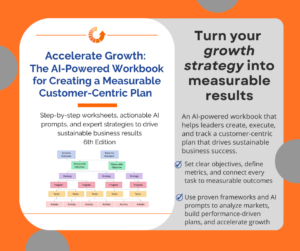
Buy Your Best-Practices Workbook
Companies use a number of overall financial metrics to measure growth. As part of the growth engine, the Marketing function has the opportunity to impact real revenue growth (revenue after overall increases or decreases in the profit index) and sustainable revenue growth (how much additional revenue growth your company can handle).
Therefore, the fourth area to address is the KPIs, metrics, and dashboards that reflect Marketing’s contribution to growth outcomes. The CMO in particular needs to think beyond the Marketing measures and metrics typically associated with the pipeline, such as marketing-generated “leads” or other output-oriented metrics such as campaign response rates, search engine rankings, and webinar/event participants. CMOs focused on growth embrace more outcome-oriented metrics around Marketing’s contribution to the rate, cost, and number of acquired customers, the rate of growth of specific customers, and share of wallet, advocacy, and referral growth among customers.
The bottom line: Having a clear growth strategy and strong execution are essential to achieving profitable growth. Marketing can be a major contributor to both strategy and its execution by driving innovation and leveraging actionable insights derived from data and analytics. Contact us for help with the research, strategy, and plan development.
FAQ:
A: Because growth is a top CEO priority and incremental growth is increasingly difficult. Marketing is the primary engine of growth, and Marketing leaders earn a strategic seat at the table by developing and implementing customer-focused growth strategies tied to enterprise value creation.
A: “How does—and how can—Marketing strategically help my company grow?” If Marketing is not consistently translating its work into growth contribution, it risks becoming execution-only rather than a value generator.
A:
- Innovation beyond selling: Think beyond the pipeline by owning idea generation for new products/services, gathering customer input to frame market requirements, and innovating customer experience as well as marketing tactics.
- Customer/market/product choices powered by analytics: Growth requires deciding what to pursue and what to abandon. Marketing should lead in understanding preferences, buying criteria, and buying processes—and in using analytics to generate actionable insights that inform decisions and strengthen messaging and content.
- Customer-focused growth plays (with data requirements): Growth strategies typically involve one or more customer-centric approaches that require strong data, metrics, and segmentation discipline.
A:
- Profitable growth in core businesses: Benchmark revenue growth rate, market share, and customer experience by core business; clarify core customers, differentiators, and where attractive growth pockets exist.
- High-impact value propositions for existing customers: Build sub-segments, analyze buying patterns and profit contribution, and use A/B testing to validate value propositions.
- Adjacent market entry: Use proven products/services to expand where core growth is capped; gather new market data, define target segments and buying processes, and apply analytics to score and prioritize the best opportunities.
A: Because leads, response rates, rankings, and attendance are outputs—not outcomes. Growth-focused CMOs use outcome-oriented metrics that show Marketing’s contribution to the rate, cost, and number of acquired customers, growth of specific customers, and expansion indicators such as share of wallet, advocacy, and referrals.
A: Profitable growth requires a clear growth strategy and strong execution. Marketing contributes materially by driving innovation, supplying actionable customer and market insight, shaping differentiated messaging, and building dashboards that credibly link Marketing activity to growth outcomes.
Recent Posts
- Focus on Solving Customer Pain Points to Future-Proof Your Company | What’s Your Edge?
- Customer-Centricity in M&A: The Accelerant for Post-Deal Value
- How Strategic Clarity Drives Growth, Profitability, and Customer Value
- Breaking Through Stagnant Growth with a Customer-Centric, Process-Driven Approach | WYE?
- Why Lack of Accountability is Stalling Your Organization’s Growth


You must be logged in to post a comment.