
Marketing organizations are getting better at measuring ROI (return on investment), but are still struggling to determine and convey the business impact of their initiatives, programs and activities. The Marketing ROI & Measurement Study published by the Lenskold Group found that many marketers recognize they are lacking in their ability to assess the incremental impact of marketing and to diagnose what is necessary to improve performance.
Effectiveness and Impact Metrics Enable Marketing to Be More Strategic
 This is a crucial point because only when Marketing can measure how its investments and efforts are affecting the business and articulate its effectiveness and impact will it truly be able to play a more strategic role. Organizations must collect three different kinds of metrics to better understand and evaluate the impact of Marketing and to influence Marketing strategy and performance:
- Efficiency – Marketing efficiency measures relate to rate of speed, and availability. Example of these metrics for Marketing include time to fulfillment of an inquiry and cost measures that help assess how well the Marketing operation is being run. Efficiency metrics don’t help Marketing understand how it is affecting the business and how well it is driving key business outcomes. For that we need effectiveness and/or impact measures.
- Effectiveness – Marketing effectiveness measures how well the work of Marketing is helping the organization achieve it outcomes. These metrics enable you to determine whether the right actions being taken to meet the given outcomes. Examples of effectiveness metrics are those that help you understand the role Marketing is playing in acquiring and retaining customers. Effectiveness metrics guide decisions about strategy.
- Impact – These are metrics designed to demonstrate the link between what Marketing does and tangible effects on the organization’s ability to gain and sustain a competitive advantage.
Why Marketing Should Start with Effectiveness Metrics
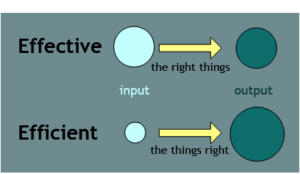
 Marketers need both effectiveness and efficiency metrics.
If you’re wondering which you should measure and improve first, effectiveness or efficiency, choose effectiveness. This may seem counter intuitive since financial pressures often take you down the efficiency path. Making Marketing more effective is about generating incremental sales and customer value as opposed to efficiency which focuses on reducing waste. It’s hard to make decisions about where to cut when you don’t know what is and isn’t working. This choice is about doing the right things and then focusing on how to do these things right.
One of the primary reasons we fall short of being a strategic partner is that we lack the data, analytical models and right metrics needed to demonstrate our contribution and connect marketing back to the business. When Marketing starts with effectiveness you can make a strong case for how the Marketing team is playing an important part in the organization’s ability to achieve key business outcomes. Therefore emphasize the analytics and metrics that show the relationship between and impact of marketing initiatives and programs to the organization.
To drive effectiveness you will need analytics and data that can be used to tease out the causal relationship between particular Marketing efforts and such business outcomes as customer acquisition, customer loyalty, and customer profitability. The more you can show the impact of Marketing investments on the bottom-line the more influence Marketing will have on company business decisions and future business strategies. These capabilities mean your team must have strong analytical skills, develop solid analytical models and have access to valid measures of company performance. Marketing leaders should harness the talent of marketers who bring data and data analysis skills to the party.
Buy Your Best-Practices Workbook
What You Measure Dictates Whether You Earn Your Seat at the Strategy Table
To earn you seat at the strategy table, Marketing leaders need to go beyond simply showing how Marketing can and has reduced costs (efficiency). Increase your focus on metrics and analytics and your team’s ability to measure its effectiveness, impact and contribution. This is the only way the Marketing function and you will gain the opportunity to become more of a strategic player. Let us know how we can help.
FAQ:
A: While ROI measurement has improved, many marketers lack the tools, data, and analytical models to assess incremental impact and diagnose performance drivers, limiting their ability to convey Marketing’s true business contribution.
A:
- Efficiency Metrics: Measure speed, cost, and operational performance (e.g., time to fulfill inquiries, cost per lead).
- Effectiveness Metrics: Assess how well Marketing actions drive desired business outcomes such as customer acquisition and retention.
- Impact Metrics: Demonstrate the causal link between Marketing efforts and tangible competitive advantages or financial results.
A: Effectiveness metrics should come first. Prioritizing effectiveness ensures Marketing does the right things to generate incremental sales and customer value before optimizing how well those things are done (efficiency).
A: Effectiveness metrics enable Marketing to make a strong case for its role in achieving key business outcomes, increasing influence on company decisions and strategy beyond cost reduction.
A: Strong analytical skills, robust data models, access to valid company performance measures, and talent adept at data analysis are essential to link Marketing initiatives to bottom-line results.
A: Emphasizing effectiveness and impact metrics—beyond just efficiency—earns Marketing a seat at the strategy table by demonstrating meaningful contribution to business growth and competitive advantage.
A: VisionEdge Marketing offers advisory services to develop and implement metrics frameworks, analytical models, and data-driven approaches to maximize Marketing’s strategic impact.
Recent Posts
- Focus on Solving Customer Pain Points to Future-Proof Your Company | What’s Your Edge?
- The Destiny of Siloed Priorities is Random Acts
- The Power of Customer-Led Product Development for Market Growth | What’s Your Edge?
- Footprint Expansion: A Customer-Centric Growth Strategy for Scaling
- The Focus on Right-Fit Customers Yields Faster Profitable Growth | What’s Your Edge


You must be logged in to post a comment.