
Perhaps this story sounds familiar…The Facebook, Twitter and LinkedIn sites for the company are up and running. There’s plenty of activity – people are following, liking, sharing, and tweeting. Judy the Intern can barely keep up with “feeding” all the platforms. And Skip in sales recently commented that it seemed like a few of the qualified leads came as a result of marketing’s social media efforts. You know in your gut this social media channel is working. But you just can’t put your finger on it. Don’t worry. Here’s how you start.
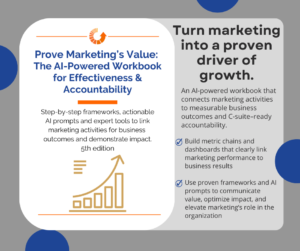
Buy Your Best-Practices Workbook
Connect Your Social Media Metrics to Customer Engagement and Business Outcomes
 CMOs and their teams are trying to determine the best way to create and measure customer engagement. As more customers connect via mobile and social channels this only adds to the complexity. Just as it took organizations time to learn how to leverage and manage websites, we are still learning how to leverage and manage these new channels. There’s no denying that social and mobile channels have become mainstream engagement vehicles that impact customer acquisition and retention. More of the Marketing budgets are now being allocated to digital channels, taking these dollars from more traditional vehicles such as print advertising.
It is important for Marketing to examine customer interactions across the channels in order to have a holistic picture. Measuring isn’t the challenge; the challenge is measuring the business value of social media that remains difficult.
There is no lack of data or metrics to track. As usual, the key challenge is selecting the right metrics and ones that are actionable. A key place to start is to determine what information actually indicates these stages of engagement that you can use to inform decision making. For example, how might you measure the quality and quantity of conversations started via social media channels and the conversion rate of these conversations to consideration behaviors, such as a particular type of inquiry. For example “liking” and “following” metrics may only reflect very early stages of engagement, such as contact or connection. Page views and click throughs provide insight into what captures interest and may also reflect early stage engagement behaviors.
Ultimately you want to focus on social media metrics that help you understand how to impact the entire engagement cycle – from contact to conversation to consideration to consumption and eventually consumption and community. By adding these types of metrics, you can learn content and customer communication and interaction create both the most and best interaction and engagement.
Incorporate These Categories for Measuring Social Media’s Value
 Rather than looking at social media as a broad brush stroke, we recommend linking social media programs to specific marketing objectives in order to monitor whether the program is having any impact and ascertain whether adjustments are needed. However when this isn’t possible, then your social media measures and metrics should include something from each of the following categories:
1. Activity Measures: These are measures associated with counting things. In the world of social media, these metrics include posts, page views, visitors, active contributors, connections between community members, number of community profiles, rankings, frequency and number comments, etc. Anything that measures activity associated with the social media effort. Select metrics that are relevant to the purpose for social media efforts in the first place.
2. Lead Generation Measures: These are traditional lead and pipeline measures such as cost/lead or community, number of leads/time period, ratio of qualified to non-qualified leads, lead conversion, etc.
3. Customer Engagement/ Relationship Metrics: These metrics are beginning to take an outcome orientation and focus on measuring social media in terms such as affinity, referral, user generated content, content and connection relevance, new product ideas, new product adoption rate from social media idea vs. traditional sources, etc.
4. Impact to the Business Metrics: While it might not be easy to get to a financial ROI, you can begin to assess whether the social media efforts are achieving their results and the value as a result. To do this, you will first need to know which needles you want to move and be able to track the impact of your social media efforts against this target. So choose relevant metrics that reflect specific business initiatives. For example, specific business targets might be increasing offline sales by x amount, or increasing demo downloads by a certain percentage within a specific time period, or usage of special promotion offers. If you can know the value of this additional traffic then you can begin to quantify the value derived from the social media efforts.
When you can craft a link between the activity measures and the business impact metrics you are well on your way to understanding how social media connects customer engagement to business outcomes.
FAQ:
A: Social and mobile channels generate abundant activity (followers, likes, shares, comments), and teams can sense momentum. The challenge isn’t collecting metrics—it’s translating social activity into measurable customer engagement and business value.
A: Start by defining what social behaviors indicate meaningful stages of engagement, then select metrics that are actionable and tied to decision-making—not just easy to collect.
A: Social metrics should support insight across the full engagement cycle, including:
- Contact/connection
- Conversation
- Consideration
- Consumption
- Community
A: Likes and follows often reflect only early-stage engagement (contact/connection). They rarely indicate intent, progression through the buying process, or impact on acquisition and retention without additional behavioral and outcome measures.
A: Metrics tied to the quality and quantity of conversations and the conversion of those conversations into consideration behaviors (e.g., inquiries, content downloads, demo requests) are more diagnostic than surface-level engagement.
A: When direct linkage to specific objectives isn’t possible, include metrics from each category:
- Activity Measures: Posts, page views, visitors, contributors, comments, community connections, profiles, rankings, and other activity indicators.
- Lead Generation Measures: Cost per lead/community, leads per period, qualified vs. non-qualified lead ratio, lead conversion.
- Customer Engagement/Relationship Metrics: Affinity, referrals, user-generated content, relevance of content and connections, new product ideas, adoption rates driven by social-sourced ideas.
- Business Impact Metrics: Measures that indicate whether social efforts are producing meaningful business results, even if full financial ROI is not yet available.
Recent Posts
- Focus on Solving Customer Pain Points to Future-Proof Your Company | What’s Your Edge?
- Customer-Centricity in M&A: The Accelerant for Post-Deal Value
- How Strategic Clarity Drives Growth, Profitability, and Customer Value
- Breaking Through Stagnant Growth with a Customer-Centric, Process-Driven Approach | WYE?
- Why Lack of Accountability is Stalling Your Organization’s Growth


You must be logged in to post a comment.