
 As my colleague Gautam Mahajan insightfully wrote: “The classic donut that we see in management is the declaration by a company: ‘We are customer-centric.’ The leaders talk about their customer-centricity, but in essence, in many companies, this is a veneer with a big hole or little inside. The companies are not truly customer-centric but hollow on the inside, just having a pretense of customer-centricity.” This metaphor captures a hard truth: Too many organizations pay lip service to customer-centricity without embedding it into the way they operate. The result? Strategies that look good on paper but fail to deliver measurable impact and customer value. Why? Because they haven’t operationalized customer-centricity and selected the best metrics.
And from a governance perspective, this gap is more than an operational issue. It represents a strategic risk. When boards lack visibility into customer insights, CX performance, and value realization measures, they lose sight of leading indicators of growth, competitive position, and long-term value creation. In this article, we’ll:
- Explore the bottom-line benefits of customer-centricity
- Recommend eight essential components needed to operationalize customer-centricity
- Highlight a hypothetical case study based on real examples
- Provide a checklist you can use to assess your operational readiness
- Offer six steps to get started
The Bottom-Line Benefits of Customer-Centricity
True customer-centricity is not a tagline or a mission statement; it’s a system of thought and action. When embedded across the business, it becomes a growth engine that drives innovation, deepens customer relationships, and builds sustainable competitive advantage. Numerous organizations that have conducted research on the topic have found that customer-centricity delivers benefits to the bottom line.
Two studies of note that reveal customer-centricity as a proven performance multiplier are:
- A study by Deloitte, found that customer-centric companies are up to 60% more profitable than their peers
- A McKinsey report, found that companies whose leaders model customer-centric behavior enjoy over twice the revenue growth compared to their competitors.
Operationalizing Customer-Centricity: 8 Really Practical Components
 In our work, we have found that companies that want to operationalize customer-centricity need to include eight key elements. Let’s quickly review each element and what it means to put it into practice.
- Customer Insights as the Foundation. It starts with understanding what your customers truly need, expect, and value.
In Practice: Regularly gather data through interviews, surveys, CRM usage, and behavioral analytics.
Example: Slack built its product roadmap by listening to users, ensuring each update directly addressed real-world pain points.
- Alignment of Strategy and Operations. Customer value should be the North Star guiding strategy, investments, and internal processes.
In Practice: Map your strategic initiatives to specific customer outcomes.
Example: Toyota links every internal improvement initiative to external customer value—not just internal efficiency gains.
- Customer Experience (CX) Management. Every touchpoint should be designed and managed to create a consistent, frictionless, and positive experience.
In Practice: Use journey mapping to uncover pain points and opportunities for delight.
Example: A B2B SaaS company might enhance onboarding and use proactive service check-ins to ensure adoption and value realization.
- Performance Measurement and Accountability. Move beyond vanity measures to those that reflect real customer
 impact.
 impact.
In Practice: Track metrics like customer effort score (CES), customer vulnerability, share of wallet, and customer lifetime value (CLV).
Example: Tie leadership compensation to improvements in customer retention and engagement, not just internal milestones.
- Culture and Leadership Commitment. Customer-centricity must be modeled from the top and embedded into the culture.
In Practice: Leaders must ask tough customer-first questions, reward customer-focused actions, and prioritize investments that improve customer outcomes.
Example: At VisionEdge Marketing, every project begins with a simple question: “How does this create value for our customers?”
A Hypothetical Case: See How Customer-Centricity Results in Success
Let’s imagine a mid-sized precision components manufacturer serving aerospace and automotive customers. The leadership team prided itself on producing high-quality products, but sales had plateaued, and customer retention and referral rates were slipping.
Initial Pain Points
- Sales and operations were siloed.
- Customer feedback was anecdotal and rarely acted upon.
- There was no clear visibility into which customers were at risk or where value was leaking.
Steps They Took to Operationalize Customer-Centricity
- Customer Insights
They launched quarterly voice-of-customer interviews and layered this with CRM and service data. A key insight emerged: onboarding was confusing, and buyers felt unsupported during technical evaluations. - Strategy Alignment
The leadership team realigned key performance indicators (KPIs) to reflect customer value delivered — not just units shipped. Product managers were tasked with reducing onboarding time and improving application success rates. - CX Improvements
They mapped the customer journey and discovered tech support often lagged during product integration. A new Customer Engineering Liaison role was created to provide faster, more responsive technical help. - Performance Metrics
They added customer retention rate, onboarding satisfaction, and value-realization timing to their executive dashboard.
What kind of results would these actions produce? In this example, by operationalizing customer-centricity, the company can see improvements in customer retention, a reduction in onboarding time, and an increase in referrals and repeat business. This manufacturer didn’t just say it was customer-centric; the company changed how it operated to become customer-centric.
Are You a Customer-Centricity Trailblazer — Or Needing Urgent Action?
Take the Quiz:
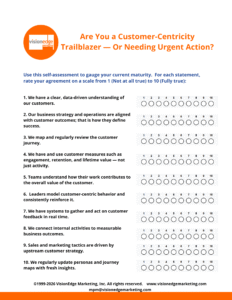
How Did You Score and Next Steps
Score 90–100: You’re a customer-centric trailblazer. You’ve operationalized customer-centricity across your organization — strategy, processes, measurement, and culture are all aligned. Your teams understand and act on customer value consistently.
Where to focus:
- Consider fine-tuning areas where you didn’t score a 10.
- Invest in system-wide optimization and advanced analytics.
- Consider mentoring others or sharing your success story.
Next step: Conduct a clarity audit to ensure alignment at scale and identify pockets of untapped opportunity.
Score 80–89: Strong Foundation, Some Gaps. You’re doing well, but you may be vulnerable. You’ve put many of the right elements in place, but there may be inconsistencies in how they’re applied. Some departments or processes might be operating out of sync with your customer-centric intentions.
Watch for:
- Misaligned incentives
- Inconsistent customer experiences
- Gaps between insights and execution
Next step: Use a readiness review session to identify which areas scored below a 9 and map improvements across silos.
Score 70–79: Good Intentions, Mixed Execution. You’re on the journey — but at risk of stalling. You likely have the language of customer-centricity but not yet the operating model. Some departments may be performing well while others lack clarity or accountability. Customers may be experiencing inconsistency or friction.
Risk: Competitors that are more operationally aligned may pull ahead.
Next step: Identify your lowest-scoring statements and address root causes — especially leadership modeling, feedback loops, and CX metrics.
Score 60–69: Gaps That Threaten Growth. Customer-centricity may be more surface-level than structural. Your organization may be doing some of the right things, but inconsistently or reactively. Key systems — like feedback loops, performance metrics, and journey mapping —are likely underdeveloped or siloed.
Warning Signs:
- High churn or customer confusion
- “Random acts” of customer focus
- Leaders talk about customers but don’t measure their impact
Next step: Start with a facilitated strategy alignment session. Focus on converting vision into daily execution.
Score Below 60: Urgent Action Needed. Customer-centricity is likely a veneer — not a reality. Your current state may be putting retention, growth, and customer trust at risk. If customer-centricity is being used as a buzzword rather than a business system, you’re operating in a danger zone.
Urgent priorities:
- Secure leadership commitment
- Build your customer insight engine
- Create cross-functional accountability
 Next step: Schedule a customer-centricity readiness review session immediately to assess gaps and build your foundation.
How to Get Started: 6 Practical Steps
- Assess Your Current State. Consider having key stakeholders complete the checklist and use the results to find high-impact gaps.
- Map the Customer Journey. Identify any touchpoints along the journey that are among your high-impact gaps. Start with these moments of truth.
- Define Customer-Centric Outcomes. Align success measures to your customers’ outcomes. Note the operative phrase here: your customers’ outcomes, not yours.
- Build Cross-Functional Collaboration. Break silos between marketing, sales, product, and support.
- Implement Balanced Metrics. Identify, select, and track both internal and customer-facing indicators.
- Invest in Learning Loops. Use continuous feedback to fuel innovation and improvement.
Bringing It All Together: From Veneer to Value
Operationalizing customer-centricity isn’t a one-time campaign — it’s a strategic commitment. It’s about moving customer value from the marketing department to the boardroom, from the website to the warehouse floor.
When you embed customer focus into how you plan, execute, and measure success, you shift from being a hollow donut to a company filled with purpose and value — and sustainable growth.
Ready to move beyond the veneer? Let’s schedule a customer-centricity readiness review session. We’ll pinpoint your strengths, uncover the gaps, and chart a tailored path toward measurable, customer-driven performance. Contact me to book your session and start building a truly customer-centric organization — one that grows with clarity, confidence, and purpose.
FAQ:
A1: The donut metaphor captures a governance-grade risk: many organizations declare “we are customer-centric,” but the operating model is hollow. Customer-centricity becomes a veneer—language without systems. When this happens, strategies may look polished yet fail to produce measurable customer value or sustained growth. Boards should care because the absence of customer insight, CX performance visibility, and value-realization measures removes critical leading indicators of competitive position, retention health, and long-term value creation.
A2: Customer-centricity is not a branding exercise; it is a performance multiplier when embedded across the business. Research cited in the article highlights two outcomes leaders should take seriously: customer-centric companies can be significantly more profitable, and organizations whose leaders model customer-centric behavior can achieve materially higher revenue growth. The practical implication is that customer-centricity—when operationalized—improves innovation relevance, deepens relationships, strengthens retention, and builds durable differentiation.
A3: Operational customer-centricity requires eight practical components that translate intent into execution:
- Customer insights as the foundation: Systematically gather and analyze customer needs, expectations, and value drivers.
- Alignment of strategy and operations: Map initiatives and investments to customer outcomes—not internal activity.
- Customer experience (CX) management: Design and manage touchpoints intentionally using journey mapping and “moments of truth.”
- Performance measurement and accountability: Replace vanity measures with customer-impact metrics (CES, CLV, vulnerability, share of wallet) and tie accountability to outcomes.
- Culture and leadership commitment: Leaders model customer-first decisions, reward customer-focused behaviors, and ask customer-value questions consistently.
- Cross-functional collaboration: Break silos so Marketing, Sales, Product, and Support operate as one system delivering customer value.
- Process discipline and operational excellence: Standardize and improve processes that shape reliability, responsiveness, and consistency.
- Learning loops: Continuous feedback mechanisms that turn insight into iteration and improvement.
A4: It means boards expect customer-centricity, require evidence, and govern through metrics and cadence—not anecdotes. Boards should insist on: clear customer outcomes tied to strategy, dashboards that include leading customer indicators (retention risk, effort, onboarding success, value realization timing), and accountability mechanisms that prevent “spin.” In other words, customer-centricity becomes measurable, reportable, and improvable—rather than inspirational.
A5: It shows how customer-centricity becomes real when the organization changes how it operates. The company’s plateau was not due to product quality; it was due to silos, anecdotal feedback, and lack of visibility into risk and value leakage. By building a customer insight engine (VoC + CRM/service data), realigning KPIs to customer value delivered, mapping the journey, creating a Customer Engineering Liaison role, and adding retention/onboarding/value-realization measures to the executive dashboard, the company shifts from intention to execution—and creates measurable improvements in retention, onboarding speed, referrals, and repeat business.
A6: Use a readiness checklist and score yourself honestly. The scoring bands in the article provide a practical diagnostic:
- 90–100: Trailblazer (optimize and scale)
- 80–89: Strong foundation with gaps (fix inconsistencies, align incentives)
- 70–79: Good intentions, mixed execution (risk of stalling; tighten accountability)
- 60–69: Gaps threaten growth (customer-centricity is reactive/siloed)
- Below 60: Urgent action needed (customer-centricity is likely veneer)
The value of the assessment is not the score; it is identifying the lowest-scoring areas that represent the highest leverage improvements.
A7: A disciplined start looks like this:
- Assess current state with key stakeholders to identify the biggest gaps.
- Map the customer journey and prioritize high-impact “moments of truth.”
- Define customer-centric outcomes (customer outcomes, not internal outputs).
- Build cross-functional collaboration to eliminate siloed execution.
- Implement balanced metrics (internal + customer-facing leading/lagging indicators).
- Invest in learning loops so feedback becomes continuous improvement and innovation.
A8: You move customer-centricity from a statement to a system. When customer value is embedded in strategy, processes, measurement, and governance cadence, the organization stops being a hollow donut and becomes operationally aligned around delivering measurable customer outcomes. That is when customer-centricity becomes a growth engine rather than a slogan.
Recent Posts
- Focus on Solving Customer Pain Points to Future-Proof Your Company | What’s Your Edge?
- The Destiny of Siloed Priorities is Random Acts
- The Power of Customer-Led Product Development for Market Growth | What’s Your Edge?
- Footprint Expansion: A Customer-Centric Growth Strategy for Scaling
- The Focus on Right-Fit Customers Yields Faster Profitable Growth | What’s Your Edge


 Customer-centricity is the Only Way to achieve sustainable, profitable growth.
Leave a Reply
You must be logged in to post a comment.