
For this One Good Idea episode, we’re talking about pivoting your growth strategy. For our first-time viewers, One Good Idea is a result of our work with customers and conversations with other business professionals. We always welcome a discussion with you; we promise you will always leave with at least one good idea. Hence the creation of this series.
In this episode, we recall the situations where we had several customers who had completed all the necessary steps to develop their growth strategy and plan. They’re well into implementation when things go haywire. The cause might have been a major shift in the market, a significant and unexpected change in regulation, or an unanticipated geo-political scenario, all resulting in the current plan being blown up.
This happened to many companies during the pandemic which caused firms to pivot or quickly change their strategic direction to adapt. Of course, if a company is committed to scenario analysis they might already have a plan in their “back pocket” for the circumstance. But if not, it’s important to know how to regroup to pivot.
How Do You Know Where to Pivot Your Growth Strategy?
This is a great question. When it comes to pivoting on the fly, it can be better to figure out how to take advantage of the current, so to speak, rather than go against it. For example, during the pandemic we saw plenty of restaurants quickly pivot to takeout and curbside pickup, some restaurants made this a regular option as part of their revised business model.
To survive, businesses must meet market requirements. When you don’t meet market requirements, your business is at a disadvantage against competitors who already have this as part of their business model.
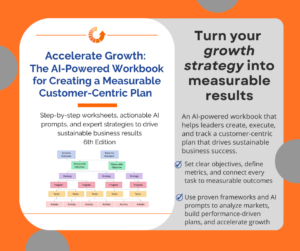
Buy Your Best-Practices Workbook
Let’s return to a B2B example which involved a customer who relied heavily on industry and other in-person events as part of the customer engagement tactics, especially to “demo” and interact with their product. Product experience was a critical part of the customer buying journey.
The pandemic pretty much put an end to in-person events. It didn’t take long before this company began to experience a decline in customer orders. Hence the need to pivot, and pivot quickly.
Keep the Customer Buying Journey in Mind
In our conversation with the president of this company, we quickly explored how they could create ways for customers to “demo” and interact with the product, and potentially experience it. We teed up several ways to do this along with a strategy and set of tactics. We had to think outside the box and explore doing things differently than before.
We began exploring how to quickly leverage virtual events since the industry was also pivoting. 
One of the first steps was to create a virtual interactive demo. That took some time but that has now become a standard part of their customer buying journey. We also suggested creating a cost-effective variation of the product that could be quickly manufactured and ordered so customers could interact and experience the primary features and functions of the product at a lower cost.
They made a series of moves that allowed them to pivot to survive. And they revised their marketing touches accordingly. They recognized the importance of being better able to anticipate various scenarios. As a result, they’ve implemented a scenario analysis process that the leadership team employs quarterly.
Pivoting takes courage. Seems like we may have more than One Good Idea in this episode. Thinking outside the box and using scenarios to help anticipate the unexpected.
Let’s wrap this episode with more than One Good Idea and a Smart Business tip. You can find content on thinking outside the box and using scenario analysis on the VisionEdge Marketing website.
If you found this episode helpful, please like the video. Subscribe to our channel to be notified of more smart business tips that we’ll share in the future.
FAQ:
A1: It means regrouping and shifting strategic direction when unexpected events blow up the current plan—such as market disruption, regulatory change, or geopolitical instability. A pivot is not a restart; it is a practical course correction designed to restore momentum and protect growth.
A2: Because implementation occurs in a dynamic environment. Even strong strategies can be disrupted by forces outside the organization’s control. When conditions change materially, continuing to execute the original plan can waste resources and increase competitive disadvantage.
A3: Use the “current” rather than fighting it. In other words, look for the direction the market is moving and adapt to meet emerging requirements. Survival depends on meeting market requirements; failing to do so puts you at a disadvantage against competitors who already operate with the new conditions.
A4: Scenario analysis reduces surprise and accelerates response. If you have scenarios “in your back pocket,” you can pivot faster and with more confidence. If you do not, the pivot process should include building scenario discipline so the organization is better prepared for future disruptions.
A5: A company that relied heavily on in-person events for product demos experienced order decline when events stopped. The pivot required redesigning the buying journey to preserve product experience—by creating virtual interactive demos and developing a lower-cost, quickly manufactured product variation so customers could still interact with core features.
A6:
- Think outside the box when conditions change; do not default to the old playbook.
- Anchor pivots to the customer buying journey so you preserve the experience buyers need to decide.
- Institutionalize scenario analysis (e.g., quarterly leadership review) to anticipate disruptions and pivot faster next time.
Recent Posts
- Focus on Solving Customer Pain Points to Future-Proof Your Company | What’s Your Edge?
- Customer-Centricity in M&A: The Accelerant for Post-Deal Value
- How Strategic Clarity Drives Growth, Profitability, and Customer Value
- Breaking Through Stagnant Growth with a Customer-Centric, Process-Driven Approach | WYE?
- Why Lack of Accountability is Stalling Your Organization’s Growth


Leave a Reply
You must be logged in to post a comment.