
Regardless of your size or industry, strategic business decisions regarding markets, customers, solutions and the competition should be based on data and insights. Acquiring data and insights often requires conducting research. Use these tips to conduct primary research among direct sources even with limited funds.
Every organization regularly makes critical strategic decisions about markets, which ones to enter or not; about customers,which ones to pursue and how; about solutions, which ones to build, buy, or pass on. Too often companies rely on experience or instinct rather than data. Why? Because data for these types of decisions require conducting research. Good research takes time and money. Bad decisions however are costly and can even be fatal.
Convinced that research is the best option for helping you make better decisions! Then here’s what you need to know.
Base Your Research on a Critical Decision

 Conduct research to inform decisions.
Your company like many we work with has limited time and money. At the same time you need to make decisions about customer needs. Knowing these needs might help you decide what features are most important, the best way to price, purchasing criteria, supplier processes, the alternatives your customers are considering. The sole reason to conduct market research is to secure information and insights that aid a decision.
Therefore you need to clarify your research outcomes right from the start. Before you conduct any research be sure you have a clear understanding of the question you need to answer or the problem you need to solve. Common questions/problems revolve around reducing lost sales, improving customer satisfaction and/or loyalty, reducing customer churn, understanding awareness and perception of your company, products/services, and brands, improving competitive market positioning, and defining new products/services.
Be specific in the purpose/objective of the research. Try to state your question or problem in terms of the business decision you need to make.
For example:
“To decide whether to pursue this market we need to know___________.”
“As a result of this research, we will be able to make the following business decisions(s) _____________.”
Once you understand the problem and opportunity, start the process by answering these four questions:
- What do we know now?
- What are the best opportunities as we understand them now?
- How can we frame our options based on what we know now?
- What do we need to know that we don’t know now to make this decision?”
Be Thoughtful About Your Research Approach
Research is generally thought of as primary; research you collect directly from sources. Secondary research is an alternative option. It involved using research that was conducted for another purpose yet is useful to you. It can also be used to augment your primary research when your own studies are limited.
There are a variety of methods for gathering primary research: interviews, focus groups, and written instruments, mystery shopping/observation and so on. Entire books are available research methodologies.
The key is to choose a method that will answer the question and guide your decision. This often requires securing information from your customers and prospect about their industry, revenue, business pains, technology platforms, and so on. Don’t get married to any particular research technique.Use the technique that is most likely going to give you the information you need.
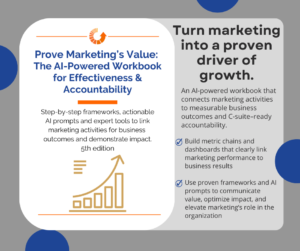
Buy Your Best-Practices Workbook
Good Research Can Be Affordable
Conducting primary research is within any company’s reach. Explore one of these four ways to find the information you need:
- If your budget is tight, start with free or relatively inexpensive secondary research methods. Use the internet to search publications, libraries, and other sources. Reach out to trade associations. Read third party reports in journals or from analysts who cover your industry and look at general demographic information from organizations such as Hoovers, InfoUSA and government agency reports such as The US Census Bureau. Use events you are already attending to gather key information. Have people complete short surveys at your booth and/or at your presentation. In your follow up communication ask people to take a survey and offer them something of value in return a white paper or research report they couldn’t easily secure on their own. Create customer and technical advisory boards you can tap for insight.
- If the information you need isn’t readily available, consider purchasing a third party’s primary research. While the study might not be an exact fit, if the methodology was sound you might be able to use this information to validate your assumptions.
- If there are still holes, consider participating in a primary research effort by joining a study where you can have some specific questions included.You may find a publication or set of partners willing to let you join in for a reasonable investment.
- Conduct your own research. Use your internal resources if you have the expertise needed to develop and test the instrument, conduct the research, and analyze the results. If you don’t, seek the help of research experts.
Convert Your Research Findings into Action
A lot goes into conducting your research. It would be a waste if you didn’t take your effort to the finish line. What does that entail.
- Selecting the right analytics and strong skills to analyze the data.
- Once you complete your analysis, look for the trends, patterns that will help you answer the question.
- Offer clear specific actionable recommendations.
- Create the story around the insights to help your leadership team understand your recommendations.
If research is essential to making an informed decision, then tapping experience and expertise is a worthwhile investment.
FAQ:
A: Relying on experience or instinct alone can lead to costly or even fatal errors. Data-driven research provides the clarity and insights needed to make informed decisions about markets, customers, solutions, and competition.
A: Start by identifying the specific business decision you need to make. Clearly state the question or problem in terms of the intended business outcome. Define what you need to know to inform your decision.
A: Ask:
- What do we know now?
- What are the best opportunities as we understand them now?
- How can we frame our options based on what we know now?
- What do we need to know that we don’t know now to make this decision?
A: Use primary research (gathered directly from sources) for targeted, specific insights. Secondary research (existing data) is cost-effective and can supplement primary research. Choose the method most likely to answer your business question.
A: Four practical approaches:
- Use free or low-cost secondary sources (internet, associations, government data, events).
- Purchase third-party primary research to validate assumptions.
- Participate in group studies to include your questions at a lower cost.
- Conduct your own research if you have the expertise, or engage research experts.
A: Analyze data for trends and actionable insights, then provide clear, specific recommendations. Present findings as a story to help leadership understand and act on your recommendations.
A: VisionEdge Marketing offers guidance and expertise in research design, analytics, and actionable recommendations to support better business decisions.
Recent Posts
- Focus on Solving Customer Pain Points to Future-Proof Your Company | What’s Your Edge?
- Customer-Centricity in M&A: The Accelerant for Post-Deal Value
- How Strategic Clarity Drives Growth, Profitability, and Customer Value
- Breaking Through Stagnant Growth with a Customer-Centric, Process-Driven Approach | WYE?
- Why Lack of Accountability is Stalling Your Organization’s Growth


You must be logged in to post a comment.