
Social media marketing- one of Marketing’s shiny toys. Social media is a game-changer; it has fundamentally changed the way we speak to customers, drive conversations, and increase sales. Consider that even NASA has created a Twitter account (which has 2.05 million followers) for the Mars Curiosity Rover to generate conversation and function as a PR channel for the organization as they shoot for the stars.

Marketers believe that because social media marketing is more targeted and personal, it is ideal for spreading word-of-mouth (WOM) for your products, your brand, and for establishing a relationship with your prospects and customers. Compared to traditional marketing, which often involves force-fed messages being widely distributed, social media marketing is about targeting specific customers and engaging them with something that is direct, memorable, and meaningful to them. Social media marketing requires learning and using tools to make your social media marketing efforts effective.
Two Key Social Media Questions
You know in your gut that social media channels are working, but how can you tell what is actually resonating with prospects and customers and what is lost in the endless noise? Two questions seem to be consistently top of mind with marketers when it comes to social media:
- How do we effectively use, engage, and acquire new customers and transform existing customers into advocates?
- How do we use social media to improve company visibility, strengthen customer relations, identify new revenue opportunities, and create viral word-of-mouth?
Knowing requires analysis and measurement. So, what should you be measuring when considering your social media presence in order to prove and quantify its value? Rather than looking at social media as a broad-brush stroke, we recommend linking social media programs to specific business outcomes (e.g., some number of existing customers buying a new service or product and then to the marketing objectives (e.g., some number of existing customers trying the new service or product) designed to achieve those outcomes. Then you can monitor whether the program is having any impact and ascertain whether adjustments are needed.
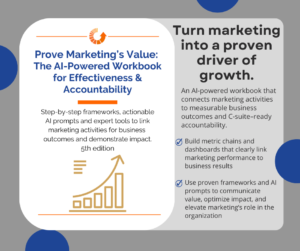
Buy Your Best-Practices Workbook
Your social media marketing measures and metrics should include a selection from each of the following categories:
- Activity and Output Measures & Metrics: These are measures and metrics associated with counting production of “things” such as the number of new posts or actions (outputs) from something you produce, such as page views, number of visitors, or number of comments, etc. Anything that measures activity associated with the social media effort can be included in activity metrics and ideally has a corresponding output. Select metrics that are relevant to the purpose of social media efforts in the first place.
- Operational Measures & Metrics: These include traditional lead measures and metrics focused on efficiency, such as cost/lead or community, number of leads/time period, ratio of qualified to non-qualified leads, etc.
- Customer Engagement/ Relationship Metrics: These metrics include measures such as affinity measures, referral rates, content and connection relevance, etc.
- Outcome-based Metrics: While it may not be easy to get to a financial ROI, you can assess whether your social media efforts are creating value and achieving the expected results. To do this, you will first need to know which needles you want to move and how to track the impact of your social media efforts against these business targets. For example, your outcome might be to increase offline sales by $X, or increase share of wallet by X% within a specific time period. If you understand the value of each of these, then you can begin to quantify the value derived from the social media effort.
Employ These Best Practices to Make Your Social Media Efforts Payoff
If you’re like many companies, you’ve been so gung-ho to get into the game, you haven’t really had a plan. We all know that with any endeavor, we are more likely to be successful if we have a plan than if we just shoot from the hip. Companies successfully utilizing social media employ these best practices:
1. They tie their social media tactics to a clear, measurable objective – such as growing share of preference.
2. They have outcome-based performance targets for social media programs and activities (such as increasing the number of inquiries or demos).
3. They are premeditated in their communication- These firms think about the messages they are sending out and focus on making them meaningful, relevant, and consistent.
4. They take a conversational, brief tone. They use informal, personable language and avoid blatant advertising messages and sales solicitations. They recognize social media is really about creating a conversation. And a conversation entails listening and responding.
5. They think beyond their own social media vehicles. For example, they search for topics related to their business and target market on LinkedIn and Facebook and join the conversation. They are active in responding to comments and participating in conversations.
6. They share. They share information, provide links to helpful resources that may not necessarily be their own, they participate in blogs on other sites, passon relevant news stories, etc.
Social media has become a major touch point that all marketers need to leverage to keep their organization customer-centric and relevant. For tips on the metrics needed to help you shoot for the stars, contact us about our workbook “Leveraging 8 Key Metrics for the Customer-Centric Organization.” Or, learn what your company can do to improve customer experience and engagement across all touch points with VEM’s Touch Point Effectiveness Lab. Or, if this is a strategic initiative, time is of the essence, or you need an objective third party, contact us to discuss your goals and timeline.
FAQ:
A: Because it has fundamentally changed how organizations communicate with customers, drive conversations, and influence sales. Social media enables more targeted, personal engagement than many traditional channels—and can accelerate word-of-mouth and relationship-building at scale.
A:
- How do we effectively engage and acquire new customers—and transform existing customers into advocates?
- How do we use social media to improve visibility, strengthen customer relationships, identify new revenue opportunities, and create viral word-of-mouth?
A: Because “knowing in your gut” is not enough to determine what is resonating versus what is lost in the noise. Measurement enables analysis, course correction, and proof of value—especially when social media is tied to specific business outcomes and marketing objectives.
A: Start by linking social media programs to a specific, measurable business outcome (e.g., increase offline sales by $X, grow share of wallet by X%, increase share of preference). Then link that outcome to the marketing objectives designed to achieve it (e.g., number of customers trying a new service). This structure enables you to monitor impact and adjust tactics.
A: Include a selection from each category:
- Activity and output metrics: Volume of posts and resulting outputs (page views, visitors, comments). Select metrics aligned to the purpose of the effort.
- Operational metrics: Efficiency and lead-related measures (cost per lead/community member, leads per period, qualified vs. non-qualified ratio).
- Customer engagement/relationship metrics: Affinity, referral rates, content relevance, connection relevance, and relationship strength indicators.
- Outcome-based metrics: Measures tied to business targets (e.g., revenue impact, offline sales lift, share of wallet, retention, preference). Even if full ROI is difficult, outcome-based tracking helps quantify value.
A: Companies that use social media successfully tend to:
- Tie tactics to clear, measurable objectives (e.g., grow share of preference).
- Set outcome-based performance targets (e.g., increase inquiries or demos).
- Be premeditated in communication—messages are meaningful, relevant, and consistent.
- Use a conversational, brief tone—informal and personable, avoiding overt advertising; listen and respond.
- Think beyond owned channels—join conversations on LinkedIn/Facebook around relevant topics; engage actively in comments.
- Share value—links to helpful resources (not only your own), participate on other sites, and pass along relevant news.
A: Social media is a major touchpoint that helps keep an organization customer-centric and relevant. When measured and managed against outcomes, it can strengthen engagement, improve relationships, and support acquisition, retention, and advocacy.
Recent Posts
- Focus on Solving Customer Pain Points to Future-Proof Your Company | What’s Your Edge?
- Customer-Centricity in M&A: The Accelerant for Post-Deal Value
- How Strategic Clarity Drives Growth, Profitability, and Customer Value
- Breaking Through Stagnant Growth with a Customer-Centric, Process-Driven Approach | WYE?
- Why Lack of Accountability is Stalling Your Organization’s Growth


You must be logged in to post a comment.