
Have you ever had one of those piles on your desk that you keep moving from one corner to another? You know that you need to get to it, but avoid it because it will take some real effort to tackle. For many leaders and professionals responsible for Marketing, accountability, metrics, analytics, and performance management are in that pile.
Not too long ago, at a conference where Laura was speaking, the organizers had set up breakfast table discussions. Laura was sitting at the Measuring Marketing ROI table, which was strategically located right next to the buffet line. While she was sitting there, she kept hearing people say things like, “Oh, measuring Marketing, that’s just too hard.” Or “Our tools give us the measures we need.” Or “We have this measurement thing figured out.” If that were true, the Gartner study wouldn’t have concluded that “CMOs struggle to align marketing metrics with business priorities.”
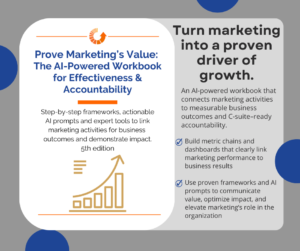
Buy Your Best-Practices Workbook
Marketing Accountability Enables Effectiveness and Efficiency
We must stop avoiding this topic and tackle the pile. As Sylvia Reynolds, the CMO of Wells Farg,o says, “Marketing must be a driver of tangible business results…we must start with the goal in mind and a clear way to measure that goal.” Measuring Marketing’s value, contribution, and impact is critical for Marketing accountability. Accountability enables us to justify spending and run the Marketing organization more effectively and efficiently, and knowing what is and isn’t working helps us achieve greater influence and serve in a more strategic role. Various surveys suggest that 33-42% of Marketing budgets are insufficient to achieve the expected outcomes and impact.
Perhaps your organization, like many others, is in the midst of budget planning. A key part of the process is to establish and validate the money you plan to spend. The more aligned Marketing is with the outcomes of the organization, and the extent to which the plan includes performance targets and metrics, the more likely you will be allocated the budget you need to achieve the expected results. Marketing accountability goes a long way toward helping secure the budget.
Six Affordable Steps for Improving Accountability and Performance Management
So what does it take to tackle this Marketing Accountability pile and improve performance management? Here are six affordable steps any Marketing organization can take to get started.
- Be Focused. Nothing that is relevant gets done on its own. To effectively tackle Marketing measurement will take all of Covey’s seven habits: from taking a proactive approach and beginning with the end in mind (the outcomes you are expected to impact) to keeping the effort a priority when other things present themselves as urgencies, to making marketing measurement a win/win for you, your team, and the rest of the organization. More than likely, you are going to need a cross-functional team to achieve this goal – people from finance, sales, IT, operations, etc., working collaboratively together to define the metrics and hunt down and organize the data.
- Plan an attack. You know that age-old question, “How do you eat an elephant?” The answer is, “One bite at a time.” This is true for answering the Marketing accountability question. If this is a new effort for you, you need to break it into manageable pieces. Quantify your objectives, decide how you will measure them, collect the data that you need to meet the objectives, establish a baseline, gain commitment to the measurement plan, and finally, measure results.
- Collect data. “Data is the new creative,” declares Stephan Chase of Marriott Rewards. Establishing metrics, determining effectiveness, and understanding efficiencies all take data. Without data, you cannot monitor and measure results. And don’t assume that you have the data needed to measure your objectives. For example, if you want to measure how many new customers are interested in a new product, you may find that you need first to determine what constitutes a “new” customer. This may require different views of your existing customer records or new evaluation strategies.
- Analyze. Once you have the right data, the challenge is to generate insights that facilitate fact-based decision-making. One of the most valuable applications of data and analytics is in leveraging your metrics. Metrics enable continuous improvement as you strive to achieve and set new performance standards. Just looking at numbers doesn’t tell you as much as evaluating trends or creating statistical models that help you identify an optimized approach to your marketing efforts. Consider looking at your measurements for what isn’t immediately obviou,s such as what might have happened if that campaign had gone to the three bottom deciles of customers?
- Use a systematized process. You may need to set up systems and processes that enable you to capture and track results on an ongoing basis.
 Many organizations put a substantial amount of energy into initiating these programs and then let them fizzle as other priorities surface. It takes both process and discipline to sustain a measurement effort. Systems help you automate a process so that the process can become a manageable part of your day-to-day operations. Today, every marketing organization is moving at a breathless pace. Implementing a test and control environment can keep you from having a fatal, head-on collision
 Many organizations put a substantial amount of energy into initiating these programs and then let them fizzle as other priorities surface. It takes both process and discipline to sustain a measurement effort. Systems help you automate a process so that the process can become a manageable part of your day-to-day operations. Today, every marketing organization is moving at a breathless pace. Implementing a test and control environment can keep you from having a fatal, head-on collision
- Get in Shape. Many marketers are unaccustomed to living in a metrics-oriented environment. You may need to invest in measurement, analytics, data training, and skills development. Start by taking a skills inventory. Find out who in the organization has data management, analytics, and measurement skills.

Decide what skills they need to perform at your expected levels. Develop or bring in training that fills the skill gaps. Doing this in-house allows you to tailor to your needs, but consider courses from universities, associations, and external consultants to fill out your requirements.
FAQ:
A: Because it often feels like the “pile on the desk”—important, unavoidable, and effort-intensive. Many leaders assume measurement is too hard, believe their tools already provide what they need, or think they have measurement “figured out.” Yet research (including Gartner) continues to show CMOs struggle to align marketing metrics with business priorities.
A: Accountability enables Marketing to demonstrate value, contribution, and impact—helping justify spending, improve effectiveness and efficiency, and strengthen Marketing’s strategic influence. When leaders know what is and isn’t working, they can allocate resources with discipline and improve outcomes.
A: It means defining the outcomes Marketing is expected to influence and establishing a clear way to measure progress toward those outcomes—before launching programs. As Sylvia Reynolds (Wells Fargo CMO) notes, Marketing must be a driver of tangible business results, which requires measurement designed around goals.
A: During budget planning, the more clearly Marketing aligns to enterprise outcomes—and the more the plan includes performance targets and metrics—the more credible the budget request becomes. Accountability increases the likelihood of securing adequate funding to achieve expected results, especially when surveys suggest 33–42% of Marketing budgets are insufficient for expected impact.
A:
- Be focused: Treat measurement as a priority; begin with outcomes; build a cross-functional team (Finance, Sales, IT, Operations) to define metrics and organize data.
- Plan an attack: Break the work into manageable steps—quantify objectives, define measures, collect data, establish baselines, secure commitment, and measure results.
- Collect data: Ensure the required data exists and definitions are clear (e.g., what qualifies as a “new customer”); don’t assume your systems already capture what you need.
- Analyze: Move beyond isolated numbers to trends, comparisons, and models that generate insight and enable optimization (including “what if” analysis).
- Use a systematized process: Put repeatable processes and systems in place to sustain measurement; consider test-and-control environments to reduce risk and improve learning.
- Get in shape: Build measurement capability—inventory skills, identify gaps, and invest in training for data management, analytics, and measurement.
A: Lack of process and discipline. Many organizations launch measurement initiatives with energy, then allow them to fizzle as new urgencies arise. Systematized processes and enabling systems help make measurement sustainable in day-to-day operations.
A: Start with a skills inventory, define the competency levels required, and close gaps through tailored internal training and/or external programs (universities, associations, consultants). Building capability is essential to making accountability operational—not aspirational.
Recent Posts
- Focus on Solving Customer Pain Points to Future-Proof Your Company | What’s Your Edge?
- Customer-Centricity in M&A: The Accelerant for Post-Deal Value
- How Strategic Clarity Drives Growth, Profitability, and Customer Value
- Breaking Through Stagnant Growth with a Customer-Centric, Process-Driven Approach | WYE?
- Why Lack of Accountability is Stalling Your Organization’s Growth


You must be logged in to post a comment.