
Podcast: Play in new window | Download (Duration: 7:10 — 4.1MB) | Embed
In the realm of modern business, the quest for customer-centricity takes on the character of a strategic venture—fraught with challenges yet ripe with proven top and bottom-line rewards. However, like intrepid explorers who encounter obstacles along the way, business leaders often stumble upon common pitfalls that unknowingly jeopardize their path to competitive-level customer-centricity. This episode of What’s Your Edge? delves into four prevalent mistakes related to strategy, data, insights, and measurement that are often made in the pursuit of customer-centricity and how these missteps can be transformed into strategic advantages for success.
Ready to recognize and overcome common stumbling blocks to chart a course to success? Let the exploration begin!
Lack of a Strong and Clearly Communicated Customer-Centric Strategy
One of the first obstacles we often encounter in our work with business leaders is the absence of a strong clearly communicated strategy. Business leaders would do well to heed the wise words of Jeroen Kraaijenbrink who teaches at the University of Amsterdam Business School and the TSM Business School in Enschede, “organizations today still need to be prepared for the future, find ways to distinguish themselves, stability to maintain themselves, common frame of reference everyone can refer to, and alignment and guidance for the actions that they perform. Without any one of these core functions of strategy, the risk of drifting away with the winds of change is simply too large for any organization today.”
A customer-centric quest without a strong strategy can result in fragmented efforts and inconsistent customer experiences.
How to Course Correct:
Before you begin your quest, define what customer-centricity means for your organization. According to Dr. Peter Fader, author of Customer Centricity, a company that is customer-focused offers customers a consistently great and relevant experience across all touch points. You are customer-centric when you’re customer-focused and your business efforts are focused on high-value customers with an emphasis on customer lifetime value. Start developing your strategy by answering these two questions:
- What are your customers’ most vital needs and desires?
- How can you surpass your competitors in fulfilling these needs?
Use the answers to these questions to create a customer-centric strategy that serves as a beacon. Outline your goals and chart the path you’ll take to achieve them. Ensure that this strategy is not hidden away in an obscure file but is shared across your organization, inspiring everyone from employees to partners, to align their efforts with the quest for customer-centricity.
Ineffective Use of Data to Uncover Valuable Customer Insights
Without the right analytics framework and skills, more data does not necessarily yield more insights. While most organizations have access to a treasure trove of data, many organizations struggle with using this data effectively. As a result, businesses fail to uncover valuable insights needed to succeed in their customer-centric quest.
Since 2012, NewVantage Partners has conducted a survey of data and information executives. In their most recent study, they found that “just 23.9% of companies characterize themselves as data-driven, and only 20.6% say that they have developed a data culture within their organizations, reflecting that becoming data-driven is a long and difficult journey that organizations increasingly recognize playing out over years or decades.”
How to Course Correct:
The data-to-insights journey is a quest of its own. Focus on creating a data-to-insights culture. To master the art and science of data, equip your organization with well-experienced professionals and resources needed to collect, analyze, and interpret customer data effectively.
Break down the barriers that confine your data in hard-to-access silos. Make your data accessible and shareable so everyone tasked with the customer-centricity quest can identify opportunities to improve strategies, processes, and customer interactions.
Failure to Turn Customer Insights into Powerful Actions
As we venture deeper into the realm of analytics, we often uncover priceless insights about our customers. Yet, a Forrester report found that while 74% of firms say they want to be “data-driven,” only 29% are actually successful at connecting analytics to action. A study by Fivetran, a global leader in modern data integration, revealed, that “while ubiquitous for enterprises today, very few companies are able to correctly leverage the data of these systems for decision-making.”
How to Course Correct
The quest to achieve customer-centricity is greatly hampered if your organization remains challenged to translate insights into action. It’s akin to acquiring a valuable tool but not knowing how to wield its power. One way to tackle this challenge is with a well-honed insights supply chain.
Borrow the five supply chain stages from The Supply Chain Operations Reference (SCOR) model to Plan, Source, Make, Deliver, and Return to maximize your opportunity to increase customer value and sustain a competitive advantage.
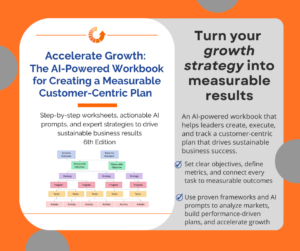
Buy Your Best-Practices Workbook
Neglecting to Measure 3 Important Customer Centricity Measures
How will you know how close you are to achieving your customer-centricity quest? Many organizations neglect to measure their journey toward customer-centricity, making it challenging to discern what is working and what adjustments are needed. Lack of customer-centric measures is a fourth common mistake.
Without clear measurable outcomes for your customer-centric initiatives and the ability to diligently track your progress, it will be hard to stay on the right path.
How to Course Correct
In our guide “Bring Your A-Game to a Customer Empowered Market” and our “CustomerDNA” Infographic, we offer activities & actions, approaches & strategies, and the 3 most important measures, that together predict whether you will win more customers by improving customer-centricity. Use the CustomerDNA model as a framework and checklist to determine what it takes to achieve a customer-centric growth A-Game and how to measure your success. The white paper covers seven signals that you may be off your A-Game and recommends 5 steps to get it back.
Be the hero in your organization’s quest for customer-centricity by ensuring your organization doesn’t fall victim to these four common mistakes. It is possible to overcome each pitfall and emerge from your customer-centricity quest more competitive and resilient, better attuned to your customers’ needs and priorities, and well-prepared for the ever-evolving business landscape. Be brave adventurers and fully reap the rewards of a customer-focused future.
FAQ:
A1: Because customer-centricity is not a slogan or a single program; it is a strategic operating model. Leaders often pursue it with good intent but stumble on predictable pitfalls related to strategy, data, insights-to-action, and measurement. These missteps create fragmented efforts, inconsistent experiences, and weak accountability—undercutting both customer value and business results.
A2: Without a clear strategy, customer-centricity becomes a collection of disconnected initiatives. Teams interpret “customer-centric” differently, priorities conflict, and the customer experience becomes inconsistent across touchpoints.
How to course correct: Define what customer-centricity means for your organization and make it explicit. A practical definition aligns with delivering a consistently relevant experience while focusing effort on high-value customers and customer lifetime value. Start by answering:
- What are our customers’ most vital needs and desires?
- How will we outperform competitors in fulfilling them?
Then translate the answers into a shared strategy—communicated broadly so employees and partners can align decisions and actions.
A3: More data does not automatically produce better insight. Without the right analytics framework, skills, and accessibility, data becomes noise—often trapped in silos. Research consistently shows that relatively few organizations consider themselves truly data-driven or have built a durable data culture.
How to course correct: Build a data-to-insights culture supported by the right talent and tools. Break down silos and make customer data accessible and shareable so teams can identify patterns, opportunities, and experience gaps that inform strategy, process improvement, and customer interactions.
A4: It creates “analysis without advantage.” Many firms aspire to be data-driven but struggle to connect analytics to decisions and execution—meaning insights remain interesting, not useful.
How to course correct: Establish an insights supply chain—a repeatable process that moves from planning and sourcing data, to producing insights, to delivering actions and learning loops. Treat insights as an operational asset with owners, handoffs, and performance expectations—not a report.
A5: Because what you do not measure, you cannot manage. Without defined outcomes and customer-centric metrics, leaders cannot tell whether initiatives are improving customer value—or simply creating activity.
How to course correct: Establish a small set of customer-centric measures that reflect progress toward customer value and competitive CX. Use a framework (such as a CustomerDNA-style checklist) to define outcomes, track progress, identify “off-course” signals, and drive corrective action.
A6: Customer-centricity becomes a competitive advantage when it is treated as a disciplined system: clear strategy → usable data → operationalized insights → measurable outcomes. Avoid these four pitfalls, and you increase the odds of delivering consistent customer value, improving resilience, and earning the top- and bottom-line rewards of a customer-focused future.
Recent Posts
- Focus on Solving Customer Pain Points to Future-Proof Your Company | What’s Your Edge?
- Customer-Centricity in M&A: The Accelerant for Post-Deal Value
- How Strategic Clarity Drives Growth, Profitability, and Customer Value
- Breaking Through Stagnant Growth with a Customer-Centric, Process-Driven Approach | WYE?
- Why Lack of Accountability is Stalling Your Organization’s Growth


 Customer-centricity is the Only Way to achieve sustainable, profitable growth.
Leave a Reply
You must be logged in to post a comment.