
The importance of good planning and execution seems obvious. A good strategy that is customer-centric and well-executed has the ability to positively impact a market, competitive position, or business model. Developing and implementing growth plans and strategies designed to increase revenues for the business often falls within Marketing’s domain. It is Marketing’s job to identify, quantify, and drive new products, new market opportunities, and new process initiatives as well as direct aspects of the organization’s marketing policies, objectives, strategies, and tactics.
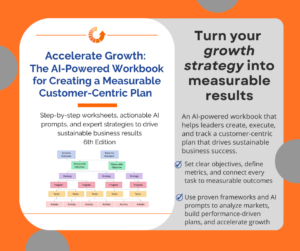
Buy Your Best-Practices Workbook
A solid growth plan is grounded in your company’s strategic plan. Strategic planning needs to be a core part of your growth and development process. Strategic planning revolves around allocating the resources of money, time, people, and capital to engineer a more profitable business. The process analyzes an organization’s core capabilities and weaknesses, the market size, market share potential, and competitive factors.
A strategic plan generally addresses a one-year or multi-year time horizon. It details everything from product launches and infrastructure investments to brand position and pricing schemes, all aimed at outmaneuvering competitors. A good strategic plan never takes its eyes off the prize of building long-term customer value. Good strategies are customer-centric. At the same time, it must be capable of undergoing continuous refinement to drive real impact quickly.
Employ a 3-Phase Process for Customer-Centric Strategic Planning
 Gain customer and market insight. This phase requires gathering key information about the needs and values of customers and the market, especially the high-value groups. Questions often addressed in this phase include: How much are different customer groups and market segments worth and what are their potential values; which customers/markets drive your business today; which customers/markets offer the highest potential return for driving your business tomorrow; and what are their most important needs? If you don’t know the answers to these questions, then conduct the necessary research to gain the answers. Data, processes and metrics are needed to ensure your strategy achieves the desired results.
- Identify Strategic Opportunities. This phase involves analyzing the market, competition, and trends. The kinds of questions typically addressed in this phase include: How large is the market? Are there enough of these customers out there to justify investment? Are their numbers growing or declining? What channels do they use? How likely are their needs to change in the future? How well is the competition meeting these needs? Consider incorporating scenario analysis into your process.
- Develop the Plan’s Strategic Initiatives. In this phase, identify and selects initiatives that will enable your organization to achieve its objectives. Initiatives can include product launches, operational maneuvers, marketing campaigns, pricing changes, and so forth. They are determined according to a number of criteria: What are your core capabilities? How do they stack up against the needs of the valuable customers you are trying to acquire? What can financial models around each initiative tell us about the likelihood of success?
 Gain customer and market insight. This phase requires gathering key information about the needs and values of customers and the market, especially the high-value groups. Questions often addressed in this phase include: How much are different customer groups and market segments worth and what are their potential values; which customers/markets drive your business today; which customers/markets offer the highest potential return for driving your business tomorrow; and what are their most important needs? If you don’t know the answers to these questions, then c
Better to have a good strategy and no written plan than a written plan built on a bad strategy. Failure is expensive and wastes precious resources. Whatever role you play in whatever size organization, success hinges on using market and customer insights to leverage market opportunities and make strategic decisions. Most companies find using an outside resource to facilitate the strategic planning process extremely helpful, especially if the outside resource can help with the research phase. Also check out our workshops to leverage proven processes.
FAQ:
A: A customer-centric, well-executed strategy can materially improve market impact, competitive position, and business performance. Because growth planning often sits within Marketing’s domain, Marketing must identify, quantify, and drive new products, new market opportunities, and key process initiatives—and then translate strategy into measurable execution.
A: A solid growth plan is grounded in the strategic plan. Strategic planning focuses on allocating money, time, people, and capital to build a more profitable business by assessing core capabilities and weaknesses, market size and share potential, and competitive dynamics.
A: Strategic plans generally span one year or multiple years and often address product launches, infrastructure investments, brand positioning, and pricing—all aimed at outmaneuvering competitors while building long-term customer value. Strong plans remain adaptable and are refined continuously to drive real impact.
A:
- Gain customer and market insight: Identify high-value customer groups, quantify current and potential value, and clarify needs and buying criteria. Use research when answers are unclear, supported by data, processes, and metrics.
- Identify strategic opportunities: Analyze market size, growth/decline trends, channel preferences, evolving needs, and competitive performance. Scenario analysis can strengthen this phase.
- Develop strategic initiatives: Select initiatives (e.g., product launches, operational improvements, campaigns, pricing changes) based on capabilities, customer needs, and financial models that indicate probability of success.
A: A written plan built on a weak strategy is more dangerous than having a strong strategy without a formal document. Poor strategy leads to expensive failure and wasted resources.
A: Many organizations benefit from an external facilitator—especially one who can support the research and insight phase—to reduce internal bias, accelerate alignment, and improve decision quality.
Recent Posts
- Focus on Solving Customer Pain Points to Future-Proof Your Company | What’s Your Edge?
- Customer-Centricity in M&A: The Accelerant for Post-Deal Value
- How Strategic Clarity Drives Growth, Profitability, and Customer Value
- Breaking Through Stagnant Growth with a Customer-Centric, Process-Driven Approach | WYE?
- Why Lack of Accountability is Stalling Your Organization’s Growth


You must be logged in to post a comment.