
The spread of social networking and the proliferation of information at one’s fingertips has created an empowered customer. These empowered customers can now discover, compare, evaluate, choose and experience brands all without direct contact or experience with a company. There’s some research that supports what many companies are seeing from their own data – that customers will now switch brands without hesitation if they get a better offer. For some of our customers as much as 40% of their customers generate 60% of the turnover.
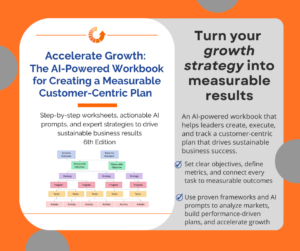
Buy Your Best-Practices Workbook
There are all kinds of reasons for this situation, ranging from failing to meet customer expectations, creating less than satisfactory customer experiences, poorly designed loyalty programs, and failing to remain relevant to customers and the market. And the increase flow of data to the mix and it becomes difficult to sift out the root of the problem and design appropriate initiatives to improve customer service and retention.
Stemming the tide of customer defection is important to your company’s long-term viability. A study by Accenture of more than 700 companies found that marketing and customer management impact customer loyalty and ultimately increase company margins and shareholder value.

Invest in Five Capabilities to Enhance Customer Loyalty
In the Age of the Empowered Customer, the following five capabilities can positively impact your ability to create and improve customer loyalty.
- Develop and deliver a “branded” experience. Branding when done well enables your customers to form and emotional attachment with your brand, whether that’s a company or a specific solution. It is essential that the essence of your brand is apparent in every interaction your customer has with your company. Your brand promise must permeate across every touch point. Employees, customers, partners all must experience the same brand promise.
- Innovation. Innovation is what enables companies to continue to meet customer needs and satisfy customer wants. This innovation extends beyond new product development. It applies to employing new research techniques, to developing new partners to make it easier for customer to buy, to how you expand into new markets. Innovation is the foundation for being first to market on any front; such as being first to market, developing value propositions that address latent demand and implementing leading marketing and customer management techniques. High-performing companies make offerings attractive to more customers and experiment with new channels as they expand into new markets. They also apply new research techniques and study future needs while strategically using channels to present a consistent face to customers.
- Harness talent and technology. A rather obvious and important capability. There is a high correlation between employee loyalty and customer loyalty. Hire, manage, train and retrain the most talented people you can. Give them the technology and processes to work efficiently. Apply technology whenever you can to routine processes. Create ways to share best practices throughout your organization.
- Data and Analytics. Every company today is gathering and grappling with data. Data is only valuable if you can translate into insights that you then use. Leaders use advanced analytics to gain greater insight into customer behavior. They create a data-analytics-insights culture.
- Drive Marketing to meet performance objectives. High-performance marketers have an organizational structure that enables work across functional areas, incorporates clear job descriptions and aligns with business goals. In this organizational structure, marketers and customer managers track performance against goals that are tied to business objectives and enable timely measurement of brand impact on business performance. Learn how to organize your teams to be more customer-centric.

Each of these capabilities enable your organization to focus on how to improve keeping your customers. Combined they create a powerful recipe to enhance customer loyalty.
One of the best observable customer behaviors that help you assess whether your customer loyalty efforts are working is word of mouth. Numerous studies have found that existing loyal customers who actively recommend and endorse your company and brand help drive sales. Customer loyalty studies have found that most consumers and customers prefer “recommendations” as part of their purchasing decision. Some studies find that 70% of customers are more likely to purchase as a result of a personal recommendation or online review.
Investing in stellar customer experiences that produce recommendations and referrals is one of the best things any marketer can do to affect brand and customer loyalty. To understand what constitutes stellar customer experience requires “listening” to customers. As you think about the importance of listening, review your Marketing budget. What percentage of your Marketing budget is actually designated for listening to customers and stimulating recommendations? Is there a line item in your budget for voice of customer, customer advisory boards, and other customer listening initiatives? If not, you may be missing the boat. Customers view listening as one of the top things they want a company to do. What do they want you to listen to? Use their feedback related to existing and new products and services to answer this question for starters.
If you’re serious about customer loyalty and experience, then at a minimum invest in these two affordable efforts: Establishing customer advisory boards and initiating a voice of customer. Both of these are techniques any company can implement with just a little help and guidance.
FAQ:
A: Customers now discover, compare, and evaluate brands independently—and will switch without hesitation for a better offer. For some companies, 40% of customers generate 60% of revenue, making retention critical.
A: Reasons include unmet expectations, poor experience, weak loyalty programs, and irrelevance. Stemming defection is vital to long-term viability and shareholder value.
A: Strong. Accenture research found marketing and customer management impact loyalty, which increases company margins and shareholder value.
A: (1) Deliver a branded experience (consistent brand promise across touchpoints), (2) innovation (products, channels, research techniques), (3) talent and technology (employee loyalty drives customer loyalty), (4) data and analytics (insights guide decisions), and (5) performance-driven marketing (aligned to business objectives).
A: High correlation exists. Talented, well-trained employees with the right tools and processes deliver better customer experiences—which drives loyalty and recommendations.
A: Create cross-functional structure with clear job descriptions aligned to business goals. Track performance against objectives tied to business outcomes, enabling timely measurement of brand impact.
A: Word of mouth and referrals. Studies show 70% of customers are more likely to purchase based on personal recommendations or online reviews—making referrals a key loyalty metric.
A: (1) Customer advisory boards and (2) Voice of Customer (VoC) programs. Both are implementable with modest resources and signal to customers that you’re listening—which customers value highly.
Recent Posts
- Focus on Solving Customer Pain Points to Future-Proof Your Company | What’s Your Edge?
- Customer-Centricity in M&A: The Accelerant for Post-Deal Value
- How Strategic Clarity Drives Growth, Profitability, and Customer Value
- Breaking Through Stagnant Growth with a Customer-Centric, Process-Driven Approach | WYE?
- Why Lack of Accountability is Stalling Your Organization’s Growth


You must be logged in to post a comment.