
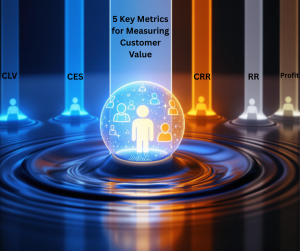
How do you quantify customer value? Any company that is or aspires to be customer-centric needs to focus on creating and quantifying this important metric. Customer value is the measurable worth your customers bring to your business over time. It encompasses more than revenue—it reflects loyalty, advocacy, and the overall impact of each customer on your long-term growth. Businesses that quantify customer value gain a strategic advantage. Many of our customers struggle to identify the right metrics to measure customer value and act on. And while we have written many articles on various customer measures, we thought it might be helpful to suggest five we have found matter the most and how to use them.
In this article, we’ll cover:
- 5 key metrics for quantifying customer value
- 3 common pitfalls to avoid
- 4 practical steps to get started
5 Key Metrics That Matter the Most for Measuring Customer Value
While there are dozens of customer-related measures, we have found these five provide the clearest lens into and have the greatest ripple effect on value creation and long-term ROI. These metrics help you identify your most profitable segments, wisely allocate resources, and design strategies that foster loyalty and retention.
- Customer Lifetime Value (CLV): CLV is the cornerstone of customer value measurement. It calculates the total revenue a customer is expected to generate over their relationship with your business. We recommend it be among your key performance indicators (KPIs).
- Why it matters: CLV helps you prioritize high-value customers and allocate resources to retain them.
- Use this measure to:
- Identify which customer segments contribute the most to your revenue and profitability
- Offer loyalty programs, personalized experiences, or exclusive benefits to retain high-CLV customers
- Inform marketing spend to ensure acquisition costs align with long-term profitability
- Evaluate the impact of customer-centric strategies
- Customer Effort Score (CES): CES measures how easy it is for customers to interact with your business. Whether it’s navigating your website, resolving an issue, or making a purchase, effortless experiences lead to loyalty.
- Why it matters: Research shows reducing customer effort is a stronger predictor of loyalty than exceeding expectations.
- Use this measure to:
- Identify breakpoints in the customer journey
- Uncover patterns in areas where customers face challenges
- Maintain a continuous focus on ease of doing business
- Customer Referral Rate (CRR): CRR tracks the percentage of customers who refer others to your business. It’s a direct indicator of advocacy and satisfaction.

- Why it matters: Referrals are one of the most cost-effective ways to acquire new customers. A study conducted at Wharton Business School found that referred customers, on average, are $0.45 more profitable per day than any other customers. In addition, the customer acquisition cost (CAC) for these customers is $23.12 less than non-referred customers.
- Use this measure to:
- Track which customer segments generate the most referrals and reward them
- Identify and nurture advocates who can amplify your brand’s reach
- Evaluate the effectiveness of loyalty and/or referral programs
- Customer Retention Rate: Retention is a critical driver of long-term growth. It measures the percentage of customers who continue to do business with you over time. Track retention alongside CLV to understand the full impact of your efforts on long-term profitability
- Why it matters: Retaining customers is more cost-effective than acquiring new ones, and loyal customers tend to spend more.
- Use this measure to:
- Analyze retention rates or customers at risk by customer segment
- Develop targeted retention strategies, such as exclusive discounts, proactive outreach, or personalized engagement
- Measure the success of customer experience improvements and loyalty programs
- Profit Per Customer Segment: Many organizations focus on measuring revenue by customer segment. While this is a helpful starting point, especially when assessing market penetration or sales growth, it can be misleading if the costs associated with serving certain segments are high. For example, a segment generating significant revenue may have high CACs, making it less profitable. Operational inefficiencies, such as servicing demands or support costs, can erode margins in high-revenue segments.

We recommend shifting the focus to profit by customer segment so you can gain a more holistic understanding of your customer base. This approach aligns with long-term growth strategies by ensuring you’re investing in segments that drive revenue and deliver meaningful returns to your bottom line.
- Why it matters: Profit by customer segment provides a more accurate view of financial performance, enabling you to prioritize segments that deliver the greatest return on investment (ROI).
- Use this measure to:
- Identify high-ROI segments that bring the highest profit after accounting for acquisition, servicing, and retention costs, and those segments where costs may be too high relative to revenue
- Allocate marketing and operational budgets toward segments that yield the best financial returns, not just the highest sales
- Refine product offerings, pricing strategies, and customer engagement efforts for each segment
- Ensure your growth efforts contribute to long-term financial health rather than short-lived revenue spikes
3 Common Mistakes to Avoid
Creating these measures is an investment. We hope you use some of these measures and/or consider embracing them for your business. If this is a new undertaking, know it’s easy to make mistakes and find yourself in rough waters. Here are the most common pitfalls we’ve encountered and how to avoid them.
- Customer effort is a leading indicator of satisfaction and loyalty. If ignored, it can lead to churn, even if other metrics like revenue appear strong. Focusing solely on revenue metrics like CLV or CAC while ignoring CES can lead to frustration and dissatisfaction. Customers may achieve their goals (e.g., completing a purchase), but if the process feels cumbersome, they’re less likely to return or recommend your business. Regularly measure CES to identify friction points in the customer journey. Prioritize improvements that make interactions easier and more seamless, as this directly impacts retention and advocacy.
- Many businesses fall into the trap of prioritizing quick wins, like those achieved through aggressive sales tactics, at the expense of long-term relationships. It is important to balance immediate revenue with sustainable growth strategies. Prioritizing immediate gains over long-term value can harm relationships. For example, focusing solely on upselling or aggressive acquisition without considering retention can alienate customers. Be sure to balance your short-term revenue goals with strategies that build lasting relationships. Use metrics like CLV and CRR to guide decisions, so you know which customers contribute to long-term growth.
- Metrics like CES and CRR are only as valuable as the actions they inform. Ignoring customer feedback can lead to missed opportunities for improvement and ultimately erode trust. Create a process to systematically collect, analyze, and act on customer feedback. For example, if CES scores reveal high effort in a specific touchpoint, prioritize fixing that issue and communicate the changes to customers. We cannot emphasize enough the importance of turning insights into tangible improvements that build trust and loyalty.
Take a Systematic Approach to Quantify Customer Value
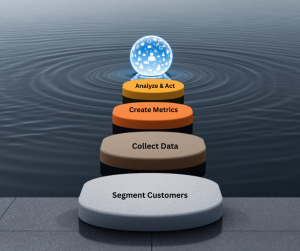
By now, we hope you agree that quantifying customer value is a worthwhile endeavor. And we hope you’re ready to add all or some of these measures to what you track and monitor. We advise you to take a systematic approach, start with these four stepping stones:
- Segment Your Customers: Group customers based on behavior, demographics, or revenue contribution.
- Collect Data: Gather data from your internal systems, such as your CRM, ERP, and other platforms. Ask customers and other stakeholders to provide feedback through surveys, focus groups, and in-depth interviews. Employ analytics platforms to analyze the data and find patterns.
- Calculate Metrics: Focus on the measures to gain a comprehensive view of customer value. Establish how you will track and a reporting cadence (monthly, quarterly).
- Analyze and Act: Identify trends and opportunities, then tailor strategies to maximize value.
 surveys, focus groups, and in-depth interviews. Employ analytics platforms to analyze the data and find patterns.
Use Your Customer Value Metrics to Drive Growth
Once you’ve quantified customer value, the next step is to leverage these insights to fuel growth. Focus on delivering value to your highest-performing segments. Invest in areas that drive the greatest impact. And use customer feedback from customer experience surveys to guide product or service improvements.
Quantifying customer value helps you understand what your customers bring to the table and how you can better serve them. It is a critical capability for any customer-centric company. By focusing on metrics like CLV, CES, and CRR, you can create strategies that drive loyalty, advocacy, and long-term growth.
Ready to release the full potential of your customer base? Book a meeting to explore how we can help you measure and maximize customer value with proven tools and strategies.
FAQ
(written with the help of Penn at Sentra.ai)
1. What is customer value, and why does it matter?
Customer value is the measurable worth a customer brings to your business over the entire relationship—not just in revenue, but also in loyalty, advocacy, and influence on growth. Quantifying customer value enables organizations to prioritize high-impact segments, make data-driven decisions, and drive sustainable, long-term growth.
2. Which key metrics should I use to measure customer value?
The five essential metrics are:
- Customer Lifetime Value (CLV): Total revenue expected from a customer throughout their engagement.
- Customer Effort Score (CES): How easy it is for customers to do business with you.
- Customer Referral Rate (CRR): Percentage of customers who refer others.
- Customer Retention Rate: Percentage of customers who remain over time.
- Profit Per Customer Segment: Profitability of each customer group after accounting for all costs.
3. How do I calculate Customer Lifetime Value (CLV)?
CLV is typically calculated by multiplying the average purchase value, purchase frequency, and average customer lifespan, then factoring in gross profit margins. This metric helps identify your most valuable customer segments and guides resource allocation.
4. Why is Customer Effort Score (CES) important for loyalty?
CES measures the ease of customer interactions. Research shows that reducing customer effort is a stronger predictor of loyalty than delighting customers. Tracking CES helps uncover friction points and drives improvements in the customer journey.
5. What is the difference between customer retention and customer referral rate?
Retention Rate tracks how many customers stay with your business over time, reflecting loyalty and satisfaction.
Referral Rate measures how many customers recommend your business, indicating advocacy and the effectiveness of your customer experience.
6. Why focus on profit per customer segment instead of just revenue?
Revenue alone can be misleading if certain segments are costly to serve. Profit per segment accounts for acquisition, servicing, and retention costs, enabling smarter investments in high-ROI segments.
7. What are common mistakes when measuring customer value?
- Ignoring customer effort and feedback can lead to churn.
- Prioritizing short-term revenue over long-term relationships.
- Failing to act on insights from customer metrics results in missing opportunities for improvement.
8. How can I systematically quantify customer value?
Follow these four steps:
- Segment your customers by behavior or value.
- Collect data using CRM, surveys, and analytics platforms.
- Calculate the recommended metrics consistently.
- Analyze results and act on insights to refine strategies.
9. How do customer value metrics drive business growth?
By identifying high-value segments, reducing friction, and fostering retention and advocacy, these metrics inform targeted strategies that maximize ROI and position your business for sustainable growth.
10. Where can I get help implementing these metrics?
You can book a meeting with VisionEdge Marketing to explore proven tools and strategies for measuring and maximizing customer value.
Recent Posts
- Focus on Solving Customer Pain Points to Future-Proof Your Company | What’s Your Edge?
- Customer-Centricity in M&A: The Accelerant for Post-Deal Value
- How Strategic Clarity Drives Growth, Profitability, and Customer Value
- Breaking Through Stagnant Growth with a Customer-Centric, Process-Driven Approach | WYE?
- Why Lack of Accountability is Stalling Your Organization’s Growth


 Customer-centricity is the Only Way to achieve sustainable, profitable growth.
Leave a Reply
You must be logged in to post a comment.