
Podcast: Play in new window | Download (Duration: 18:07 — 41.5MB) | Embed

In this episode of What’s Your Edge?, we captured the highlights from our 20th anniversary conversations with customers from around the world and from all five of the industries we serve, holding C-level and VP positions. We held a series of 20-minute virtual gatherings where we addressed two topics. As they looked back 20 years, what did they see were the major changes and shifts in business? And as they look to the future, what do they see will be their priorities, challenges, and opportunities for growth? As you can image key shifts ranged around the topics of how customers are engaged, the channels of engagement, the role and volume of data, and the importance of selecting the right metrics. Looking forward, the conversation quickly focused on growth and how Marketing must step up and serve as a more strategic partner. Listen in to hear their perspective.
How to Predict a Future That Delivers on Growth
We didn’t have time in the conversations to talk in-depth about how to address growth and prepare for the future. Predicting the future is always a gamble. There is, however, an interesting area known as flash foresight that provides an approach to help your organization successfully navigate the future and potentially even create it. Daniel Burrus, author of Flash Foresight: How to See the Invisible and Do the Impossible, says it “is about looking into the future and transforming it into a new paradigm for solving ‘impossible’ problems, unearthing ‘invisible’ opportunities, and running extraordinarily successful businesses”.

 Navigate the future with flash foresight
Here are 3 steps you can take now to leverage this approach and identify growth opportunities.
- Start with the hard trends that are shaping our future. You might be able to identify a hard trend by answering the question “What are the problems our customers are facing in the next few weeks, months, years?” A customer advisory board and voice of customer research may help reveal the answer to this type of question.
- Use these hard trends to anticipate your future challenges and opportunities. Then apply your learnings to redefine your product or service and/or enter new markets. Ask this type of question: “Using these hard trends, how do we expect our industry or business to transform in the next few years?” You may need to conduct market research to acquire the insights you need to answer this question.
- Look beyond what seems like a current problem. Take the problem your company is facing and look at it from different angles to reveal what may be the real problem. This may require you to look differently at your data and explores the patterns that emerge.
The purpose of this approach is to help you “look where no one else is looking to see what no one else is seeing and do what no one else is doing.” While it’s impossible to predict the future with certainty, good market and customer research, a commitment to deliver solutions to that solve real business problems, and the willingness to invest in Marketing will go a long way toward enabling the future you want to create.
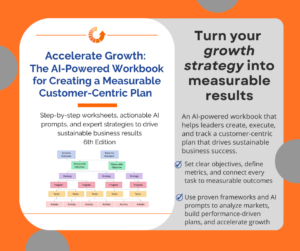
Buy Your Best-Practices Workbook
Use your insights to develop a strategy to outpace and outsmart the competition. To create the future, be willing to redefine and reinvent your business. Let’s talk about how we can work together to create a future of profitable growth for your organization.
Hope you found this episode of What’s Your Edge? Helpful. What’s Your Edge? Is the creation of VisionEdge Marketing. VisionEdge Marketing, founded in 1999, helps our customers solve the most difficult problems when it comes to using data, analytics, process, and measurement to accelerate growth, create customer value, and improve performance. We always welcome hearing from you.
FAQ:
A1: To capture executive-level perspectives on two questions: looking back over 20 years, what were the major shifts in business; and looking forward, what priorities, challenges, and growth opportunities leaders expect to face.
A2: Key shifts centered on how customers are engaged, the channels of engagement, the role and volume of data, and the growing importance of selecting the right metrics to manage performance and value creation.
A3: Growth—and the expectation that Marketing must step up as a more strategic partner, helping the organization navigate uncertainty, identify opportunity, and connect investments to measurable outcomes.
A4: Because uncertainty is unavoidable. The goal is not certainty; it is preparedness—using structured methods and evidence to reduce risk, improve decision quality, and increase the odds of choosing the right growth moves.
A5: Flash foresight is an approach to looking into the future and transforming it into a practical framework for solving “impossible” problems and uncovering “invisible” opportunities—so organizations can navigate change and, in some cases, help create the future they want.
A6: Start with hard trends shaping the future by asking: “What problems will our customers face in the next weeks, months, and years?” Sources such as customer advisory boards and voice-of-customer research can help surface these trends.
A7: Use hard trends to anticipate future challenges and opportunities, then apply what you learn to redefine your product or service and/or enter new markets. A practical question is: “Given these hard trends, how will our industry or business transform in the next few years?”
A8: Because the visible problem is often a symptom. Examining the issue from multiple angles—and re-interrogating your data for patterns—can reveal the real constraint or opportunity, enabling more effective strategy and investment decisions.
Recent Posts
- Focus on Solving Customer Pain Points to Future-Proof Your Company | What’s Your Edge?
- Customer-Centricity in M&A: The Accelerant for Post-Deal Value
- How Strategic Clarity Drives Growth, Profitability, and Customer Value
- Breaking Through Stagnant Growth with a Customer-Centric, Process-Driven Approach | WYE?
- Why Lack of Accountability is Stalling Your Organization’s Growth


You must be logged in to post a comment.