
 According to a Gartner CMO Survey, 48% of Marketing leaders struggle to prove Marketing’s value. Let’s hope you’re not among them. Growth-focused leaders—CMOs, CGOs, CFOs, Chief Strategy Officers, and CEOs—need more than experience, activity reports, and vanity measures. They need clear, actionable insight into how the Marketing function drives business performance. The traditional marketing measurement playbook no longer works. Dashboards and lagging indicators don’t provide the agility or accountability required to drive customer-centric growth. It’s time for a smarter, more deliberate approach to Marketing Performance Management (MPM).
In this article, we’ll explore the cutting edge of MPM:
- What’s replacing outdated metrics
- Which new data sources are gaining traction
- How you can harness this information to tie marketing performance directly to business outcomes
It’s Time for a New Approach to Marketing Performance Management
MPM is at a tipping point. As Bob Dylan famously wrote, “The times they are a-changin’.” And nowhere is that more evident than in how businesses measure the value of marketing and the Marketing function.

For years, many B2B organizations have relied on a patchwork of tools and measures such as clicks, impressions, and form fills to evaluate marketing effectiveness. While these measures offer surface-level insights, they often fail to answer the most pressing questions:
- What’s actually driving growth?
- How does marketing contribute to creating customer value?
- Where should we invest next?
Here’s a common challenge: Consider a global manufacturing firm that recently ramped up digital marketing. Despite a surge in webinar registrations and whitepaper downloads, the CMO faced a tough question from the CFO: “Which of these activities actually led to new business?” The answer—I’m not sure—revealed a familiar problem; fragmented data and legacy measures made it impossible to prove how Marketing’s investments impacted results.
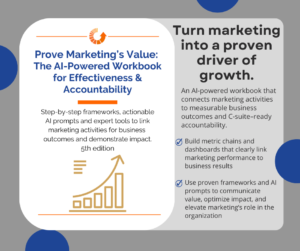
Buy Your Best-Practices Workbook
5 Sure-Fire MPM Advancements Shaping the Future of Marketing
As organizations strive to grow smarter, not just faster, modern MPM methods are emerging to eliminate guesswork and position the Marketing function as a true driver of business and customer value. To stay competitive, B2B leaders must evolve their approach to MPM. Here are five critical advancements shaping the future of marketing measurement:
1. Predictive and Prescriptive Analytics: Forecast What’s Next: Rather than simply reporting on what happened, leading organizations are leveraging AI and machine learning to forecast what’s likely to happen—and recommend next steps.
B2B Example: A medical device company uses predictive analytics to identify accounts at risk of churn. By combining purchase history, engagement data, and service interactions, the marketing team proactively delivers tailored content and offers, reducing attrition and increasing upsell opportunities.
2. Multi-Touch Attribution + Unified Measurement: Connect the Dots: Sophisticated attribution models now account for the entire customer journey—across digital, in-person, and partner touchpoints.
B2B Example: A technology firm unified its event, digital, and partner marketing data. This revealed that prospects who attended both a webinar and a partner event were three times more likely to convert. With this insight, the team shifted the budget to high-impact, multi-channel campaigns.
3. Agile Marketing Mix
Modeling: Make Smarter Moves Faster: Traditional MPM was slow and retrospective. Today, machine learning-enhanced models enable real-time scenario planning and spend optimization.
B2B Example: A regional bank adopts agile MPM to adjust campaign spend weekly. When in-person events underperformed, they reallocated resources to digital channels, boosting conversations added to the pipeline.
4. Customer-Centric Measures: Track Value, Not Just Volume: Organizations are moving beyond channel-based measures to value-based metrics, such as Customer Lifetime Value (CLV), Net Revenue Retention (NRR), and Share of Wallet.
B2B Example: A SaaS vendor stopped tracking leads and started measuring NRR and CLV. This shift encouraged marketing and customer success teams to collaborate, driving sustainable growth and deeper customer relationships.
5. Strategy-to-Execution Frameworks: Turn Plans into Outcomes: Frameworks like Accelance®, Strategy Maps, and Logic Models are enabling leaders to translate strategy into measurable outcomes.
B2B Example: A supply chain firm used Accelance® to map every marketing initiative directly to strategic customer-centric business outcomes, clarifying priorities and earning greater investment in marketing.
[Learn more about how Accelance® works]
 New Data Sources that Power Smarter Marketing Decisions
 New Data Sources that Power Smarter Marketing Decisions
 Modern MPM is powered by data that’s more relevant and actionable than ever. Forward-thinking B2B organizations are integrating a wider array of data sources.
For example,
- Behavioral and Intent Data: A cloud services provider tracks content downloads and industry forum activity to identify buyers ready for outreach, resulting in higher conversion rates among enterprise prospects.
- First- and Zero-Party Data: A manufacturing firm leverages post-purchase surveys and customer advisory boards to refine messaging and inform future campaigns.
- Revenue Intelligence Platforms: A fintech company synthesizes CRM, email, and call data to pinpoint which marketing activities most effectively accelerate pipeline velocity.
- Data Collaboration and Clean Rooms: Two B2B partners in the life sciences sector securely share anonymized customer data, uncovering cross-selling opportunities without compromising privacy.
- AI-Enhanced Data Synthesis: A logistics provider uses natural language processing to analyze customer support tickets and social media mentions, surfacing emerging pain points and informing content strategy.
Evolve from Unreliable Reporting to Remarkably Deliberate Measurement

The shift from reactive, fragmented reporting to deliberate, strategic measurement enables leaders to allocate resources with confidence and demonstrate Marketing’s value as a growth engine, not a cost center.
Mini-Scenario: Imagine if your dashboard could answer, “Which investments are driving the most profitable customer acquisition?” or “How are we increasing share of wallet in our top segments?” This shift often requires moving from random measures and measuring “what’s easy” to “what matters”—ultimately drawing a direct line between marketing actions and business results. Use a framework to get started.
The 4A Framework for Smarter MPM
- Assess Your Current State: Review your existing metrics, tools, and data gaps. Are you measuring what matters, or just what’s easy?
- Adopt a Scalable, Ethical Data Strategy: With privacy regulations on the rise, focus on collecting and integrating first- and zero-party data.
- Align MPM Methods with Business Outcomes: Ensure your performance management practices are linked to growth priorities and customer value.
- Activate Insights: Leverage frameworks and tools—like Accelance®—to turn insights into action and support resource allocation.

The Risk of Inaction: Act Now Before You Fall Behind
Failing to modernize your MPM approach carries steep consequences. Without clear insight into what’s driving growth, organizations risk:
- Misallocating budgets to underperforming channels
- Undervaluing high-performing campaigns
- Losing strategic influence at the executive table
Meanwhile, competitors using AI, intent data, and value-based metrics will pull ahead with smarter decisions and stronger alignment between marketing and the business.
Are your current metrics helping you drive smarter decisions, or just filling up reports? Is it time to revise how your organization approaches marketing performance management?
Schedule a meeting if you’re ready to turn marketing measurement into a strategic advantage.
FAQ:
A1: Because the traditional measurement playbook—activity reports, vanity metrics, and lagging dashboards—cannot answer the questions growth leaders actually need answered: What is driving growth? What is marketing’s contribution to customer value and revenue? Where should we invest next? When nearly half of marketing leaders struggle to prove value, the issue is rarely effort; it is measurement design. Modern MPM must provide agility, accountability, and a direct line from marketing actions to business outcomes.
A2: The old model over-relies on surface indicators (clicks, impressions, form fills) and fragmented systems that cannot connect marketing investments to pipeline, revenue, retention, or share of wallet. The result is a credibility gap at the executive table—especially when finance asks, “Which activities actually led to new business?” and the answer is unclear. In short: the old model measures what is easy, not what matters.
A3: Five advancements are shaping the future of marketing measurement:
- Predictive and prescriptive analytics: Forecast likely outcomes and recommend next actions—not just report history.
- Multi-touch attribution + unified measurement: Connect touchpoints across the full journey (digital, events, partners, sales interactions).
- Agile marketing mix modeling: Scenario planning and spend optimization that can be adjusted rapidly, not quarterly.
- Customer-centric measures: Shift from volume to value—CLV, NRR, share of wallet, retention, expansion.
- Strategy-to-execution frameworks: Tools like strategy maps, logic models, and Accelance® that map initiatives to outcomes and make accountability visible.
A4: Modern MPM is powered by more relevant, decision-grade data sources, including:
- Behavioral and intent data to identify in-market buying signals earlier.
- First- and zero-party data (surveys, advisory boards, preference data) to improve messaging and personalization ethically.
- Revenue intelligence that synthesizes CRM, email, and call data to reveal what accelerates pipeline velocity.
- Data collaboration / clean rooms to uncover partner-driven opportunities while protecting privacy.
- AI-enhanced synthesis (e.g., NLP on support tickets and social mentions) to surface emerging pain points and inform content strategy.
These sources move marketing from reporting activity to understanding causality and opportunity.
A5: Deliberate measurement means your dashboard can answer strategic questions such as: Which investments drive the most profitable customer acquisition? How are we increasing share of wallet in top segments? Which experiences reduce churn risk? It requires replacing random measures with outcome-linked measures and using frameworks that connect strategy → programs → tactics → metrics → results. The goal is not more reporting; it is better decisions and clearer resource allocation.
A6: The 4A Framework provides a practical path:
- Assess your current metrics, tools, and data gaps (what matters vs. what’s easy).
- Adopt a scalable, ethical data strategy (privacy-forward, first/zero-party emphasis).
- Align MPM methods to business outcomes (growth priorities and customer value).
- Activate insights using tools and frameworks (e.g., Accelance®) to drive action and investment decisions.
It is designed to move MPM from fragmented reporting to executive-grade performance management.
A7: The risk is strategic, not cosmetic. Without modern MPM, organizations misallocate budget, undervalue what works, and lose influence at the executive table—while competitors using AI, intent data, and value-based metrics make smarter moves faster. Inaction turns marketing into a cost center by default; modernization positions marketing as a measurable growth engine.
Recent Posts
- Focus on Solving Customer Pain Points to Future-Proof Your Company | What’s Your Edge?
- The Destiny of Siloed Priorities is Random Acts
- The Power of Customer-Led Product Development for Market Growth | What’s Your Edge?
- Footprint Expansion: A Customer-Centric Growth Strategy for Scaling
- The Focus on Right-Fit Customers Yields Faster Profitable Growth | What’s Your Edge


Leave a Reply
You must be logged in to post a comment.