
Regardless of where we are in the calendar year, we always seem to be under the gun when it comes to keeping Marketing aligned to the business. Priorities change, customer requirements evolve, and competitors make moves. This is why it’s essential to have a Marketing plan that serves as an alignment tool.

Avoid These Common Characteristics of Your Next Marketing Plan
We’ve reviewed of hundreds of Marketing plans. They come in large and small power point decks, one to multiple excel worksheets, and short to extremely lengthy word documents. Most of them have a little narrative, a few objectives that typically are not quantified, followed by list upon list of activities, ending with a calendar and budget. As we review many of these plans, a few common characteristics stand out:
– There are few specific quantified business outcomes that comprise the revenue target.
– The Marketing objectives are ambiguous, mostly broad-brush stroke statements such as “increase the number of qualified leads” or “improve awareness.”
– It is unclear how the Marketing activities and investments are tied to the business outcomes (probably because in many cases there aren’t any business outcomes).
– Other time or cost parameters, very few of the programs and activities have performance targets.
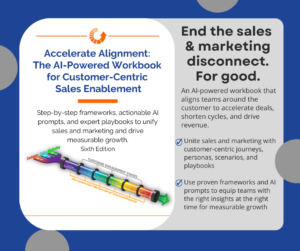
Buy Your Best-Practices Workbook
If the scenario and characteristics sound familiar, we’re here to say, “stop the presses!” We know from decades of research that the best-in-class marketers, those who excel at value creation, are obsessed with alignment. Alignment is in fact a statistically significant differentiator. Do not let your plan pass go until you ask these three questions and achieve alignment.

Ask Three Questions Before You Pass Go
Our advice – any marketer developing a Marketing plan or a program should ask these three questions before taking any implementation steps:
1. What specific, measurable business outcomes will Marketing impact?
2. How do you expect Marketing to contribute (what needles need to move and how far)?
3. How will we know and measure that Marketing achieved the objective(s)?
Armed with the answers to these questions, you can create a compelling outcome-based measurable plan and/or program that will move the needle. For more on alignment and accountability, register and download the FREE white paper Charting a Course for Marketing Effectiveness: Alignment & Accountability.
FAQ:
A: Because priorities shift, customer requirements evolve, and competitors move—regardless of the time of year. Alignment is not a one-time planning event; it is an ongoing discipline, and the marketing plan is the primary tool to sustain it.
A: Many plans include narrative, vague objectives, long activity lists, calendars, and budgets—but lack: (1) specific, quantified business outcomes that comprise the revenue target, (2) clear, measurable marketing objectives, (3) explicit linkage between activities/investments and outcomes, and (4) performance targets for programs and activities.
A: Because it creates the illusion of progress without proof of impact. If outcomes are unclear and targets are missing, you cannot connect spend to results, course-correct intelligently, or defend budgets with evidence.
A: They are “obsessed with alignment.” Decades of research indicate alignment is a statistically significant differentiator for value creation, and Best-in-Class organizations use the marketing plan explicitly to facilitate alignment.
A:
- What specific, measurable business outcomes will Marketing impact?
- How do you expect Marketing to contribute (which needles need to move—and by how much)?
- How will we know and measure that Marketing achieved the objective(s)?
A: It clarifies what Marketing is accountable for, links investments to business results, establishes performance targets up front, and creates a basis for ongoing measurement, learning, and adjustment—so the plan can reliably “move the needle.”
Recent Posts
- Focus on Solving Customer Pain Points to Future-Proof Your Company | What’s Your Edge?
- Customer-Centricity in M&A: The Accelerant for Post-Deal Value
- How Strategic Clarity Drives Growth, Profitability, and Customer Value
- Breaking Through Stagnant Growth with a Customer-Centric, Process-Driven Approach | WYE?
- Why Lack of Accountability is Stalling Your Organization’s Growth


You must be logged in to post a comment.