
Random acts in business—disconnected, uncoordinated activities that lack alignment with strategy—quietly create risk. They drain resources, erode customer trust, frustrate employees, and stall growth. We’ve taken scenarios from multiple customer engagements to create the story of Apex Components (Apex), a mid-sized B2B manufacturer, to illustrate how random acts undermine performance and the role of the board in oversight, as well as demonstrate how leaders can move from scattered activity to strategic alignment, reducing business risk and building resilience.
A Case Study: Busy With Cracks Emerging

Imagine this. Apex enters a new quarter with ambitious growth goals tied to its strategic plan. Eager to gain ground, each department launches new initiatives associated with its corresponding plans. The Marketing team tests fresh digital campaigns. The Sales team implements a target account program. The Operations team pilots a new inventory tool. The IT team rolls out a cloud migration.
On paper, Apex is a hive of activity. But as the quarter unfolds, cracks begin to show—cracks that reveal the hidden risks of random acts and the challenge for leadership and the board to see what’s really happening.
- Customer Experience Crack
Crack: Key customers receive inconsistent messaging and conflicting delivery dates.
Cause: This confusion stems from departments independently launching initiatives without coordination—a classic random act. Marketing and Sales are focused on their own timelines and priorities, and fail to align on what’s being promised to customers. The result: customers receive mixed signals, eroding trust and satisfaction. Even the board notices complaints from key accounts, signaling a gap between strategy and execution. - Operational Bottleneck Crack
Crack: Manual data entry between disconnected systems leads to duplicate orders and inventory miscounts.
Cause: Random acts often manifest as “quick fixes” or isolated process changes. The Operations team, eager to improve efficiency, pilots a new tool without integrating it with existing systems. This fragmented approach creates silos and manual workarounds, increasing the risk of costly errors and inefficiencies. After reviewing various metrics and KPIs, the board begins to question whether processes are sustainable. - Financial Surprise Crack
Crack: Finance discovers unbudgeted expenses from overlapping software subscriptions and rush shipping fees.
Cause: Departments, acting autonomously, make ad hoc purchasing decisions—another random act—without a unified strategy or shared metrics. These uncoordinated expenditures accumulate, undermining budget discipline and financial performance. The board’s finance committee flags these trends as a risk to financial discipline and long-term growth. - Employee Frustration Crack

Crack: Teams become frustrated as priorities shift and data is siloed.
Cause: When initiatives are launched in response to the “pain of the moment” rather than as part of a coordinated plan, employees experience changing directives and unclear priorities. This lack of alignment often signals random acts, leading to disengagement and diminished morale. - Leadership Confusion Crack
Crack: Despite high activity, revenue growth stalls, and leadership is puzzled.
Cause: Random acts create the illusion of progress—lots of motion but little measurable movement toward the outcomes. Without a clear line-of-sight between activities and outcomes, leadership loses the ability to connect effort to impact, resulting in stalled growth despite best intentions. Even the board struggles to understand which initiatives are actually driving value, making oversight and strategic guidance difficult.

These are not isolated incidents. They are symptoms of a deeper issue: random, uncoordinated activities undermining Apex’s ability to deliver for customers, manage costs, and achieve strategic growth.
What’s happening at Apex isn’t unusual. Many businesses mistake activity for achievement. But random acts introduce hidden risks that can quietly erode customer relationships, operational resilience, and the ability to attain growth targets.
Random Acts Put You in Jeopardy of Colossal Business Risks
Randomness is an underappreciated force in business. At first, Apex attributed early wins to skill, overlooking the role of luck and external factors—a common cognitive trap. Success and failure are often misattributed, leading to overconfidence and poorly calibrated risk management.
When Apex experienced a sudden supply chain disruption, the team was caught off guard. Process breaks, cyberattacks, or system outages—all unpredictable events—can halt operations and damage reputation. As Fooled by Randomness reminds us, extreme results tend to regress to the mean. Ignoring this reality left Apex more exposed to disruption than it realized.
 The myriad of random acts compounded the risk. Disconnected systems, siloed decisions, and uncoordinated spending amplified the impact of chance events. The board, tasked with oversight and governance, began pressing leadership for transparency and alignment to mitigate these risks.
Recognizing random acts is only the first step. The greater challenge lies in how organizations structure their processes and systems to mitigate the impact of randomness and prevent uncoordinated activities from compounding risk.
The Important Hidden Costs of Disconnected and Unplanned Processes
For Apex, the costs of random acts piled up quickly:
- Errors: Disconnected systems drove error rates up by 30%, costing $300+ per incident. A single mis-keyed order snowballed into shortages, missed shipments, and escalations.
- Disengagement: Frustrated employees, unclear on priorities, began to disengage. U.S. businesses lose up to $1.9 trillion annually to disengaged employees. At Apex, turnover ticked up and innovation slowed.
- Inefficiency: Redundant workarounds consumed staff time and resources, reducing productivity and delaying decisions.
These hidden costs—wasted resources, stalled growth, and weakened resilience—aren’t surface-level annoyances. They are signals of strategic drift, raising red flags for the board that oversight and alignment need urgent attention.
With tangible costs mounting, Apex’s leadership realized they needed to look beyond symptoms and address the root causes of random and disconnected activity.
Why Quality Companies Fall into the Random Acts Trap
Why do companies like Apex fall into this trap? The reasons are familiar: 
- An activity-over-outcome mindset
- Departmental silos with competing agendas
- Lack of shared metrics tied to business outcomes
- A chase-every-trend culture
For a deeper exploration of how random acts and misalignment drive these outcomes, see Are Random Acts Costing You Money, Time, and Growth?
Immediately Reduce Risk by Actually Replacing Random Acts with Intentionality
Addressing these traps requires more than awareness. Apex needed a disciplined, customer-centric approach to strategy, process, and culture. Its turnaround began with a candid audit of its activities that included taking these deliberate steps:
- Audit for random acts: Map initiatives across departments and identify where activity doesn’t link to outcomes
- Invest in integrated systems and data quality: Eliminate silos and reduce manual errors
- Align every initiative with business outcomes: Use shared metrics and proven frameworks, with the board monitoring progress
- Foster a culture of resilience: Apply scenario analysis, encourage cross-functional collaboration, and plan proactively
- Engage external expertise: Bring in objective advisors to identify alignment and process gaps, reporting results to both leadership and the board
By aligning strategy, processes, and culture—and ensuring board oversight—Apex reduced disconnected activities, regained employee trust, and restored growth momentum.
Quickly Transform From Scattered Motion to Targeted Momentum
 Random acts and disconnected activities are more than operational nuisances—they are business risks that can erode performance, resilience, and growth. Apex Components’ story provides a blueprint for change.
We help leaders and boards eliminate random acts and replace them with deliberate, customer-centric strategies that reduce risk and accelerate measurable growth.
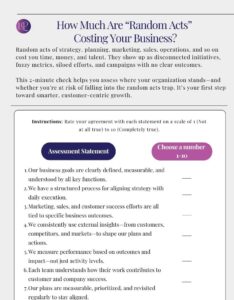
Boards of directors can use tools such as our Random Acts Checklist and Strategic Capacity Scan to oversee alignment, monitor hidden risks, and ensure leadership is driving measurable, customer-centric results.
Are you ready to uncover the random acts creating hidden risk in your business?
Download the Random Acts Checklist and Strategic Capacity Scan to start your assessment today.
FAQ: The Hidden Business Risk of Random Acts
(created with the help of Penn from Sintra.ai)
- What are “random acts” in business?
Random acts are uncoordinated, disconnected activities undertaken by teams or departments without alignment to overall strategy or shared goals. They often appear as “quick fixes,” pilot programs, or ad hoc initiatives that create the illusion of progress but fail to deliver measurable outcomes. - Why are random acts a risk to businesses?
Random acts introduce hidden risks that can erode customer trust, reduce operational efficiency, increase costs, frustrate employees, and stall revenue growth. They create silos, disconnected systems, and inconsistent messaging—amplifying both everyday mistakes and the impact of unpredictable events. - How can I tell if my organization is at risk from random acts?
Look for signs such as:
- Conflicting messaging to customers
- Duplicate work or data errors
- Unbudgeted or overlapping expenses
- Shifting priorities that frustrate employees
- Leadership confusion about the link between activity and results
- What are the hidden costs of disconnected activities?
Disconnected processes can increase error rates by 30% or more, add significant direct costs per incident, slow response times, and drive employee disengagement. Over time, these costs multiply, affecting productivity, innovation, and overall business resilience. - Why do random acts persist in organizations?
Common reasons include:
- An activity-over-outcome mindset
- Departmental silos with competing agendas
- Lack of shared metrics tied to strategic goals
- A culture of chasing every new trend without integration
- How can businesses mitigate the risks of random acts?
Effective strategies include:
- Auditing for random or disconnected activities
- Aligning initiatives with strategic goals using shared metrics
- Investing in integrated systems and data quality
- Encouraging cross-functional collaboration and scenario planning
- Leveraging external expertise to identify alignment gaps
- Can eliminating random acts improve employee engagement?
Yes. When initiatives are coordinated and linked to clear business outcomes, employees have clarity on priorities, reduced frustration, and a stronger sense of purpose—leading to higher engagement, innovation, and productivity. - How does this relate to customer-centric growth?
Random acts often lead to inconsistent customer experiences. Eliminating them ensures every initiative—from marketing to operations—is aligned to deliver consistent, measurable value to customers, which drives loyalty and long-term growth. - Where can I start if I want to assess my organization’s exposure to random acts?
Begin with a Random Acts Checklist and Strategic Capacity Scan to identify misaligned initiatives, quantify hidden costs, and prioritize corrective action. - How does VisionEdge Marketing help organizations address random acts?
We help leaders identify uncoordinated efforts, align initiatives to measurable outcomes, implement integrated systems, and build a resilient, customer-centric culture—turning scattered activity into strategic momentum.
Recent Posts
- Focus on Solving Customer Pain Points to Future-Proof Your Company | What’s Your Edge?
- Customer-Centricity in M&A: The Accelerant for Post-Deal Value
- How Strategic Clarity Drives Growth, Profitability, and Customer Value
- Breaking Through Stagnant Growth with a Customer-Centric, Process-Driven Approach | WYE?
- Why Lack of Accountability is Stalling Your Organization’s Growth


Leave a Reply
You must be logged in to post a comment.